

What Are The Differences Between American Whiskey And Japanese Whisky?

From Scandinavia down to Australia and from North America to Asia, people around the globe enjoy drinking and producing whisky (or whiskey). And if you believe they all taste the same, that's just one of many false facts about whiskey you thought were true. While many distilling regions use similar techniques, each has its own unique traditions. In the U.S., for instance, several distillers make bourbon whiskey, which is unique to the States in the same way that tequila is unique to Mexico. The U.S. also traditionally refers to this spirit as "whiskey," while other countries, like Japan, spell it "whisky" without the "e." We're not talking about two kinds of liquor here — how a country spells whisk(e)y reveals its origins.
When it comes to the U.S. and Japan, the slight spelling variation is far from the only difference between the two countries' whisk(e)y traditions. The type and mix of grain mash used, how they're distilled (and in what), as well as how they're aged all vary. Each country also maintains its own regulations that have developed differently over time and deliver different drinking experiences. Let's explore some of the key differences between American whiskey and Japanese whisky.
Japanese whisky resembles Scotch
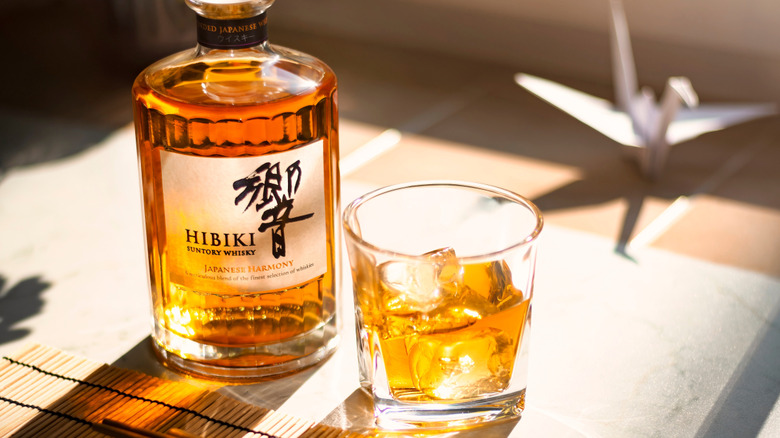
Some people claim that the "e" in whiskey came about when the Irish wanted to distinguish their distilled spirit from the Scotch whisky produced across the North Channel in Scotland. A connection to Scotland is what determined Japan's choice to use the "whisky" spelling for its fermented grain mash liquor. Taketsuru Masataka, the man who brought authentic whisky distilling to Japan in the early 20th century, apprenticed in Scottish distilleries, learning both production and blending, so it's no wonder that the Japanese version resembles Scotch.
Like Scotland's product, Japanese whisky uses malted barley distilled in pot stills. But as the spirit evolved in Japan over the past century, it moved away from rigidly following the Scottish tradition and was tailored to a Japanese palate. Japanese whisky is fruitier, more floral, and less peaty than Scotch. The smokiness in the Japanese spirit is also lighter and often compared to incense rather than the Scottish version's more intense, smoky essence.
The grains and distillation processes are different
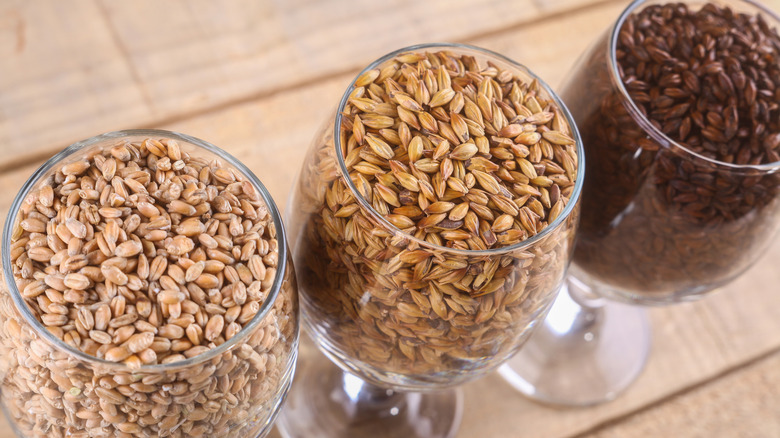
Whisk(e)y is made from fermented mash, the technical term for the grain or combination of grains used. This could be malted barley, rye, wheat, or corn (the latter is considered a grain once it's mature). Like scotch, Japanese whisky typically uses malted barley mash, sometimes with other grains added in. Different types of American whiskey use different blends of grain. Bourbon whiskey must be made with at least 51% corn mash in order to be called bourbon. Likewise, the mash for American rye whiskey is made from at least 51% rye. If 80% of the mash is corn, then it's called corn whiskey.
Japanese and American producers also use different stills. In Japan, whisky is distilled in pear-shaped copper pot stills, which are well-suited for smaller batches, allowing for more control in the distillation process. Towering column stills are more popular in the U.S. and are used to make bourbon, rye, and grain whiskeys. They can be made from copper or steel and are continuously operational, which creates a more efficient system. Each type of still creates a different texture in the spirit. The column version can distill to a much higher proof, so a lot of the fusel oils that would otherwise coat the tongue are filtered out, creating a lighter, crisper mouthfeel.
Japanese regulations are newer than American
American whiskey production actually predates the country's founding. Presidents have been sipping whiskey to unwind since George Washington, who was one of the largest whiskey producers of his day. It wasn't until the 1820s that James C. Crow brought some regularity to America's signature bourbon distillation process. The Bottled-in-Bond Act of 1897 endeavored to legally define whiskey, but true regulations didn't appear until after the end of Prohibition. These included the percentage of grains in the mash, proof limit, and charred oak barrel aging. Tweaks have been made over the years, like when the Alcohol and Tobacco Tax and Trade Bureau established a standard of identity for American single malt whiskey in early 2025. But the ground rules for what makes a bourbon, rye, or other American whiskey have been around for the better part of a century.
The Japanese whisky industry got a much later start with Taketsuru Masataka introducing Scotch to Japan in the early 20th century. Distilleries operated largely without government regulation until 2021, when, like other countries, the industry opted for a set of rules that would ensure quality and authenticity. The Japan Spirits and Liqueurs Makers Association has mandated that in order to be labeled Japanese whisky, malt must be used, the water must come from Japan, production and bottling must take place in Japan, and the whisky must be aged for at least three years in wooden barrels.
American whiskey is bolder and sweeter
The use of column stills in American whiskey distillation and pot stills in Japanese whisky differentiates the mouthfeel of the two spirits. Pot stills produce a lower proof, maintaining a lot of the fusel oils from the barley that sit on the tongue when sipping. This tends to produce whisky with a richer flavor. Because American whiskeys are distilled to a higher proof, the heavier flavors of the fusel oils are stripped away, leaving more room for the taste of the charred oak barrels to penetrate during the aging process.
Generally speaking, Japanese whisky is lighter and gentler in its flavors, which reveal themselves over time. It features floral and fruity notes, and like Scotch, there's a peatiness to Japanese whisky, but it's softer. American whiskeys are bolder and have more of a kick. The notes are sweeter, like vanilla, caramel, and oak. Due to its more than 50% corn mash, bourbon is even sweeter than other whiskeys. Corn has a more saccharine flavor profile than barley, which is nuttier.