

Customers Flag 5 Disadvantages Of Using Blackstone Grills
We may receive a commission on purchases made from links.
America's latest home-cooking obsession has risen to prominence with TikTok's hype of the Blackstone griddle. Is this line of backyard flat tops just another passing fad, soon to be relegated to the dusty corner of a garage, like a spiralizer or panini press? Or will these inexpensive, approachable griddles become the new kitchen staple, like an air fryer? We'll have to wait and see. But for now, customers who have actually tried a Blackstone griddle have said it's not as easy as TikTok makes it seem, although the grills are still widely praised for making flat-top cooking accessible at home.
Home cooks who've brought a Blackstone into their households said the grills tend to heat unevenly, are difficult to control during heating and cooking, are made cheaply and hard to assemble, rust easily, and have trouble with the grease traps. Still, customers praised the grills' ease of use and versatility. If you avoid common mistakes with your Blackstone grill, you're likely to get a lot of good use from it.
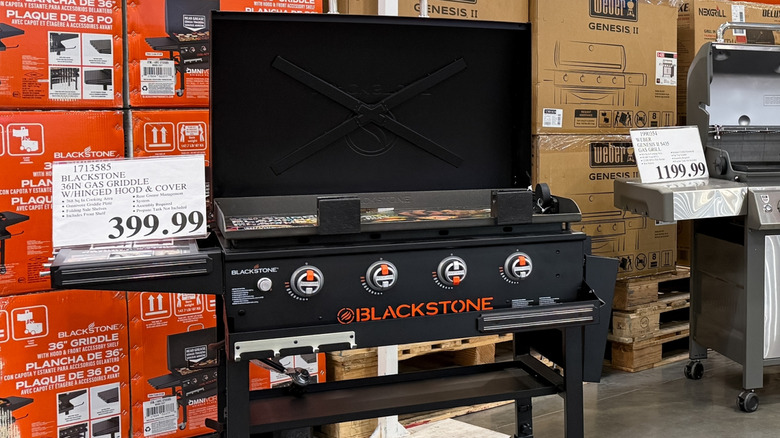
When comparing Blackstone to other flat-top grill brands, one important point is price. Consumer Reports' favorite flat-top grill in 2026 was a competitor's, LoCo, selling for around $800 at The Home Depot. Meanwhile, Walmart sells a comparable Blackstone for $550. Blackstone grills may be a good entry-level choice, but here's what you should know about its limitations before you buy one.
Uneven heating leads to hot and cold zones
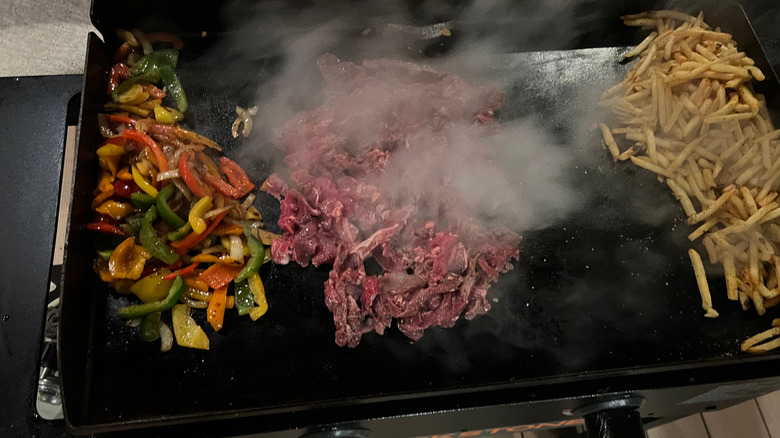
Like any grill (or any cooking appliance, for that matter), a Blackstone griddle will have hot and cold zones. Don't expect every inch of the flat top to cook a burger or stir-fry equally and perfectly — you'll need to get to know your cooking surface. The LoCo grill is reportedly very good at heating evenly, and that may be a result of the brand's digital temperature control, whereas Blackstone griddles have dials to adjust the heat similar to what you might see on a regular grill or stove.
For many customers, hot and cold zones aren't inherently a dealbreaker, just something to work around. The best way to adapt your cooking is to know where those zones are so you can use them to your advantage. To check, use the bread test developed by The Flat Top King blog. Spread out slices of regular white bread across your griddle's surface, then heat the grill to low and let it sit for about 10 to 15 minutes (which is roughly the grill's natural preheating time). Flip all of the slices of bread over and check how toasted they are. Darker, more toasted bread represents a hot spot, while bread that's still pale is a cold zone.
Blackstone grills can run (very) hot
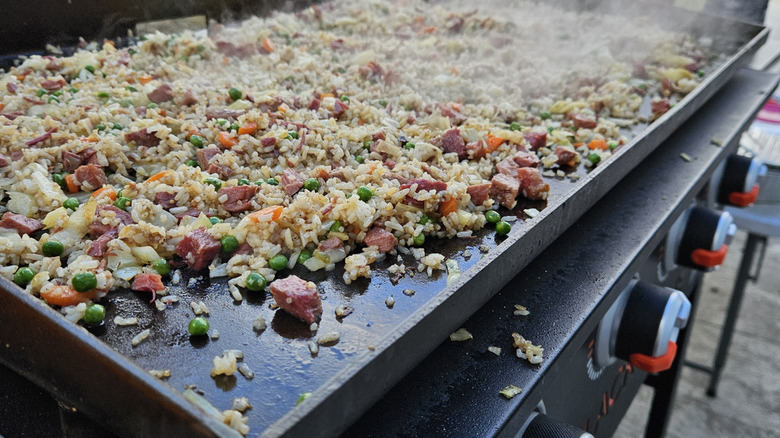
Although some areas of the Blackstone griddle will get hotter than others, it tends to run hotter than other grills. First-time users who aren't prepared might come out with a batch of burgers cooked somewhere between well-done and burnt to a crisp. It's best to start the grill on a low temperature, then gradually raise the temperature as necessary. The grill will take longer to cool down than heat up since it's effective at retaining heat.
Each model will behave slightly different, but customers have reported temperatures exceeding what Blackstone estimates as its maximum temperature. According to the manufacturer, the grill can range from roughly 200 degrees Fahrenheit on the keep-warm setting (or 250 degrees Fahrenheit for low heat) up to around 550 degrees Fahrenheit for very high heat. One Reddit user, though, reported their grill running around 415 degrees Fahrenheit on the lowest setting and 610 degrees Fahrenheit on high. Another found a remarkable range of 545 to 700 degrees Fahrenheit — much hotter than most kitchen appliances will ever get.
Blackstone acknowledges these high temperatures, stating its griddles can reach over 650 degrees Fahrenheit, but cautions against using such high temperatures for regular cooking. Environmental factors like wind and weather can influence the griddle's surface temperature and heating efficiency, but customers consistently reported Blackstone grills run very hot.
Grills are hard to assemble and poorly made
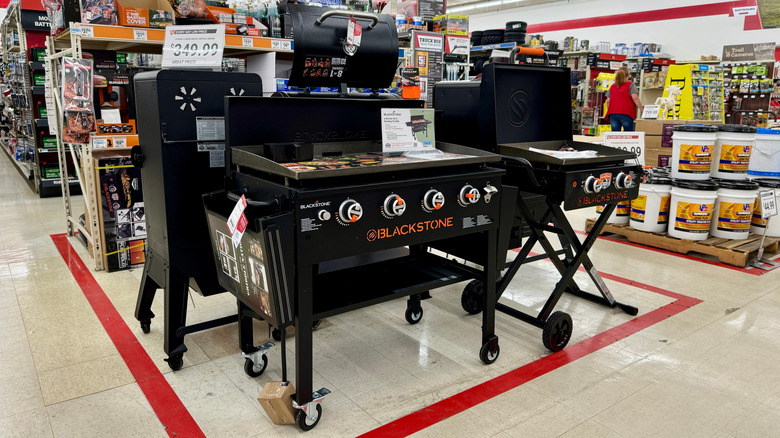
Blackstone grills are generally sold unassembled in a box for transport, requiring the customer to handle putting it together. That can be a pain point for some, even if the resulting grill is great. A five-star review on the Blackstone website noted you should set aside some serious time to put the grill together. "Do not be fooled by the assembly time ... The box states that the griddle can be assembled in as little as 30 minutes. Yeah, no. The unboxing can take as much as 30 minutes," the customer said. "Plan on an hour or more."
Why does it take so long to put together this grill? Some customers said it's simply because the product isn't well-made, so things don't quite work the way they're supposed to. "Nothing lined up properly and the whole unit seems to be cockeyed," wrote one user on Reddit. "The one door won't stay shut and cannot be adjusted. The griddle is all jacked up and don't even think the holes were cut right." Even the little things cause problems on some Blackstones. One customer complained about the instructions being useless and scratched parts that made assembly difficult.
Some Blackstone grills lose paint or rust easily
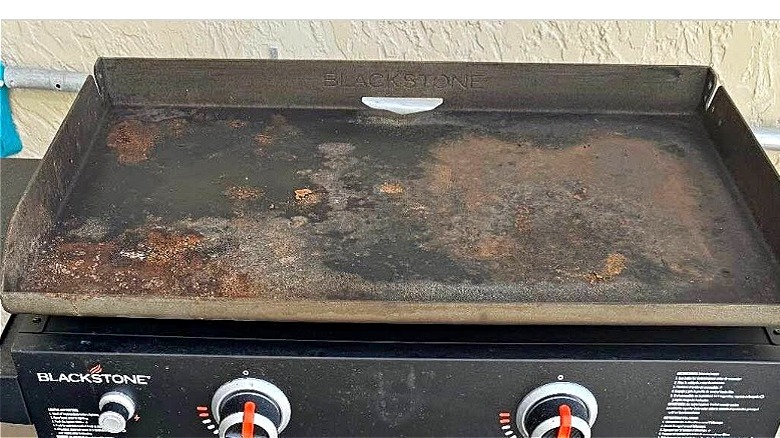
A large metal appliance that's kept outdoors is prime real estate for rust buildup. And although most of the Blackstone grill's structure (not the griddle itself) is coated with paint, some customers said that doesn't save it because the paint comes off easily. "After my first use, the paint around the knobs started rubbing off," wrote one user on Reddit. Others reported similar issues developing rapidly. "Seasoned it and used it once and the front part of the griddle is already rusting (not the cooking surface but the exterior part) after being out of the box for two days," another wrote. "Every time I take the cover off to use it there's rust, even the underside of the griddle is rusting," said another.
The Blackstone griddle needs to be thoroughly seasoned before using it and requires ongoing maintenance. The griddle should be kept clean and oiled after each use and prevented from interacting directly with weather. Instructions for the griddle encourage moving the grill out of the elements and removing the griddle, if necessary, for safe inside storage. Blackstone also sells hard and soft covers designed to protect the cooking surface itself.
Be careful with the grease trap
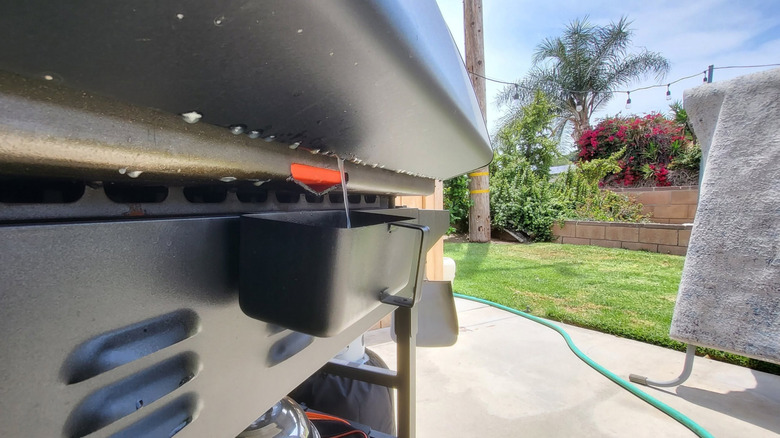
Like most flat-top grills, Blackstone griddles come with a built-in grease trap that allows you to simply scrape grease or oil off the cooking surface and down a small drain in the back, which sends it to a collection cup. You can also buy accessories that include a larger grease trap and disposable foil liners for the cup. But some customers reported issues with the cup's stability. "This thing is not very secure on mine and when I take on and off the cover, I have to be real careful," wrote one user on Reddit. "Mine has come off several times, and it is not fun to clean up."
Others said the design of the grease trap causes other problems. "The slope from the back of the griddle top does not go into the grease trap well and thus I have grease running down the innards of my Blackstone and leaking out by the wheel," said another Redditor. But multiple other users said they haven't experienced the same problem and mused it may be a leveling issue, so there's no evidence these problems are widespread.