

What Happens To The Leftover Food At NFL Stadiums?
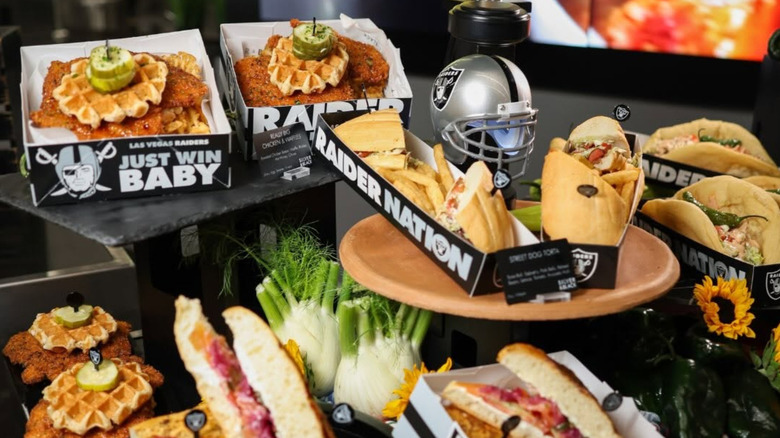
At home, it's easy not to think about the unbelievable amount of food that goes to waste on a regular basis. But what about institutions that generate enormous quantities of it? Oftentimes, those organizations look for solutions. Cruise ships often use biodigesters for leftover food, many colleges send surplus food to be composted, and various chain restaurants donate their leftovers. At an NFL stadium, meals also play a huge role in operations. Roughly 5,000 pounds of food will be prepared for each game, and more than a couple hundred thousand meals are prepared for the Super Bowl. How are leftovers handled?
The good news is that unused food isn't simply sent to the landfill after a game. In fact, items that are still safe for consumption are generally donated under a program called NFL Green. That includes cooked dishes that haven't been served, packaged foods, and leftover items from sponsored events. Individual NFL stadiums also have their own food waste management programs. These can involve on-site compost digesters and relationships with livestock farms to use edible food as animal feed.
NFL Green also oversees waste management for the Super Bowl, which can result in 140,000 pounds of donated food and drink. Unaffiliated volunteers and organizations also positive contributions. One pregame Players' Tailgate before the 2026 Super Bowl LX resulted in 14,000 pounds of food (the equivalent of around 12,000 meals) being donated via an organization called Food Recovery Network. "Not only can we recover shelf-stable food — tortilla shells, for example — there are also unopened raw ingredients," said Regina Harmon, the CEO of Food Recovery Network, to The Silicon Valley Voice. "In the chefs' area, they'll still have [uncooked] food in coolers."
These NFL stadiums have developed innovative ways to reduce waste
The NFL itself doesn't necessarily oversee every aspect of food waste disposal at each stadium. However, several arenas have found ways to cut back. Nevada's Allegiant Stadium, where the Las Vegas Raiders play, has an on-site biomass machine that processes around 650 pounds of food and plant waste a day. This undertaking shrinks the volume by 85% to 93%, after which the material gets converted into compost. The stadium also collects around 12,000 pounds of food scraps per event, which are sent to a nearby livestock farm for animal feed.
Where the Kansas City Chiefs play, at Arrowhead Stadium, food waste is fed into a series of on-site compost biodigesters — the same type of equipment used on some cruise ships. These biodigesters chop up the excess food, aerate it, and give it the perfect conditions for microbes to get to work breaking it down. This equipment turns the food into a powder, also reducing its volume by about 90%.
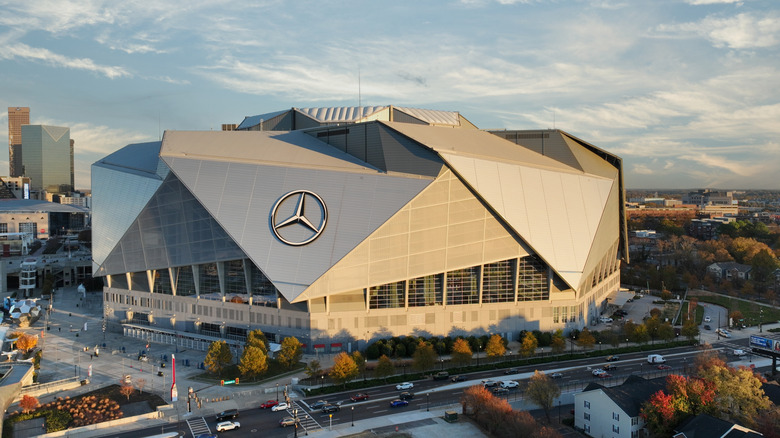
In Atlanta, Georgia, the Mercedes-Benz Stadium (home of the Atlanta Falcons) even has its own resource recovery room where staff sort a variety of waste to be processed separately. This includes a compactor for food that will be sent out for compost. There, food is even served in compostable containers or wrappers. The stadium intends to work toward zero-waste operations by diverting more than 90% of its waste away from landfills.