

What Is America's Oldest Bottled Bourbon Brand?
Drinking bourbon, like other time-tested American liquors, can make one feel like a cowboy of yesteryear, sipping a smoky spirit in an old Western saloon. Differentiated from other grain-based spirits by the contents of its mash — bourbon is made from at least 51% corn mash — it was first concocted in 1780s Kentucky, before earning notoriety in the hearts (and glasses) of drinkers nationwide. But for pub patrons of the early 19th century, a shot of bourbon wasn't poured from a bottle but rather directly from the barrel. In fact, it wasn't until 1870 that a young Louisville-born entrepreneur named George Garvin Brown began buying bourbon batches from distilleries and sealing the liquid into bottles. The name Brown slapped on those bottles? Old Forester.
Brown's goal was to create a consistent drink. Pre-1870 cask-served bourbon was widely variable, more susceptible to spoilage, and easier to tamper with or water down by miserly bar owners. A bottled product was a stronger promise to the drinker, signaling to customers this was a product they could trust and return to.
In the beginning, Brown wasn't in the business of distilling his own product. Instead, those original 19th century bottles were filled with a mix of bourbons from three Kentucky distilleries: Mattingly, Mellwood, and Atherton. Brown named the label after his friend, the local physician, Dr. William Forrester, and began shipping his new, innovatively packaged drink around the country, but not before signing his name to every single bottle.
Old Forester continued bottling for decades, even through Prohibition
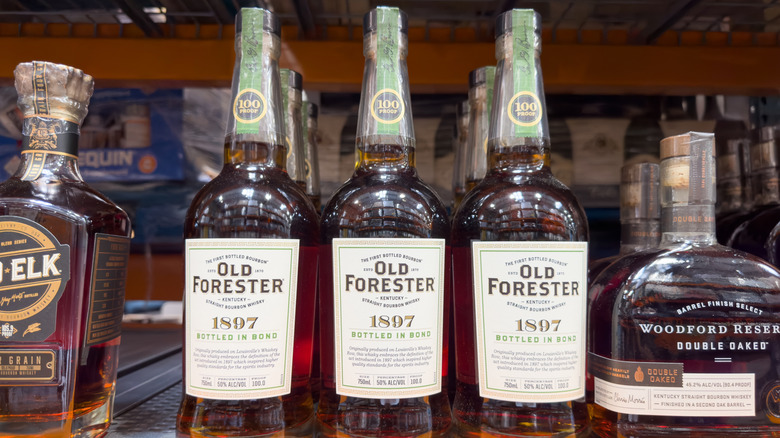
Perhaps the greatest testament to the genius of George Garvin Brown's first American bottled bourbon is the fact Old Forester can still be found on liquor store shelves and bar carts to this day. This is not a feat accomplished without challenges. In 1897, in hopes of reining in the rapidly growing, and largely unregulated, American spirit industry, the U.S. government passed the Bottled in Bond Act. The law created a set of criteria that bottled spirits must meet to be sold under that designation, including being distilled in a single season and bottled at 100 proof (50% alcohol by volume). The act represents one of the country's earliest consumer protection laws, and Old Forester adapted to grow within the confines of it. Brown soon raised the proof of his product from 90 to 100, and in 1901 purchased Mattingly Distillery to ensure legal distilling under his label.
An even greater historical challenge came in 1919, when the passing of the Volstead Act criminalized the manufacture, sale, and transportation of liquor, ushering in the 1920s prohibition era. However, the Volstead Act included provisions granting production licenses to distill spirits for alternative purposes, such as religious ceremonies or scientific experiments. Old Forester was granted one of the rare government licenses to bottle bourbon for medicinal purposes. Today, the company's website proudly states, "Old Forester remains the only bourbon continually sold by the same company before, during, and after prohibition."
Consumers and connoisseurs continue to appreciate Old Forester bourbon
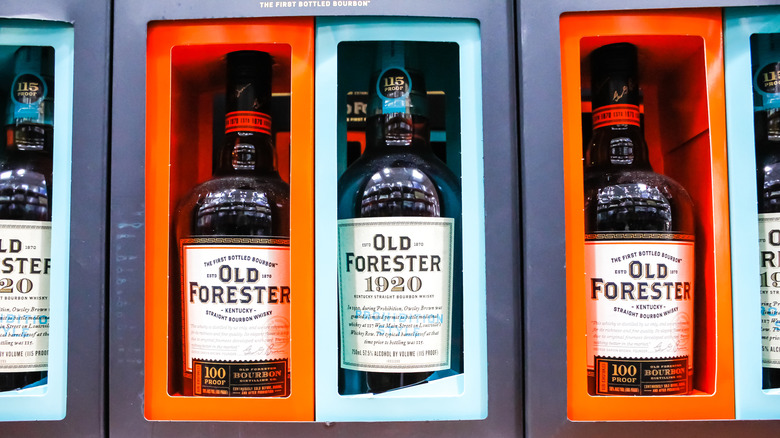
With the end of prohibition in 1933, Old Forester continued to pioneer new bourbon recipes and products to adapt with nearly a century of American change. This included crafting a lower ABV bourbon in 1959, designed specifically for the country's cocktail craze, as well as creating finer batches for the increasing culture of hobbyist whiskey connoisseurs. Since the turn of the 20th century, Old Forester has produced a number of bottles that pay homage to its long and storied history, including a 2014 four-bottle series that pays tribute to Old Forester recipes from 1870, 1897, 1910, and 1920.
Today, Old Forester enjoys a highly regarded reputation in the American whiskey scene, for its budget-friendly everyday bottles and standout specials. For a bottle under $50, we recommend Old Forester 100 Proof, which is complex enough for sipping but affordable enough to experiment with cocktails or mixed drinks. For one of the best bourbons to try, Old Forester fans can look for the rarer Birthday Bourbon, a limited batch of bottles released every September 2 since 2002 to coincide with George Garvin Brown's birthday. Old Forester recommends a retail price of $200 for its Birthday Bourbons, but retailers have been able to sell these coveted bottles for up to $650. The 2026 Birthday Bourbon was praised by experts for its particularly rich and fruity flavor, demonstrating how, more than 150 years since the brand first changed the industry with bottling, Old Forester continues to make bourbons that excite drinkers.