

Tanqueray Vs Bombay: What's The Biggest Difference Between These 2 Gin Brands?
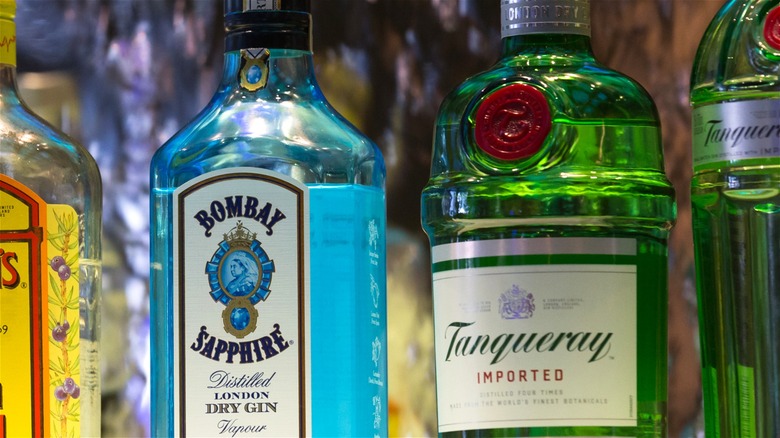
In most bars, two familiar gin bottles stand out because of their dazzling colors: the emerald-hued Tanqueray London dry gin and the brilliantly blue Bombay Sapphire. Tanqueray and Bombay are beloved brands in their own right and belong to the same style of gin (London dry). Both U.K. imports also landed in the top 10 of Mashed's popular gin brand ranking, but the similarities more or less stop there.
The foundational difference between the two gins is found in the ingredients of each brand's London dry. Tanqueray uses four botanicals in its recipe, whereas Bombay uses 10. The importance of botanicals to this spirit can't be overstated; in fact, ignoring them is one of the biggest mistakes you can make with gin. Combined with each brand's respective distillation methods, these ingredients produce distinctly different results in both flavor and aroma.
Part of this contrast is due to time. Tanqueray has thrived on consistency throughout its nearly 200-year history. The Bombay brand as we know it today has only existed since 1960, despite its origins tracing back to the mid-1700s. Bombay Sapphire, specifically, is not quite 40 years old as of this writing, having been formulated in 1987. While Tanqueray's flavor profile tends to lean on the traditional side, Bombay's take on London dry gin represents newer sensibilities, and the botanicals used in their respective recipes reflect that.
Tanqueray's embraces the intensity of its botanicals
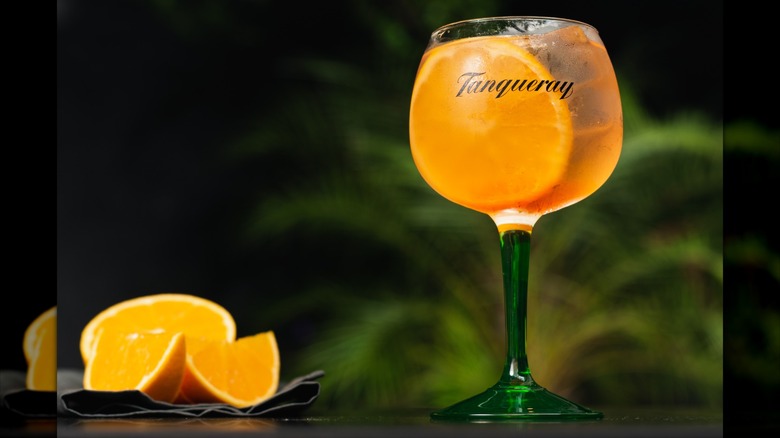
The strength of Tanqueray lies in its commitment to brand legacy. The botanicals its founder, Charles Tanqueray, used when he established his namesake gin back in 1830 – juniper berries, angelica root, coriander, and licorice — are the very same ones used today. By keeping the recipe simple, Tanqueray allows each botanical to express itself, opening with notes of juniper before giving way to a pleasant spiciness.
This is underscored by the fact that Tanqueray infuses the flavor of these botanicals into its gin through a traditional maceration process. The four ingredients are steeped directly in the liquid so the spirit can extract the flavor compounds to a large degree, giving Tanqueray its signature boldness. The gin is distilled four times to remove any impurities, allowing the botanicals to stand out even more while improving the overall smoothness. As a final nod to tradition, all of Tanqueray's London dry gin passes through Old Tom to this day, a still that has been used since the company's founding.
While the robust flavors of Tanqueray's botanicals are balanced enough that the gin can be enjoyed straight, the relative simplicity of its formula also makes it a versatile cocktail ingredient. The botanical notes give gin-based cocktails some depth, but if you really want to experience Tanqueray at its fullest, opt for something minimal and classic, like a gin and tonic.
Bombay Sapphire celebrates the harmony of its ingredients
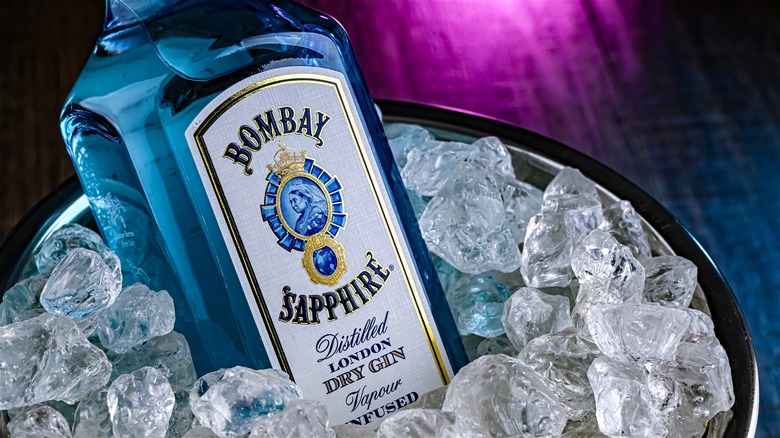
Where Tanqueray likes to keep things simple yet punchy, Bombay uses a bevy of botanicals from around the world in its gins. The lengthy list includes Chinese licorice, Indo-Chinese cassia bark, Moroccan coriander seeds, Saxon angelica root, Italian juniper berries and iris root, Spanish lemon peel and almonds, West African grains of paradise, and Javan cubeb berries. Each is carefully selected by Bombay's Master of Botanicals for its ability to bring something unique to the palate while harmonizing with everything else.
The botanicals are placed in a perforated copper basket above the still, flavoring the gin through a process called vapor infusion. As the heated gin distills, its vapors come into contact with the basket, extracting the botanicals' aroma and flavor compounds much more gently than the steeping method. Heavier, more intense compounds are left behind in favor of the vapor's condensation, resulting in a lighter-tasting gin.
Bombay Sapphire's vapor infusion makes the finished product surprisingly easy to drink despite the complexity of its botanicals. For a really refreshing drink, use Bombay Sapphire in cocktails where its citrus notes can be amplified, such as a classic Tom Collins. For something with a more unique flavor profile, use it in Anthony Bourdain's favorite cocktail, the Negroni. Bombay Sapphire was his gin of choice for the drink.