

Why Do Induction Cooktops Make A Humming Noise?
We may receive a commission on purchases made from links.
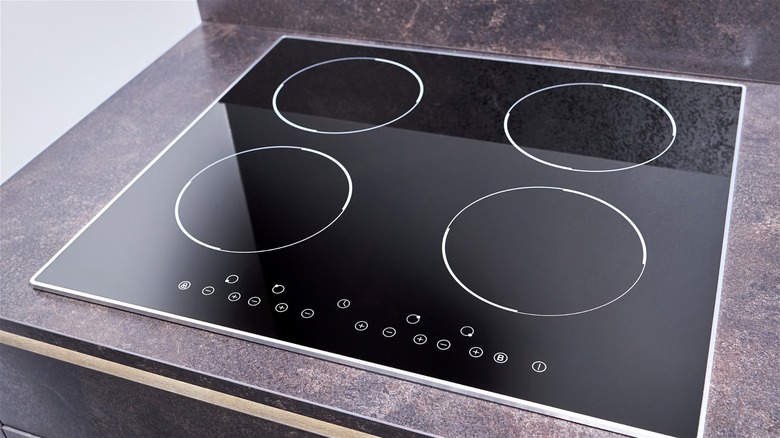
While there are a lot of advantages to using an induction cooktop, there's one tiny detail that might be a dealbreaker to those with sensitive ears. Induction stoves are known to hum when in use, especially at higher power levels. It's also generally unavoidable since the main reason you get that hum has everything to do with how induction works.
In a nutshell, induction cooktops generate small electromagnetic fields that move in alternating directions. When these fields come into contact with pans that are ferromagnetic — i.e., made with materials that react with magnetic fields in a certain way — they cause the pans' molecules to vibrate rapidly and generate heat. The humming you might hear when you cook with an induction stove is most likely the sound of those tiny vibrations.
If you think about it, your cooktop isn't actually humming; it's your pan making that noise as it makes its own heat. Typically, any sound the induction stove makes is more of a soft whooshing or whirring — that's the sound of its internal ventilation fan doing its job. Neither the fan noise nor the pan's humming are usually loud enough to be bothersome, however, so unless you need to be extremely particular with the noises in your home, there shouldn't be much issue.
How to reduce the humming sound when cooking with induction
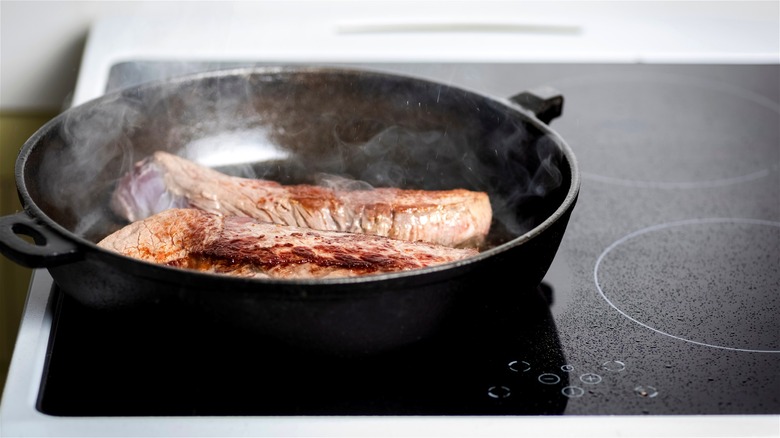
You can mitigate the humming by using induction-compatible cookware that compensates for the vibration. The first thing you'll want to look for is a pan that has a completely flat bottom. An uneven base results in less-controlled vibrations, which could then cause your cookware to hum more loudly as it shakes against the glass cooktop of your induction stove.
You'll also want a fairly heavy pan to go with your cooktop. Generally speaking, dense materials tend to make less noise, so it's a good idea to look for thick, hefty cookware. Keep in mind, however, that some pans feel heavy because they're made of multiple layers of metal — these can actually hum quite a bit on induction cooktops because the layers can vibrate against each other and resonate sound in the microscopic spaces between them.
Going by these guidelines, your best options for quieter cooking are cast iron and five-ply stainless-steel pans rather than three-ply ones, which are less heavy and tend to hum more. Cast iron, in particular, is a great choice because of its weight and solid construction. Since a cast-iron pan is one of those items every kitchen needs anyway, you might as well keep one handy for your induction stove.
Induction hums and buzzes that may be red flags
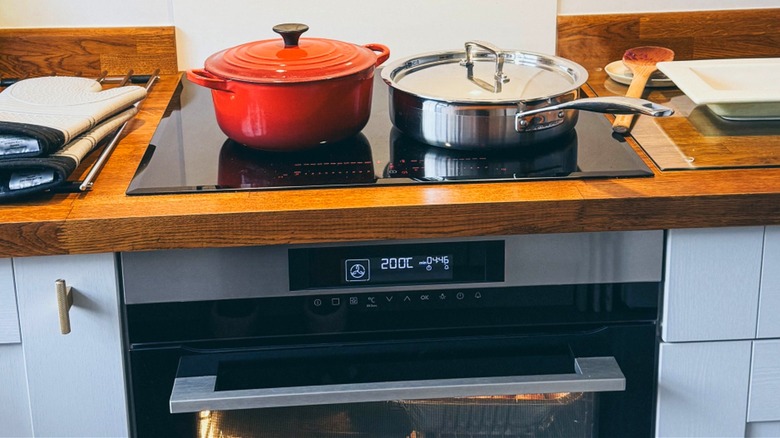
While some humming is normal for induction cooking, there are a couple of noises that are actually signs of something wrong. If you hear a high-pitched whining sound when your stove is unoccupied and on standby mode, there might be an issue with the internal parts. In some cases, it's possible the mechanism that detects whether or not a pan is on the cooktop has malfunctioned, causing the stove's power supply to operate on its own. The power supply itself could also have a malfunction, so it's best to get your stove checked by an expert if you hear any whining.
You might also hear some faint crackling while you're cooking, which might sound like a buzz at certain frequencies. Sometimes, this is caused by damp pans. Water and other liquids can get trapped between the pan and cooktop, resulting in a crackling noise as it boils. However, this could also be a sign your pan is damaged — liquids can seep into cracks on multi-clad pans and boil between the different layers.
Lastly, loud humming could come down to an issue of build quality, with some manufacturers simply making noisier induction cooktops than others. If you haven't bought one yet, it helps to read up on customer reviews before doing so. The Frigidaire Gallery, for instance, has been praised by customers for running relatively quiet, which is probably part of the reason it's Consumer Reports' top-rated induction range of 2026.