

The Difference In How Fast Induction And Gas Stoves Boil Water
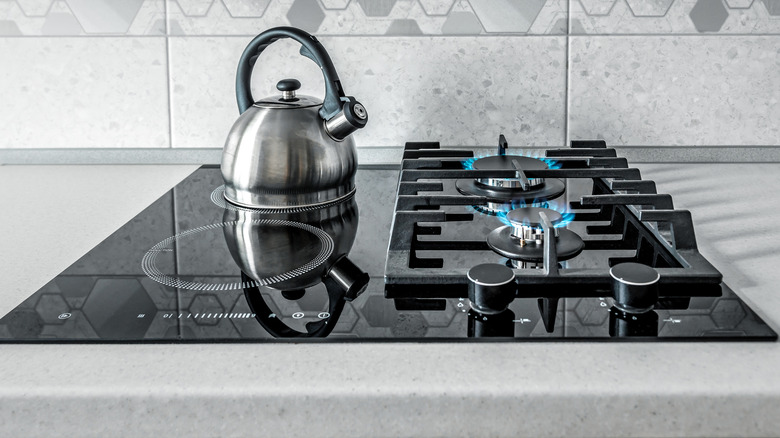
When it comes to judging a stove's performance, seemingly every cook has an opinion. Gas options, with their open flames, respond quickly to temperature adjustments but may negatively impact air quality within the home. Induction cooktops are energy-efficient and won't heat up without a pan or pot on top of them. However, one of the issues owners flag with these appliances is that they don't work with all types of cookware. In addition to weighing the broader pros and cons, you can compare them using a simple test: How fast do induction and gas stoves heat up water?
The Water Boiling Test (WBT) is an easy way to gauge the efficiency of a stove. It works like this: Pour a measured amount of water into a pot, set it on your cooking apparatus, and time how long it takes for the liquid to boil. If you're comparing two different appliances, be sure to use the same amount of water. When a team from Bank Australia conducted the test with induction and gas stoves, they discovered a stark difference between the two. It took only one minute and 16 seconds for an induction cooktop to bring 500 milliliters of cold water to a boil in an unlidded stainless steel saucepan. The gas stove took five minutes and 9 seconds. The difference boils down to how the appliances generate and transfer heat.
Induction stove
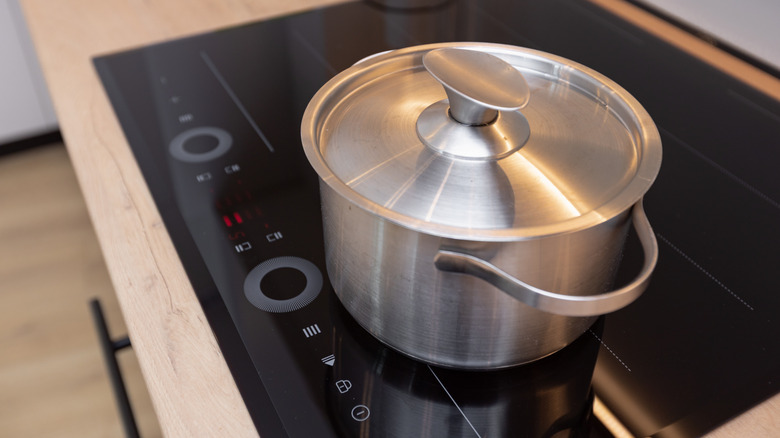
As demonstrated by the Water Boiling Test, cooking speed is one of many advantages of using an induction stovetop. The appliance relies on electromagnetic energy to heat the pots and pans placed on it rather than raising the temperature of the cooktop itself. This is made possible by a series of coils under the surface that have electrical currents running through them. Contact with the cookware generates a magnetic field that in turn raises the temperature of the pot or pan. This is a highly efficient process. In fact, the Electric Power Research Institute conducted a 2014 study for the California Energy Commision and found that during induction cooking, significantly more energy makes it into food than with gas stoves. This is partly because the device doesn't rely on a heating element that would create greater energy loss.
Thanks to that efficiency, the appliance is able to bring 500 milliliters of cold water to a rolling boil in just over a minute. Its cookware-reliant heating also reduces the chances of accidental burns. However, there are still downsides worth considering. The typical lifespan span of an induction stovetop may be lower than that of a gas stove, and the initial financial investment might be higher. But if efficient cooking and energy use is what you are looking for, then induction is the better option. Just be sure you are using the right type of magnetic cookware. If induction can't take place, then the pot can't heat up, and the water won't boil at all.
Gas stove
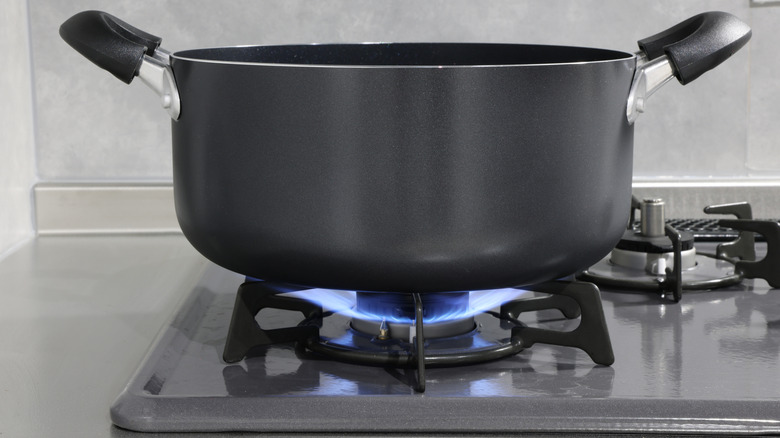
Cooking with gas requires fire. Natural gas is released and ignited, and the knobs on the stove control the size of the flames. Because this heats up surrounding structures, as little as 40% of the energy consumed while using a gas burner actually makes it into what you are cooking (per the Electric Power Research Institute). This less-efficient system leads to a longer boiling time than with induction.
If gas is your preferred method, there are ways to encourage faster boiling. Start with warm water, and position the pot in the center of the burner for even heating. Place a lid on top in order to trap in heat. (One thing you may notice in multiple head-to-head water-boiling tests is that the cookware is heated without lids, causing greater heat loss.) But, even under the best conditions, you will not be able to boil 500 milliliters of water in under a minute on a gas stovetop. Induction still wins this competition.