

Toasted, Griddled, Or Broiled: Which Method Makes The Best Hot Sandwich?
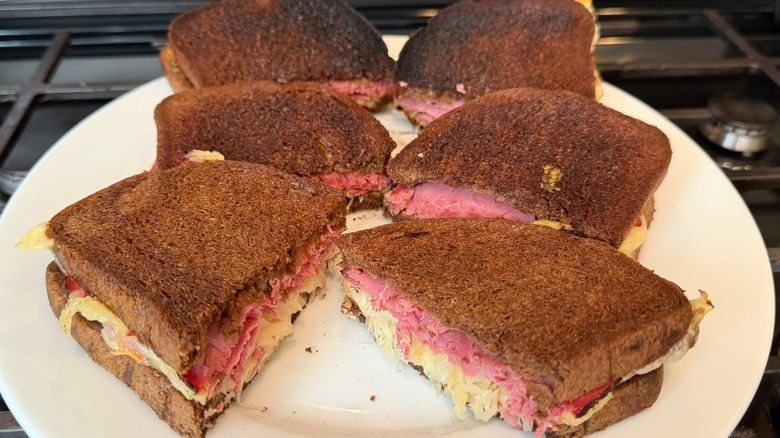
As a writer who works from home, I'm often inclined to work through lunch. If and when I stop to eat, it's likely to be a hastily thrown-together cold sandwich or, just as likely, leftovers reheated in the microwave and gulped straight out of the plastic container while I'm standing over the kitchen sink. But every now and then I'll cook up a hot sandwich, which is an easy way to feel like I'm indulging myself. Usually, I cook my hot sandwiches in a cast-iron skillet on the stovetop, but the average home kitchen offers several tools that make hot sandwiches fast, easy, and tasty: a griddle, a toaster oven, or the broiler in your oven.
While, admittedly, my go-to hot sandwich is a grilled cheese (see my tendency toward "hastily thrown-together" sandwiches above), if I'm willing to spend a little extra time and I have the ingredients on hand, I'll cook up a Reuben. Easily my favorite hot sandwich, a Reuben is easy to make, with so much flavor and texture packed into every bite that it satisfies any craving, whether you want cheesy, meaty, crunchy, tart, or buttery. The traditional recipe is sliced corned beef, sliced Swiss cheese, sauerkraut, and Thousand Island or Russian dressing inside rye bread; the sandwich is grilled so the cheese melts and the bread gets crispy. But is that the best method to get that ideal crispy-on-the-outside, steamy-and-melted-on-the-inside final result? To find out, I purchased my own Reuben ingredients and prepared a sandwich for the griddle, one for the toaster oven, and one for the broiler.
Creating my sandwiches
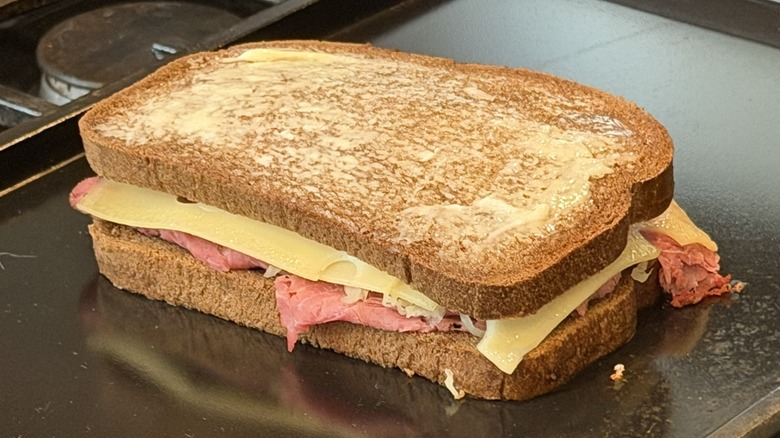
Before starting my cooking test, I had to assemble all the ingredients for my Reubens. First, I prefer thinly sliced pastrami, a common substitute over corned beef for its richer, smokier flavor, imparted through a mix of spices including peppercorns, garlic, and mustard seeds. It's smoked versus boiled or baked, which is typically how corned beef is prepared. I also prefer Russian dressing, which is different from Thousand Island. Both start with mayonnaise and ketchup, but Russian dressing includes horseradish and sometimes mustard or even chili sauce, giving it more of a kick. Finally, while marble rye is my preference for a Reuben, my local grocery store didn't have it in stock, so I went with a dark rye for that deep flavor and denser texture than Jewish rye.
I also veer away from New York delicatessens' tendency to pile on tons of meat. I like a smaller amount of pastrami paired with two slices of melted Swiss so the flavors are more balanced. However, if you're a person who likes to jam-pack your sandwiches with meat, like a traditional New York deli, it might be harder to achieve the same results as what I've achieved here. In that case, you'd need to consider how to cook the entire sandwich more evenly and slowly so the bread doesn't burn while you're waiting for the cheese to melt. You might even want to try an open-faced sandwich; I gave this option a shot as well, which I'll discuss below.
Griddled
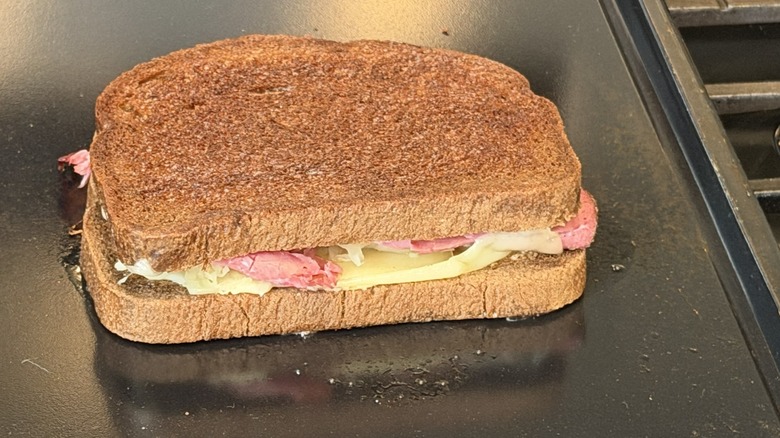
I started by griddling because I'm most familiar with cooking a Reuben this way. To mimic what a deli might use, I employed my cast-iron griddle, which came with my oven's gas stovetop. One of the best features of a griddle is that it has a nonstick cooking surface. It also provides a large surface area, so you can prepare several sandwiches at once, and it doesn't have sidewalls. This means you can see the bottom edge of the sandwich as it cooks, moisture doesn't get trapped inside, and flipping is even easier than with a skillet.
Since cast iron takes a while to heat up, I turned the heat to medium and began assembling the sandwich on the griddle while it heated up. In fact, I took for granted that it would take a while to cook this way and busied myself with assembling the other two sandwiches. This led me to overcook the bottom on the griddle. I flipped the sandwich over and found the bottom had gotten a bit scorched. I also saw that the cheese was starting to sweat but had not melted, so I needed to trap some heat inside. I tented the sandwich with a sheet of aluminum foil, and that seemed to speed up the cooking process for the middle of the sandwich.
After a few more minutes, I took it off the griddle, cut it in half, and tasted it. Immediately, I noted a buttery flavor. I liked the texture of the bread, which was nice and crispy, while the cheese was melty and the meat was steamy and moist. In all, it turned out pretty much as expected.
Toasted
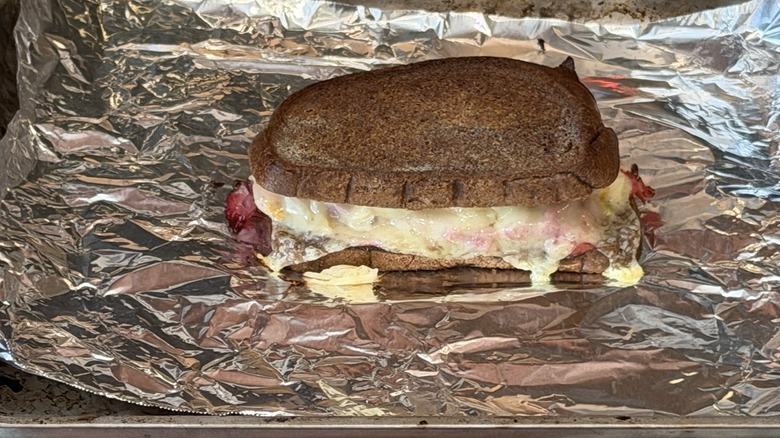
My toaster oven is a convection oven, and I've been known to use a toaster oven to make a number of unexpected dishes, from pizza to s'mores and much more, with great results. But the idea of cooking a hot sandwich this way wouldn't have occurred to me before writing this review. In fact, two of the biggest disadvantages of a toaster oven are that it cooks food unevenly and can present safety hazards. If the cheese or dressing dripped onto the heating element at the bottom, could it cause a fire?
While many people are likely to have toaster ovens, not all of them have bake settings, so I was committed to using the "toast" setting. I read up on how to use it and found that using the oven's sheet pan, versus the grate I use to make toast, was the way to go. This would also prevent drips. I removed the grate, placed the sheet pan inside on the top rack, and preheated the oven. Then I assembled the sandwich on a sheet of foil, which I would then lay atop the hot sheet pan.
This method proved surprisingly easy — even easier than the griddle. Both pieces of bread achieved a decidedly toasty flavor and great crunchy texture. And while I had feared that the middle of the sandwich wouldn't cook as well on the toaster setting, I was pleasantly surprised to see that it had cooked through. The cheese melted nicely, and the tangy flavor and crunchy texture of the sauerkraut were retained. This method also took the shortest amount of time — I never even had to flip the sandwich.
Broiled
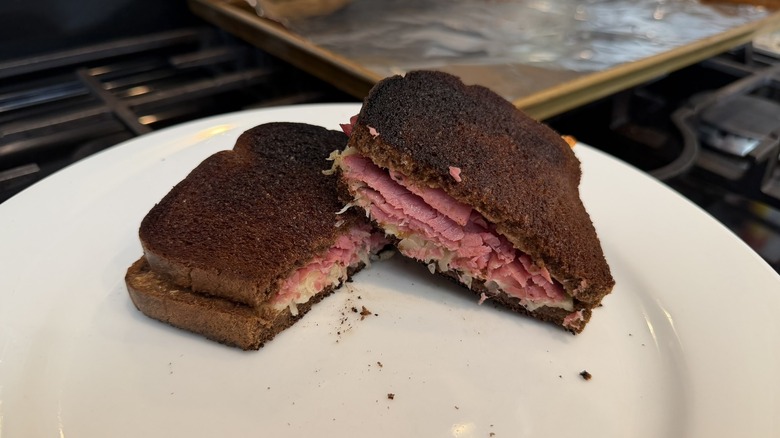
Broiling was the method I was least familiar with. Of course, I'm used to achieving a final top browning or melting cheese on a frittata with a broiler, but a whole sandwich? The difference between baking and broiling is significant; while your oven contains several heating elements found all around its interior to achieve uniform cooking, the broiler uses only the direct, radiant heat from a single source at the top. Its results are immediate and typically surface-level only. How, then, could I be sure that the bottom and inside of the sandwich cooked thoroughly without totally burning the top piece of bread?
With a little research I learned that the same method I'd employed with the toaster oven — preheating an oven-safe sheet pan on the middle rack with the heat on high — would help me ensure that heat reached the bottom of the sandwich while not cooking the bread too quickly. I also read that the low broiler setting might dry out the bread before the sandwich was done cooking, so I stuck with the high setting. I prepared the sandwich atop a piece of foil, then laid the whole thing on the prepared hot sheet pan.
The broiler, like the griddle, imparted a strong brown-butter flavor. However, since the heat was coming from the top only, even the hot pan didn't sufficiently cook the sandwich underneath, and I needed to flip it. Despite flipping, that side stayed a bit soggy. Also, because a broiler cooks so quickly, the bread crust started to burn almost right away while the inside didn't quite get hot. I found that the dressing made the underside of the cooked bread somewhat mushy.
The open-faced method
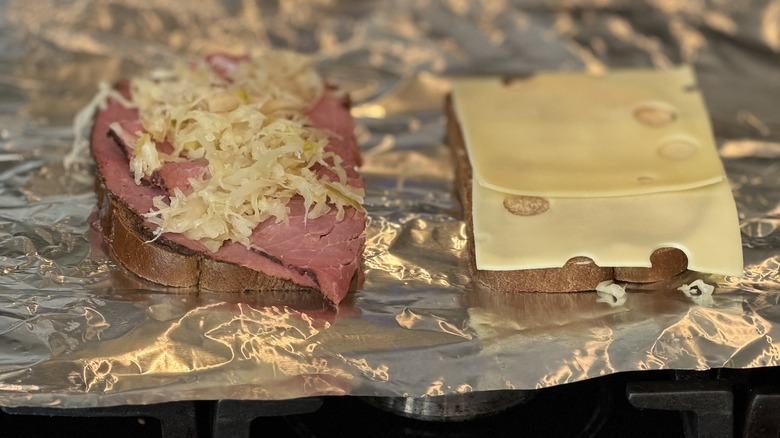
I quickly realized that broiling was not ideal for a sandwich as thick as a Reuben — not if I'm going to make sure that the bread gently toasts while the insides get cooked thoroughly. So I thought I would open it up and let the inside ingredients cook first. I preheated the pan in the oven with the broiler on high, then began assembling the sandwich. Instead of building everything on one slice of bread, I laid both slices of bread on the foil, butter-side down. On one slice, I placed pastrami and sauerkraut; on the other slice, I spread Russian dressing and topped it with Swiss cheese to ensure the cheese would melt fully. I inserted the whole thing into the oven. Then, when the filling ingredients appeared cooked, I placed the cheese-covered slice on top of the bottom half of the sandwich and broiled it until the bread was toasted, then flipped it to finish toasting the other side.
The results of this were mixed. First, I was able to achieve more of a uniform golden-brown toast on both sides of the sandwich, but I had to flip it very quickly. This was the most work-intensive method of all because the broiler works very quickly. And while the inside ingredients cooked more thoroughly using this method, the bread did get a bit mushy; in fact, the Russian dressing sort of disintegrated under the broiler, contributing to the bread's sogginess. I think I could get more creative with assembling the sandwich so that only dry ingredients are touching the bread, but overall, this method feels awkward and inconvenient.
Pros and cons of each cooking method
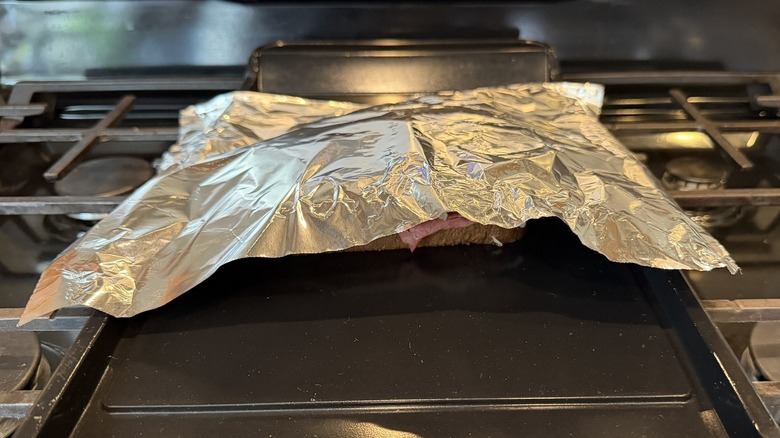
Each of the three methods has its pros and cons. The toaster oven cooks the most quickly and uniformly with the least amount of work; I didn't even need to flip the sandwich after all. But it involves a bit more preparation — preheating the oven with the pan, assembling the sandwich on foil, then quickly and smoothly sliding the foil topped with the built sandwich onto the pan. Then you have to stand and watch it closely. I also don't know how the results would have turned out if I'd added more meat or cheese; the inside of the sandwich may not have cooked so uniformly.
Meanwhile, the griddle is a more intuitive way to cook a sandwich and doesn't require so much babysitting. However, it's harder to ensure that the inside of the sandwich is cooked fully, so an aluminum foil tent or a pot lid is helpful for trapping the heat inside. And if I'd used more meat, that might have added more difficulty to the mix, requiring more time to heat through.
The broiler cooks lightning fast, but, in my opinion, that's really the only item in the pro column for this method. Otherwise, it's awkward, involves too much oversight, and doesn't easily cook the inside or even bottom of the sandwich. This led me to consider trying the broiler again with the aforementioned open-faced version of the sandwich.
The verdict
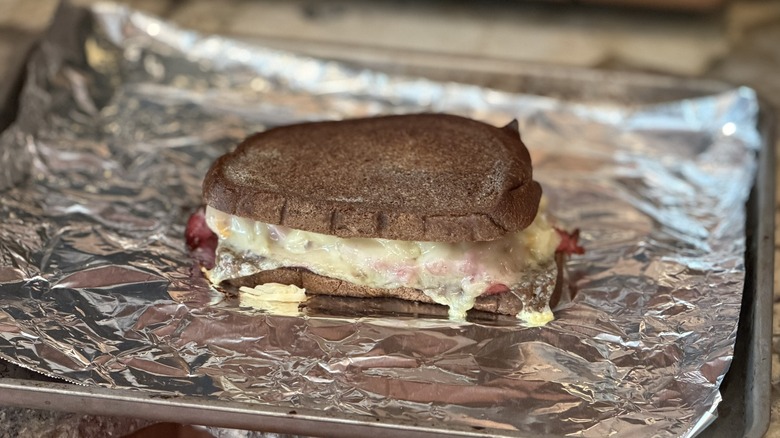
I am just as surprised as you are to learn that toasting is my preferred method in this experiment. This method not only achieved the fastest results, but it required the least amount of work. Most importantly, it yielded the ideal combination of crunchy texture outside and moist, savory flavor inside. Every ingredient was cooked evenly, all in a fraction of the time of the other techniques. The balance of flavors was best too. While I buttered the bread on all versions, this one didn't have such a butter-forward flavor, probably because the slices toasted before the butter had a chance to really brown. The size of the toaster oven managed to ensure that the sandwich was uniformly cooked. The flavors of the ingredients shone through with steamy meat, stringy melted cheese, and crunchy sauerkraut, whereas the grilled bread tended to overpower the rest of the flavors in the other methods.
In general, I would still use the griddle again. It's a tried-and-true method I know I can count on and is easier and far less awkward than broiling. A lid and frequent flipping can yield consistently tasty results. But having taste-tested all three methods (four, counting the open-faced broiler method), I definitely noticed that griddling results in a more pronounced brown-butter flavor. I might also try an unexpected way to use mayonnaise and spread it on the outside of the bread. Mayo contains oil and has a higher smoke point and would reduce that heavy butter flavor. Overall, though, I'm a lot more likely to consider toasting my sandwiches from now on to achieve that ideal combination of crispy outside, steamy-soft inside, and not a mushy slice of bread in sight.
Methodology
I selected a Reuben because it involved meat, cheese, and wet ingredients, and it needed to produce a lot of flavors and textures. This sandwich would truly test all three cooking methods. Then I knew I needed to be careful about how I assembled each sandwich. Knowing that sauerkraut and dressing can make bread soggy when they're cooked, I had to stack the ingredients strategically to give each method a fair shot at cooking the bread evenly.
First, I buttered the outside of each slice of bread. While a lot of hot sandwich recipes call for mayo for toasted or grilled sandwiches, I opted to use butter, which has a nuttier, richer flavor, rather than tangy. Then I added a layer of pastrami, a layer of sauerkraut (drained, to prevent excess moisture), another layer of meat (trapping the sauerkraut's moisture inside rather than against the bread), and two slices of Swiss cheese. Next, I applied a thin layer of dressing to the inside of the other slice of bread and put the sandwich together. Each sandwich was prepared the same way to make for a more controlled experiment. So that I could build the sandwiches fully before cooking and could monitor each method carefully, I used aluminum foil atop the cooking pans in the toaster oven and broiler.