

What Does The Boost Button Do On An Induction Cooktop?
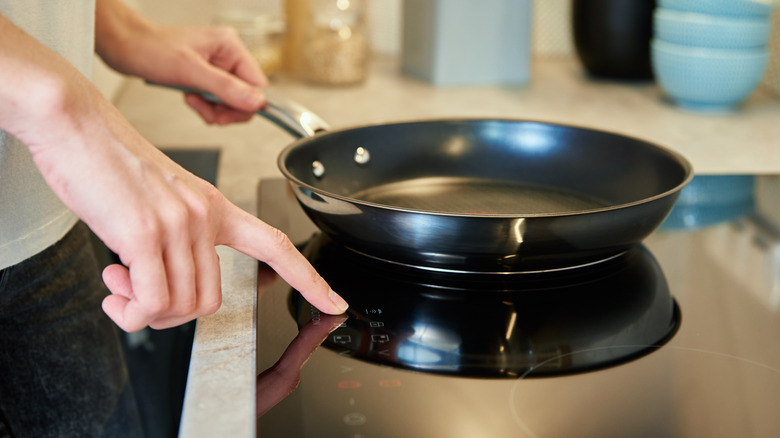
With benefits like more precise temperature control and greater energy efficiency than conventional stoves, it's easy to see why induction ranges are so popular these days. These appliances have a bit of a learning curve, though, which can lead to induction cooking mistakes like using incompatible cookware and treating the glass stovetop too rough. You should also know the purpose and function of each control, especially when it comes to something as helpful as "power boost." While it varies in function and name depending on the brand, power boost essentially increases the power in one cooking zone (or element) when in need of high, intense heat.
This feature, draws power from adjacent zones and focuses on a single area of the cooktop, which is helpful when boiling water or searing meat at high temperatures. Induction controls usually limit how long the boost can last. For example, the KitchenAid Sensor Induction Cooktop's power boost increases the temp beyond the maximum heat level for five minutes.
Power boost can also affect the other cooktop zones, which is something to remember when using multiple elements. If you boost one zone, the adjacent ones will lose some or all of their power until the boost ends. Intricacies like this, along with other owner-cited challenges of induction cooking, are worth considering before going the induction route.
Other induction cooktop features you should know about (and how they affect your cooking)

Are you a fan of easy one-pot recipes, or does your stovetop look like a mad scientist's lab when you're cooking? Your answer could indicate which functions are best for you in an induction range. While the terms "power sharing" and "power boost" are sometimes used interchangeably, there can be differences between the two features.
In some brands, power sharing enables one stovetop element to run on high, while the others in the same zone work at a reduced level. With others, power boost means power is removed from other elements within the shared zone until the boost setting is disengaged. If your culinary routine involves multiple pieces of cookware, an appliance with power share might work better.
The sizes and shapes of the cooktop heating elements are another thing to consider. It's important for your induction-compatible cookware to match the size of the burner. With rectangular elements, it's usually easier to position pans correctly, and you're free to use larger pieces of cookware that wouldn't be compatible with the individual circular heating elements. You might also be interested in an induction range with a bridge zone, which lets you combine front and rear elements on either side to create a larger cooking area.