

7 Discontinued Sodas From The '80s You'll Never Drink Again
We may receive a commission on purchases made from links.
The soda scene in the '80s was a little bit like the Wild West: a whole lot of strange and exciting flavors were wrangling for the attention of the pop-drinking public. This was the era when soda were firmly established as a staple beverage rather than a sweet treat reserved for occasional enjoyment. But the competition was stiff for room in the refrigerator case and on the soda shelves, and there was only so much space for newcomers to stake their claims. When the dust has settled, there was a selection of cans and bottles that had been put out to pasture, never to be cracked open again.
Decades have passed since the sodas of the '80s tickled our taste buds, and our imaginations have made us miss the most noteworthy and inventive carbonated beverages that couldn't make a go of it. Whether you remember the drink that once came in a caffeinated spiced version or that time one of the most famous brands in the world thought it would be a good idea to come up with an entirely new recipe, this collection of discontinued '80s beverages will remind you just how wild and wacky the soda circuit used to be.
Hubba Bubba
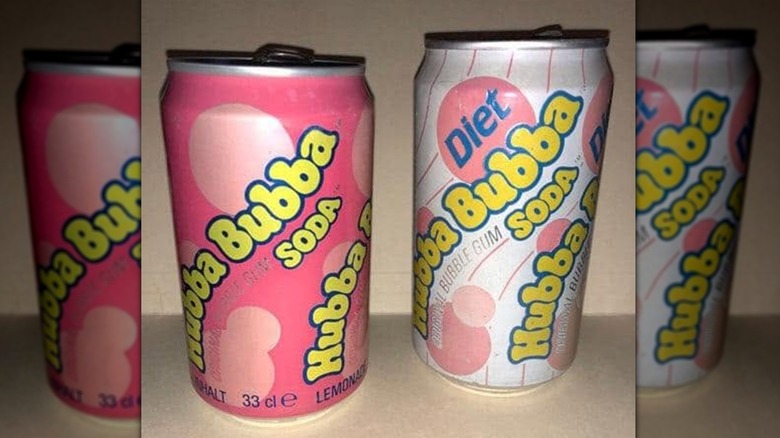
Bubblegum-flavored soda was nothing new by the time the '80s introduced younger drinkers to a drinkable version of Hubba Bubba. In fact, the ads used to sell the Wrigley-owned beverage tapped into the '50s soda shop aesthetic to tie its new bubble gum soda to the flavor's traditional origins when it appeared in 1988. It was a zeitgeist zinger that capitalized on the decade's popular nonstick bubblegum and turned it into a drinkable delight — for anyone who loves artificial flavor in a can, at least. The blindingly pink can and the joyous, rounded font from the gum package made a mighty fine can graphic, though the fizzy pink liquid looked a little more like jazzed-up lemonade. There was even a diet version for soda drinkers who were watching their sugar intake.
Alas, though Hubba Bubba continues today as the best-selling bubble gum in the U.S., the soda bubble burst just a few years after its launch. And before you get caught unawares by a sneaky listing found on Amazon for a Hubba Bubba beverage, know that the drink available in a tangy tropical flavor is not soda, but a punch-like drink that doesn't crackle when you chug it. If you want the soda, you're going to have to time travel back to some point in the late '80s or early '90s and snag a can before manufacturers pull the plug. You'll have to settle for Bubblicious Ghost energy drink or Bazooka soda instead.
Like Cola
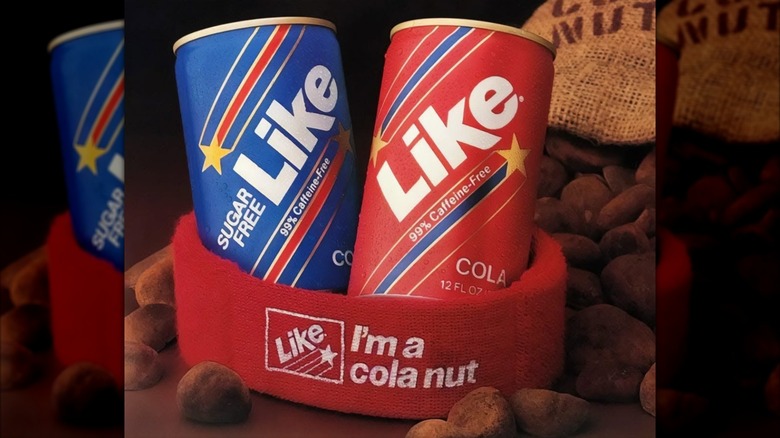
Why would anybody ever name a carbonated soda Like Cola? This wasn't the Valley-speak version of regular cola for the skater teens and mall hangers who asked for "like, cola," though it did hit shelves in 1982 at the advent of Cali slang spreading across the country. No, this was a whole new brand of canned cola enjoyment — or at least it was intended to be enjoyed, and obviously to compete with the big boys in the soda sector. There was even branded merch for devotees to don while they drank.
Like Cola made the daring move of embracing a low-caffeine recipe for its cola. Each drink contained only 1%, or 0.04 milligrams per 12-ounce serving. It makes more sense when you learn that 7UP was responsible for the experiment. The marketing team enlisted celebrities of the time, such as actor Tim Conway, plus Pac-Man, to help make this crackler palatable to the public, pitching it as a more wholesome alternative for kids than Coke or Pepsi.
By 1992, Like Cola had reached the end of its lifespan, but it made quite an impression on the industry; Pepsi had its own Pepsi Free in 1982, and Coke launched its own decaf formula in shiny gold cans in 1983. But in a world of soda trendsetters and trend followers, it's worth noting that Like Cola did it first, even if it didn't last — unless you're in Malta, where it happens to be produced by the grocery store chain Farsons.
New Coke
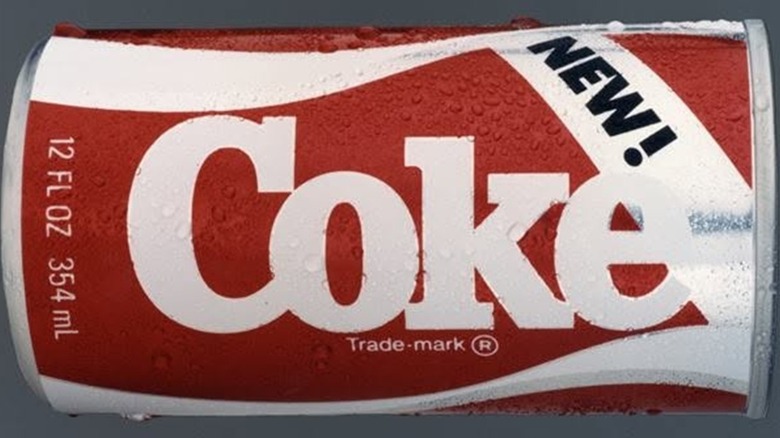
Oh, the cultural calamity that was New Coke, a 1985 object lesson in how far afield a corporation can go with a classic product that works perfectly just as it is. Not only was Coke one of the most popular soda brands ever, but it was also an iconic American creation that bested all second-rate comers to the carbonated arena and set a standard that other soda makers strove for. So tinkering with perfection became a notorious failure that proved newer isn't always better.
The hubris of the mid-'80s corporate cola mucky-mucks and their desperation to win the advertising-fueled cola wars led to one of the most colossal failures in the world of commercial products. It was such a bomb, it became shorthand for avoiding similar mistakes in all spheres and sectors; a simple "Remember New Coke?" is still an effective deterrent whenever high and mighty corporate thinkers start to get too big for their britches.
Coke regained its footing by introducing Classic Coke as a counterpoint to New Coke. Eventually, it became simply Coke once again, and New Coke was relegated to the laughable mistakes of a too-ambitious corporation trying to keep up with the times. The stain it left on the soda drinkers' collective psyche, though? Well, that will never disappear.
Pepsi A.M.
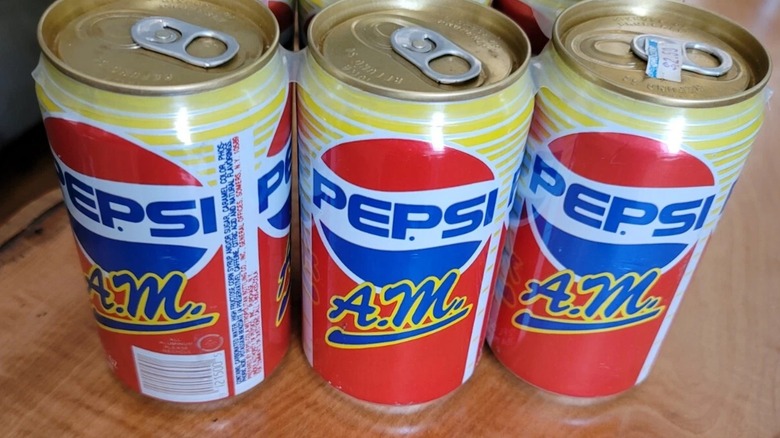
Imagine a less-carbonated version of Pepsi with jacked-up caffeine content, intended to be a coffee substitute for morning consumption to get your engine revving from a can instead of a cup. If you were a soda drinker in the '80s, that description would have drawn you to Pepsi A.M., a strange reformulation that didn't replace the original but showed up as a counterpart to entice cola fans in need of a jet-fuel jump. It was said to have between 25% and 28% more caffeine than regular Pepsi.
Redditors compare Pepsi A.M. to the similar Jolt Cola, another overcaffeinated '80s soda that still appears in some forms today. Whatever Pepsi was thinking in trying to compete with the pre-Starbucks set (hint: it was probably a money-making strategy designed to throw shade at Coke in the cola brands' unending competition). But despite optimistic goals of boosting morning soft drink consumption, Pepsi A.M. just couldn't find its footing. The variant was axed in 1990 and hasn't been back on the circuit since. The fact that you can slam shots of caffeine at any convenience store likely means there's no need for a Pepsi A.M. return. And if you still like your caffeine in a soda delivery-based system, there's always Mountain Dew, with its extra caffeine content waiting to juice up your morning.
Life Savers
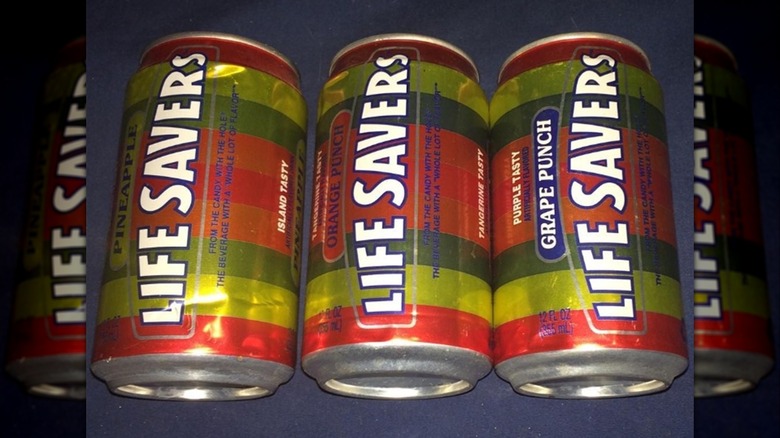
The juicy flavors of Life Savers candy jumped out of the roll and landed smack-dab in the middle of the soda selection in 1981, reimagined as Life Savers sodas. These vibrant fizzers were an ideal halfway point for kids (mostly) who loved both soda and Kool-Aid and wouldn't be put off by merging them into a single beverage. The bottles and cans came with colorful labels bearing the famous Life Savers spectrum for instant brand recognition. It was a rich time for anyone with a sweet tooth and a throat for carbonation.
Each selection in the five-flavor set featured a taste that replicated a Life Savers flavor in punch form, from tangy lime to perky pineapple. They were as colorful as their candy counterparts, too, undoubtedly thanks to generous quantities of artificial dyes. Those who tried them recall how fun these sweet sips were, especially when dropping a spark-inducing Wint-O-Green Life Savers candy into the soda and making your own frothing explosion like the nostalgic soda fans on Reddit recall doing.
These fruit-flavored spritzes had a short life, disappearing in 1982. Rather than bringing back the full-sugar sodas, Life Savers partnered with Sparkling Ice on a sugar-free set of flavors in 2026 instead. It may capture the fancy of nostalgic drinkers hoping for a taste of the past, but anyone whose corn syrup tolerance was built in the '80s knows that it's not the same. Not even close.
7UP Gold
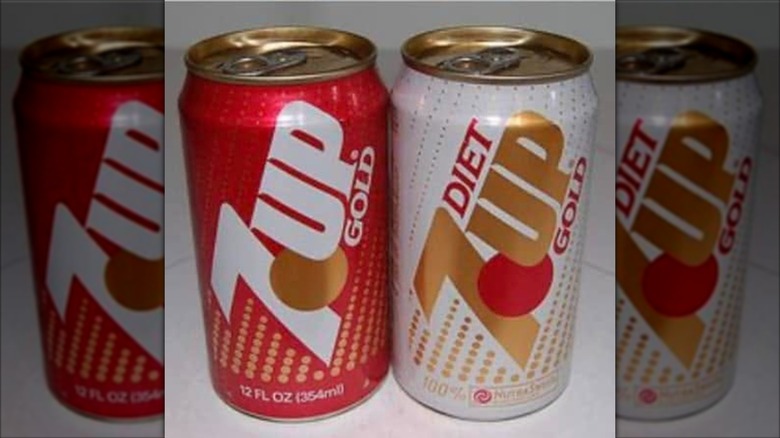
Who said 7UP had to be a colorless creation? The folks who dreamed up 7UP Gold in 1988 didn't feel hindered by the usual see-through soda. They thought it could use a spicy upgrade, so they set their soda phasers to "dazzle" and made an amber version of the usual that wasn't particularly well-received. It also contained caffeine — usually a no-no in the citrus soda sphere, but 7UP was trying new things, and apparently this was the move. The bright red cans with gold ornamentation were reminiscent of another soda biggie that focused largely on cola, which doesn't seem accidental.
The shake-up went even further. Television ads for 7UP Gold used the classic rock strains of "Wild Thing" to signal that this unhindered carbonated creation had bite — or at least it was intended to. The ginger ale-like spiced flavor blend was a departure from 7UP's typical crispness into a warmer region of the soda lover's palate, another wild left turn that was counter to the core principles of the "uncola" that was originally designed to compete with Coke.
As it happened, the crystal-clear impression of traditional 7UP, tainted with color and caffeine, likely threw consumers for a loop, according to Roger Easley, the president of 7UP Bottling Company of San Francisco at the time. By 1989, 7UP had already given up on its caffeinated experiment and removed it from the 7UP catalog — a move so swift it suggests the company was keen to forget the whole thing.
Mountain Dew Sport
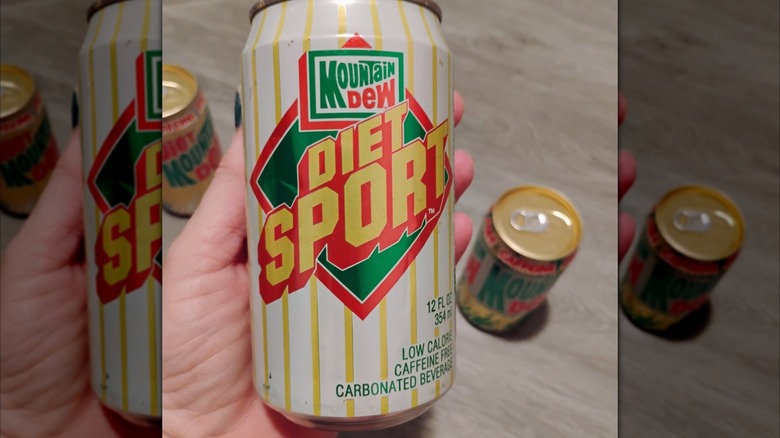
If it looks like Mountain Dew, tastes like Mountain Dew, and says "Mountain Dew" on the label, doesn't that indeed make it Mountain Dew? Not if it's Mountain Dew Sport, a carbonated refreshment from 1989 designed to challenge sports drinks while retaining its sassy soda snap. Baseball and football legend Bo Jackson showed up in ads that made it sound like Gatorade had met its match, boasting about replenishment and appearing to create a new demographic: The athlete with the steel stomach.
Why a steel stomach, you ask? The idea of participating in any physically strenuous activity that includes running or getting hit by another human being while your belly is full of bubbles is a gut bomb waiting to happen. But Mountain Dew Sport went the extra mile to make this drink even less logical by removing its trademark caffeine content and using NutraSweet instead of corn syrup for all three of its original, diet, and two-calorie versions. The only original aspect it had left was the Mountain Dew flavor.
So, really, Mountain Dew Sport was a caffeine-free sports drink with added electrolytes — which sounds an awful lot like a sugar-free Gatorade. If a green soda can have red flags signaling its probable demise, this one had them in spades. That may be why it was dropped in 1991, only to be reformulated and re-released in the mid-'90s as All Sport – which, coincidentally, ended up looking an awful lot like Gatorade.