

4 Maker's Mark Whiskey Bottles, Ranked Worst To Best
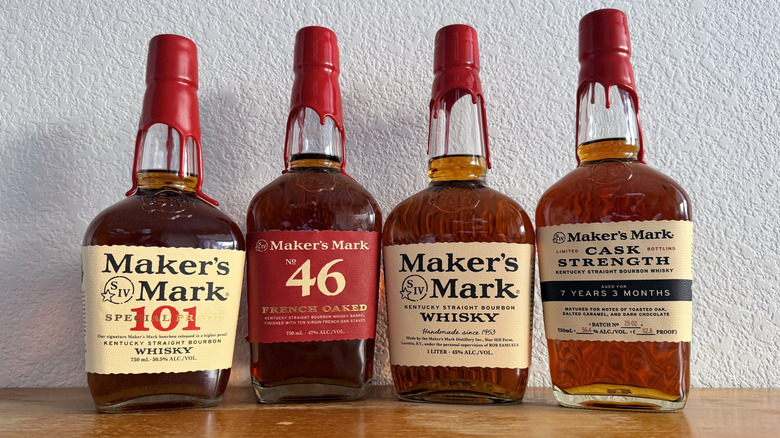
Maker's Mark is one of America's iconic whiskey brands, known for providing a solid level of quality for a reasonable price. Despite its accessibility, crafting Maker's Mark bourbon is actually a complicated process, formulated to ensure customers can consistently enjoy the flavor for which the brand has become known. There's even an argument to be made that it's the single best bourbon that belongs with a steak dinner.
While standard Maker's Mark is the product on which the company built its reputation, Maker's Mark produces a pretty considerable variety of bourbons, including a rotating selection of limited releases. Its year-round offerings consist of four products: Maker's Mark Kentucky Straight Bourbon Whisky, Maker's Mark No. 46, Maker's Mark 101, and Maker's Mark Cask Strength. I tasted and compared all four of those flagship bourbons in one sitting to figure out just how they stack up against one another. Ahead are my thoughts on each of the Maker's Mark bourbons I tried, in order from worst to best.
4. Maker's Mark No. 46 French Oaked Kentucky Straight Bourbon Whisky
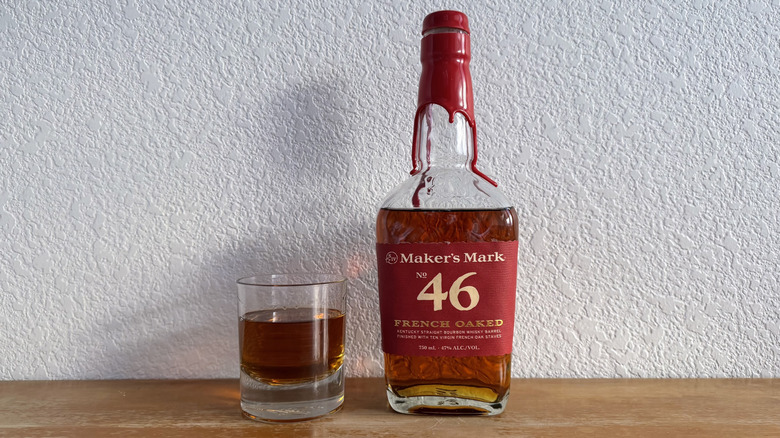
What sets No. 46 apart from baseline Maker's Mark is the addition of French oak staves to a longer aging process, intended to accentuate the core notes that define the classic Maker's Mark recipe. While the amount of money you should spend on a good bottle of bourbon in 2026 varies, No. 46 is of a particularly solid level of quality for its $40-or-so price point.
To be clear, I liked No. 46 on the whole, but I placed it at the bottom of this ranking simply because its balance of those core Maker's Mark flavors was the least to my liking of the four whiskeys I tried. Defining the experience was a bold oak flavor, accentuated by warming cinnamon and a bit of a light fruitiness, maybe akin to a green melon — that latter note was subtle, but it was unique to No. 46, and reminded me more of a scotch, like the iconic Glenlivet 12-year whisky, than a typical bourbon.
In its finish, I picked up a citrus peel component, sort of balancing its fruitiness with a bitter note. What felt particularly prominent compared to the rest of the field was its cinnamon flavor, and, on my palate, it didn't mesh as well with its oaky and fruity notes as I would have liked. With that said, its cinnamon-forward character would fit particularly well in a holiday drink — like, say, a boozy homemade eggnog recipe.
3. Maker's Mark Cask Strength 7-Years and 2-Months Aged Kentucky Straight Bourbon Whisky
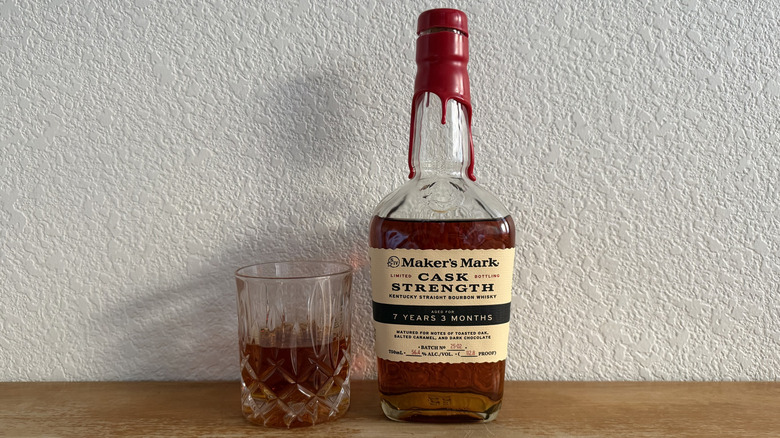
Maker's Mark Cask Strength is effectively its highest-end year-round offering, pricier than any of the brand's other three flagship products. Of course, that cost is a direct consequence of its age statement (seven years and two months), which is longer than what's standard for bourbon. At 54.5% alcohol — cask strength, although the exact percentage can vary — it's also the strongest. Accordingly, I found Maker's Mark Cask Strength big and bold. While there are plenty of strong whiskies I enjoy, I found the classic Maker's Mark flavor profile to be a merely okay match for Cask Strength's heft.
First and foremost, I noticed a prominent oakiness — bolder, even, than what I got from No. 46. Next was vanilla, providing a sweet accent to the woody taste at its forefront. To its credit, I didn't find Cask Strength particularly fiery or astringent. Its somewhat advanced age likely mellowed out its intensity. In its finish, those oaky notes became a little leathery, accented by subtle baking spices.
All in all, I found Cask Strength a tad simplistic for what's supposed to be a relatively luxurious Maker's Mark bottle. I felt it merely deepened the standard Maker's Mark recipe rather than providing a more unique experience. I liked it, but I've enjoyed other high-ABV bourbons more.
2. Maker's Mark Kentucky Straight Bourbon Whisky
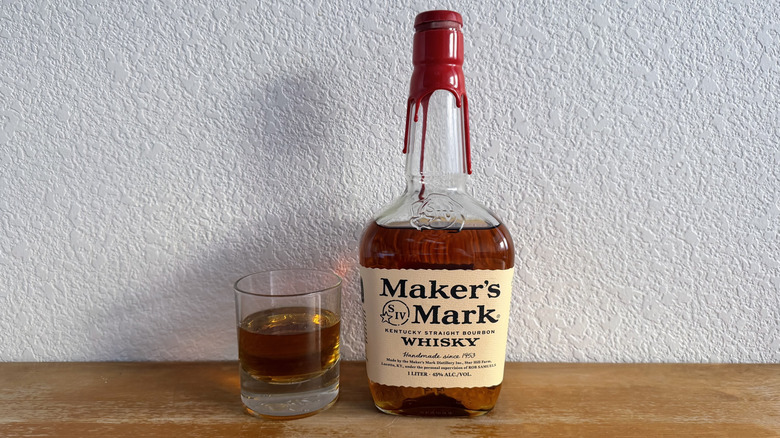
Maker's Mark uses "whisky" on its bottles instead of "whiskey" because its founders wanted to honor bourbon's Scottish roots — the latter generally refers to American and Irish whiskies, whereas the former is the standard spelling used in Scotland and elsewhere internationally. Ironically, I've always found Maker's Mark Kentucky Straight Bourbon Whisky to be one of the best representations of a baseline bourbon, emblematic of the flavor of classic American whiskey with an "e."
Compared to the other three bourbons I tried, I did find my Maker's Mark Kentucky Straight Bourbon Whisky a little astringent, but that's par for the course given its affordability. That one weakness aside, its flavor deftly balanced prominent oakiness with a nice vanilla note that lingered in its finish. Baking spices complicated those elements while remaining subtle enough to let the oak and vanilla do the heavy lifting.
While the accessibility of Maker's Mark Classic in both price and availability is certainly a part of what makes it great, I felt that it earned this list's number-two spot based on taste alone. Simply put, the long-standing Maker's Mark recipe is classic for a reason, and the fact that it's such a shining example of a baseline bourbon is a big part of what makes it taste so good.
1. Maker's Mark 101 Special Proof Kentucky Straight Bourbon Whisky
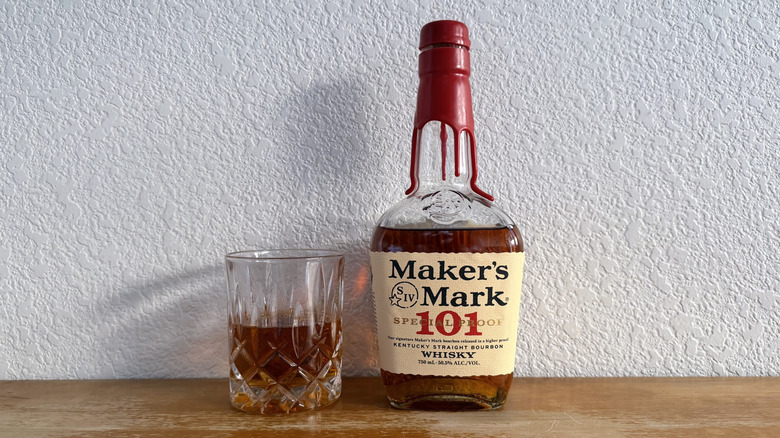
Whereas I felt that No. 46 and Cask Strength complicated Maker's Mark in ways that ever-so-slightly diminished the brand's core flavor experience, 101 Special Proof was the one bottle that, to my taste, successfully executed the idea of a better Maker's Mark. While it might elicit an unpleasant association in L.A. drivers, the 101 in its name has nothing to do with the often traffic-heavy freeway, but denotes its 50.5% ABV.
Even if 101 isn't aged to the same extent as Cask Strength, it turned out to be surprisingly mellow for its higher-than-average ABV. While amply oaky, I found a spiced flavor particularly accentuated in 101 — but whereas I thought No. 46 was cinnamon-forward specifically, 101's flavor evoked the more general and broad flavor of a baking spice blend. Further setting it apart, I got a bit of a piney, resinous note in its finish. That blend of pine and baking spices that lingered on my palate was unique and compelling, introducing a new facet to what started out much closer to classic Maker's Mark.
To my taste, at least, 101 Special Proof is the best Maker's Mark has to offer, amplifying the formula that serves as the brand's backbone, with just enough novelty to justify its existence alongside the classic recipe.
Methodology
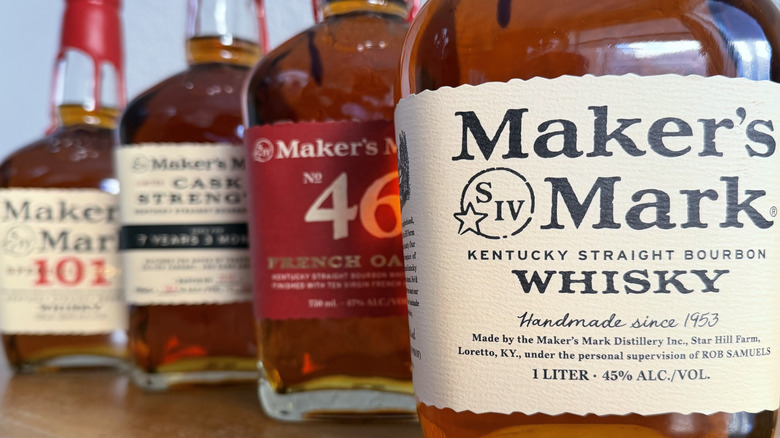
I received all four Maker's Mark bottles from the Maker's Mark brand. With that said, the brand sent them to me with the understanding that they would be subject to reviews based on my honest thoughts.
I'm a regular whisky drinker and tend to enjoy whisky straight, so the bulk of my Maker's Mark tasting consisted of trying each bourbon as-is. I proceeded in order of intensity, meaning I went from classic to No. 46 to 101 before finishing with Cask Strength. I noted down my thoughts before moving on to the next bourbon, while ensuring I didn't drink so much that I would lose my ability to keep rationally analyzing them. I then added either one large ice cube or two small ice cubes to every glass and had another small sip or two in the same order as before. That said, that round didn't fundamentally change any of my earlier observations. My analyses are based entirely on this experience, and not on any past thoughts I may have had about Maker's Mark or its flagship offerings.