

Why You Should Add Olive Oil To Homemade Pizza Dough
We may receive a commission on purchases made from links.
For the typical home cook, adding olive oil to pizza dough might be revolutionary. In fact, this one ingredient may be why restaurant pizza always tastes better than your homemade version. Adding olive oil to your pie's dough differs from some online recipes, which traditionally follow standard dough procedure for an Italian-style Neapolitan pizza: flour, water, salt, and yeast. But introducing olive oil to the mix adds a surprising twist to its taste, quality, and longevity (and may be a game changer for your next pie!).
For the pizza nerds out there, here's the science. When flour and water are mixed together, the proteins in the flour form gluten bonds that strengthen with water absorption. Being a lipid and naturally hydrophobic (i.e. water-repelling), olive oil and water tend to separate. Adding olive oil traps moisture in the dough, which can result in numerous benefits, such as easier handling, softer (and more golden) crust, and a longer shelf life.
There are a few rules, however. The first is you need to allow the gluten networks to fully form — so, allow the dough to rise — before adding your olive oil to the dough. Doing so prematurely could actually inhibit your dough structure from forming and leave you with a flat, crunchy crust. Secondly, the general rule is to add 1% to 3% olive oil by flour weight. So, for a 500-gram flour recipe, 3% oil would result in 15 grams (1 tablespoon).
The best types of olive oil for pizza dough
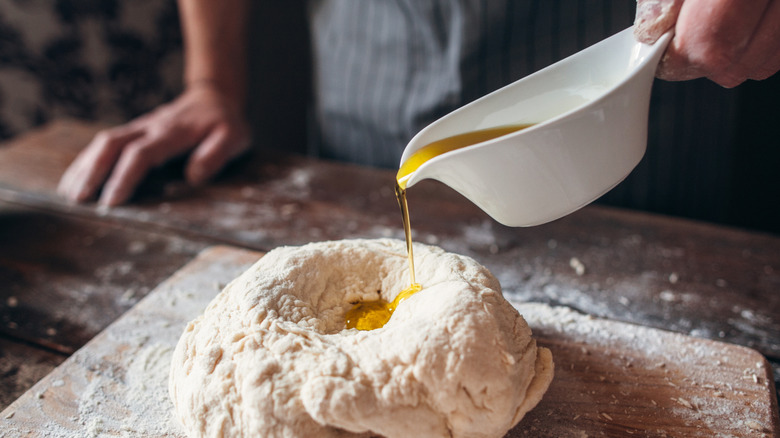
Using your favorite extra virgin olive oil (EVOO) may not be the answer to better pizza dough. Adding any olive oil can get the desired effects: easier handling, softer, tender crust, and longer shelf life. However, the taste will differ depending on the type of olive oil you use. The EVOO you love for salad dressings typically has a robust, peppery flavor that disappears once heated at a low heat point. For that reason, you might want to work in a refined or light olive oil, which have higher heat points and more neutral tastes. For example, the Bertolli Extra Light Olive Oil from Amazon will work wonders in a pizza dough.
Now, the amount of oil you add will also depend on the type of pizza you're making. New York styles have up to 5% oil whereas your New York Sicilian style pizza may call for 2% to 3%. And of course, the classic Neapolitan pizza doesn't call for olive oil at all. If you're part of the sourdough starter crowd, try out our sourdough pizza dough recipe — which uses around 3% olive oil. Of course, sometimes life is too crazy to think about feeding your starter. If you're low on time, look no further than our 20-minute no-knead pizza dough recipe — using about 5% oil.