

What Happened To Edible Architecture After Shark Tank?
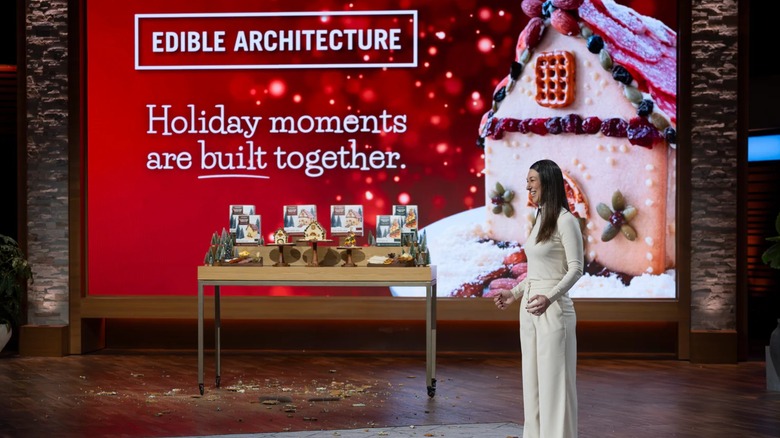
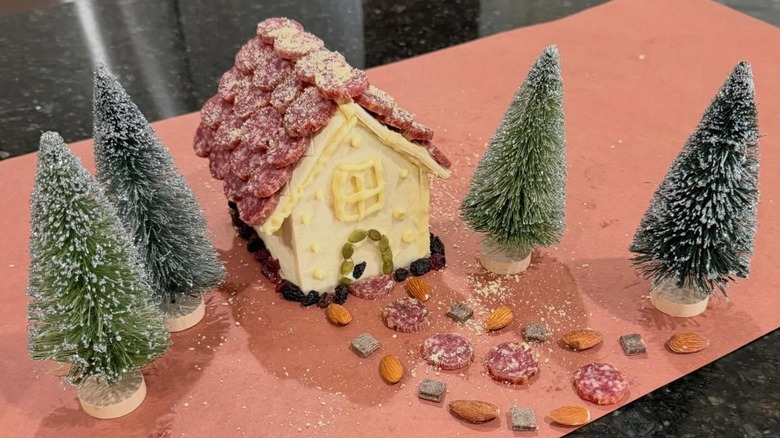
Season 17, episode 7 of "Shark Tank" featured Avital Ungar and her "grown-up" version of the classic gingerbread house. A fitting pitch for the show's holiday season special, Ungar's company, Edible Architecture, makes festive DIY charcuterie houses. The cracker structure topped with salami shingles, parmesan snow, and charcuterie accompaniments for decoration is meant to be a savory alternative to gingerbread houses that invariably grow stale and are thrown away instead of being eaten.
Having run an experiential food business in the Bay Area since 2011, the entrepreneur noticed how the charcuterie chalet had become the viral replacement for gingerbread houses. After trying it out at a company office party and seeing the positive response it got from her colleagues, Ungar decided to pitch the idea to her company's corporate clients and eventually incorporated the spin-off enterprise that became Edible Architecture.
Even before its appearance on "Shark Tank," the company had gained some traction. Launched in November, 2024, charcuterie chalet kits had found their way into retail stores and were selling online through the company website. The creative charcuterie set comes with high-quality, shelf-stable ingredients and contains everything needed to build a savory centerpiece. During her pitch, Ungar revealed that in 2024, the company's first year in business, Edible Architecture earned $123,000, and it was on track to earn $2 million in 2025. Surprisingly, all the sharks backed out except for Lori Greiner, who offered Ungar a "sharky" deal well below what the entrepreneur had asked for.
What happened to Edible Architecture's on Shark Tank?

The Edible Architecture pitch on "Shark Tank" opened with a dramatic demolition of gingerbread houses by Avital Ungar's team as she elaborated on the downsides of the traditional holiday centerpiece, which tend to dry out and not taste very good. Plus, they're not too much fun for adults. The Edible Architecture alternatives were then brought out in three sizes — the classic Charcuterie Chalet, a smaller Mini Charcuterie Chalet, and the Charcuterie Tree (akin to a Christmas Tree).
Kevin O'Leary, the most outspoken detractor, was against the idea of a savory gingerbread house counterpart. Barbara Corcoran didn't like how the edible chalets looked once a few bites had been taken from them and bowed out as well. Daymond John and Daniel Lubetzky, while appreciative of the idea, felt they didn't align with the product. Lori Greiner, however, was enthusiastic about Edible Architecture, having invested in another charcuterie business, Boarderie, in a previous "Shark Tank" episode.
Ungar's pitch asked for $150,000 for a 10% stake in her company. The money, she revealed, was needed to buy inventory to fulfill purchase orders. Greiner was quick to point out that she didn't want her money to simply go into funding inventory, and countered with an offer to pay the same sum for 25% of the company. While significantly lower than the original valuation pitched by Ungar, the offer came with Greiner's promise of helping the creative charcuterie company succeed. Both shark and entrepreneur went back and forth until the duo agreed, and Lori Greiner got 18% of Edible Architecture for $150,000.
Edible Architecture after Shark Tank
In a Reddit AMA, Ungar detailed everything that she could that wasn't covered in a non-disclosure agreement. When asked what happens after one gets a deal, she said, "After we get a deal with Lori during filming, then they have to do due diligence on our business. Because we're not in the Tank long enough to discuss all the aspects and nuances of our business, Lori's team has a lot of questions about our business afterwards that we need to answer during due diligence."
Ungar later revealed that, at the time of filming the "Shark Tank" episode, the company had over $1 million in purchase orders. Soon after the deal went through, the company would have worked on building up inventory to fulfill those orders and also prepare for the upcoming holiday season. In November 2025, about a month before the episode aired but after it had been recorded, Edible Architecture released the charcuterie tree as well as the chalet plus tree kits, which Ungar shared on an Instagram post.
Is Edible Architecture still in business and how much is it worth?

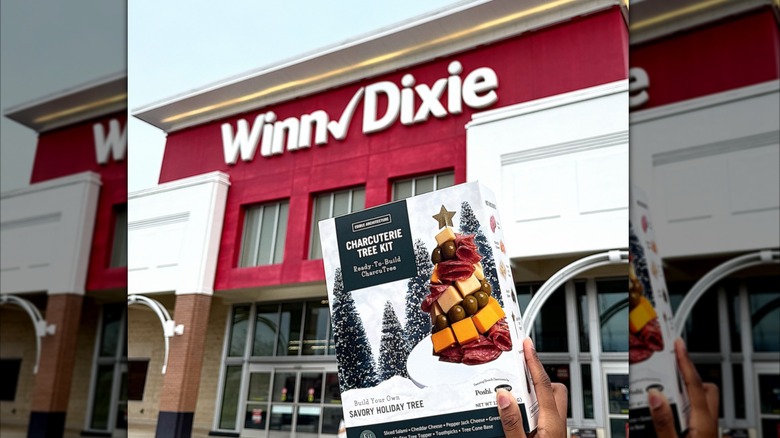
Edible Architecture is still in business and is available in dozens of retail stores and chains across the country, including Costco, H-E-B, Albertsons, and World Market. Edible Architecture kits can also be purchased through the company's website. The regular charcuterie chalet is priced at $29.99, while the mini chalet and charcuterie tree are $19.99 each. A 3-pack of Charcuterie Chalet crackers is also available for those who may want to design their own edible houses.
During her time on "Shark Tank," Avital Ungar revealed that while selling the kits through wholesale chains earned a 25% margin, the direct-to-consumer channel earned a substantially more profitable 65% margin. The company seems to be pushing direct sales and has a 50% New Year discount on purchases through the Edible Architecture website. The kits are also available through Ungar's experiential food website, Avital Experiences. The latter offers a Virtual Edible Architecture package for $90, which includes a kit and a 1-hour remote guided session with one of Avital's team members.
With her ask of $150,000 for 10% of the company on "Shark Tank," Ungar essentially pegged Edible Architecture at a $1.5 million valuation. Though the subsequent deal with Lori Greiner, which gave the shark 18% of the company for $150,000, seems like it would have lowered the value, it's also worth remembering that, at the time of filming the episode, Edible Architecture had already made $1.17 million in sales and was on track to cross $2 million in 2025 (something Daniel Lubetzky pointed out when Ungar was contemplating Lori's lower valuation deal).
What's next for Edible Architecture?
Since Edible Architecture started as a seasonal product for the holidays, one of its next moves is to start churning out kits suitable for year-round celebrations. This means that the Christmas tree-themed charcuterie could get a spring counterpart. There is also going to be the inevitable shift to increase direct sales to customers in order to earn higher margins. However, for now, the company is still in early stages and predominantly selling through retailers.
Per Avital Ungar's Reddit AMA after her appearance on "Shark Tank," Edible Architecture only diverted a small number of kits for direct sales through the company website for the 2025 holiday season, and it still needs to analyze customer behavior and key business metrics. She has her eye on the gingerbread house market, which, per Ungar, is worth millions.
Edible Architecture products essentially straddle both charcuterie board and gingerbread house markets, and while they may not look as stunning as some of Instagram's best charcuterie boards, they certainly bring a fun DIY angle that's more accessible and may appeal to a wider range of people. Plus, the product is already popular, having gone viral on TikTok even before appearing on "Shark Tank." Thus, new designs from the company can expect enthusiastic takers, and year-round charcuterie chalet kits will likely find customers not just through direct sales and retail chains but also at corporate events through Ungar's experiential food company.