

5 Ways McDonald's Fries Have Changed Since 1955
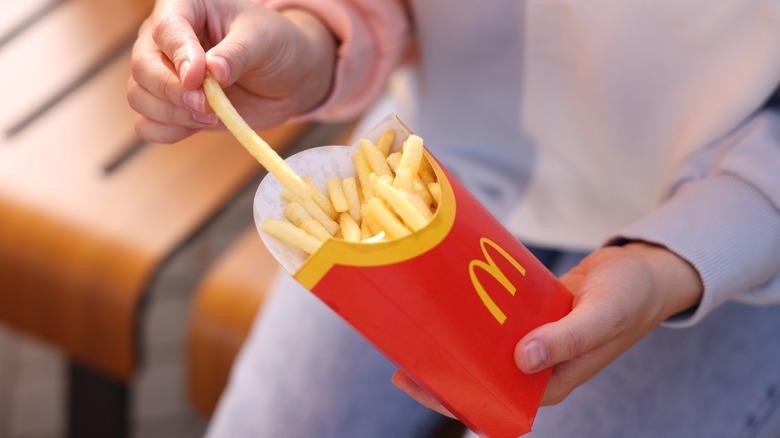
McDonald's iconic french fries were one of nine items that appeared on the chain's original 1955 menu. Along with the now-famous spuds, McDonald's offered hamburgers and cheeseburgers, plus root beer, orangeade, Coca-Cola, milk, coffee, and milkshakes in chocolate, strawberry, and vanilla flavors. The fast-food behemoth has undergone tons of changes since its inception, with plenty more updates in store for 2026, including more locations and technology upgrades in the kitchen. The chain's french fries, which earned the top spot in our ranking of fast-food fries from worst to best, have also evolved quite a bit since the '50s.
We tracked the evolution of McDonald's fries and uncovered lots of interesting developments. The chain has experimented with different types of fats, cooking oils, and flavorings over the years to achieve the perfect taste and texture. Portion sizes have also changed extensively along with packaging, and as to be expected, these fries cost a lot more in 2026 than they did in years past. While some might say that these changes amounted to a less impressive spud, there's no denying that McDonald's fries are still tops among fast-food fans.
The chain swapped beef tallow for vegetable oil
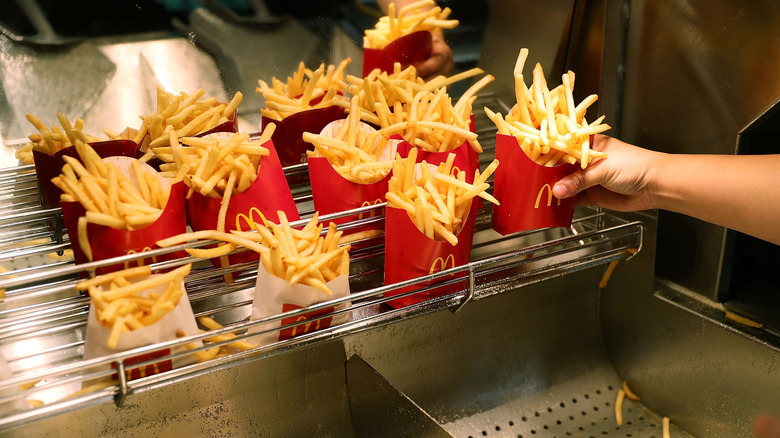
Until 1990, McDonald's cooked its fries in a combination of vegetable oil and beef tallow, with the latter ingredient making up most of the mix. A high-smoke point cooking fat sourced from cows, McDonald's initially opted for a beef tallow-heavy mixture because of the higher cost of vegetable oil. Over time, consumers became more concerned about high-fat fast-food fare and the possible impact it could have on their health. This shifting sentiment eventually influenced McDonald's to switch to an all vegetable oil cooking process for its french fries, as did fellow fast-food chains like Wendy's, Burger King, and Hardee's.
Beef tallow is often touted as a more nutritious alternative to seed oils thanks to the presence of vitamins and nutrients in the fat. However, its high saturated fat content links beef tallow to an increased risk of heart disease and other major health issues. The real power of beef tallow is the meaty, umami-forward flavor it infuses into food, and when used for McDonald's fries, it was said to create a crispy exterior and a pillowy soft interior that customers adored. While restaurants like Smashburger, Portillo's, and Buffalo Wild Wings still offer beef tallow fries, it's unlikely that the Golden Arches will be following suit any time soon.
Natural beef flavoring was introduced to attempt to mimic McDonald's fries of yore
The transition from beef tallow to vegetable oil wasn't the end of the McDonald's french fry evolution. In an effort to replicate the original taste and texture of its fries, the chain began adding natural beef flavor containing hydrolyzed wheat and hydrolyzed milk (hydrolysis is a process that breaks down proteins into smaller individual components). Restaurants and food manufacturers aren't usually required to disclose the specific ingredients in these natural flavorings, and many resist doing so to avoid giving an unfair advantage to competitors who may recreate the flavor blend for their own products. For instance, McDonald's characterizes its hydrolyzed elements as "starting ingredients," but declines to elaborate on what else is included in the flavoring.
Not only did McDonald's natural beef flavoring fail to capture the meaty goodness of beef tallow fries, it also landed the chain in legal trouble. A class action lawsuit was initiated due to claims that the restaurant failed to properly disclose the non-vegetarian nature of its french fries. McDonald's settled the suit in 2002 to the tune of $10 million and issued an apology to those affected.
McDonald's banished trans fats
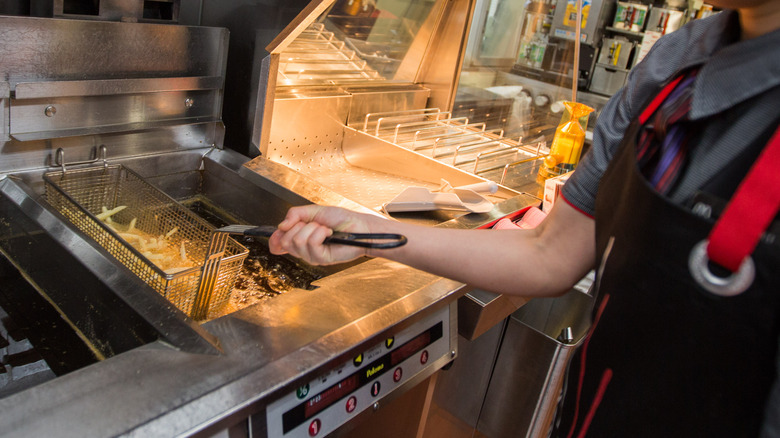
In 2007, McDonald's made another big change in how it cooks its fries. That year, the restaurant switched to a canola and soy oil blend that was wholly free of trans fats. While the decision was apparently spurred by a New York City ordinance that banned the use of trans fats in the city's dining establishments, McDonald's elected to roll out the new cooking oil blend to all of its locations. As of today, the restaurant's fries are still completely free of artificial trans fats. McDonald's wasn't alone in purging trans fats from its menu, and trans fats were subject to a nationwide ban in 2020 (though trace amounts remain in some processed items). This begs the question: What are trans fats? And why did they become so derided?
Trans fats, which were primarily derived from partially hydrogenated oils in the U.S., offer no nutritional benefits and carry major risks related to heart disease, high cholesterol, and certain types of cancer. Consider that "hydrogenated" is one of many words that are a red flag when appearing on food labels. As for which items still contain trans fats, you won't find this phrase on packaging. Instead, you'll see the ingredient described as partially hydrogenated oils, which often pop up in peanut butter, packaged baked goods, and shortening.
The chain added more size options
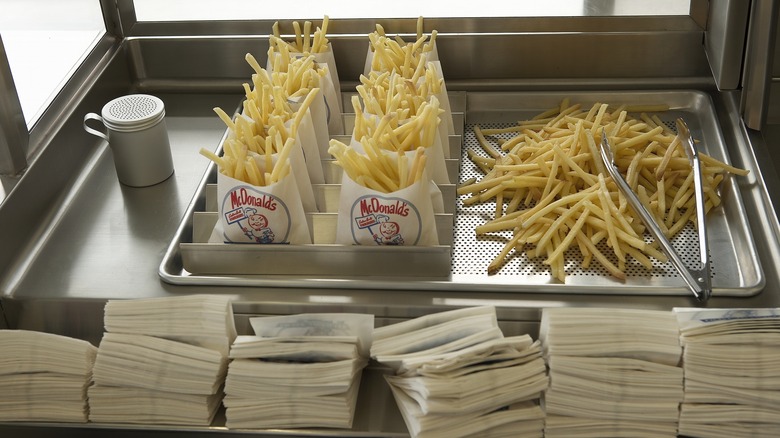
McDonald's offers four fry sizes these days: kids, small, medium, and large. According to the restaurant, a small weighs about 80 grams, a medium clocks in at approximately 114 grams, and a large is roughly 150 grams (the weight of the kids' size isn't listed). McDonald's also offers a larger basket of fries, though it's not clear if this item is available at all locations. Now, let's compare the fast-food joint's current spud offerings to what was available on McDonald's 1955 menu.
The chain only offered one size of fries back then, which were about 2.4 ounces, or roughly 68 grams. That means the chain's current small size is bigger than the only size option available at the Golden Arches when it first opened. Of course, one can't discuss McDonald's portion sizes without touching upon its Super Size option, which debuted at the restaurant in 1987. A Super Size fry from McDonald's was about seven ounces, or a whopping 198 grams. The chain phased out these substantial portions in 2004, and McDonald's claimed Super Size portions were axed in the interest of menu simplicity. However, some posited that the real reason for the change may have been "Super Size Me," a 2004 documentary that maligned the restaurant but was later found to have misled the public.
McDonald's fries are a lot more expensive these days
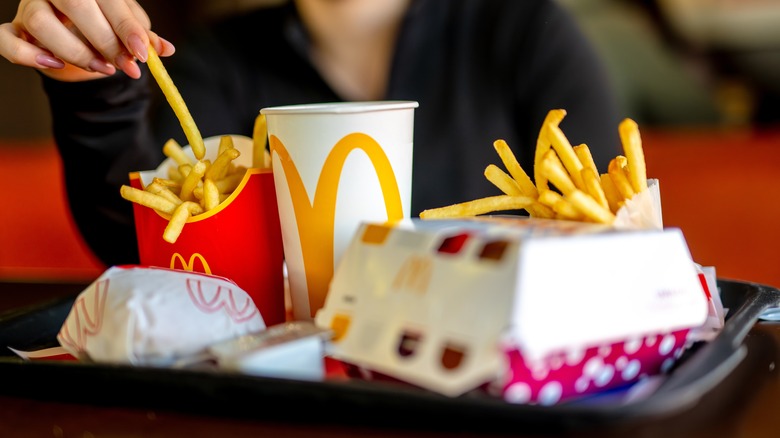
The price of everything naturally goes up as time marches on, so it's not fair to penalize McDonald's for raising its prices over the decades. However, there's a larger conversation surrounding the chain and its soaring prices, which has caused consternation in lots of customers. The restaurant's CEO Chris Kempczinski even agreed that the exorbitant prices at the chain pushed cash-strapped consumers away from McDonald's, according to CNN.
So how far has the Golden Arches really gone in terms of french fry prices? On the 1955 menu, a serving of McDonald's fries would set you back about $0.10, which equals about $1.21 when accounting for inflation. As for the restaurant's current prices, a small fry costs $2.99, a medium $3.59, and a large will run you $4.39 (at least, where we live). In an effort to quell some dissatisfaction with high process, McDonald's recently launched an Extra Value menu that hit customers like a wet sack of potatoes. While the new menu was touted as a way to enjoy the chain's fare without breaking the bank, customers balked at the high costs. On Reddit, a poster shared a screenshot of the new menu, which featured a Double Quarter Pounder with Cheese meal for the shock-inducing price of $12.29. One commenter summed up the collective aggravation neatly, stating, "These 'deals' are laughable."