

Trader Joe's Frozen Asian Foods, Ranked Worst To Best
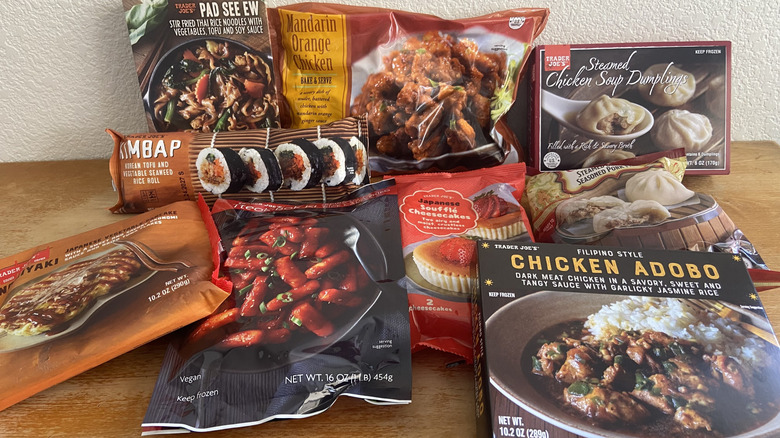
Trader Joe's is committed to doing things its own way. Something customers don't like about shopping at Trader Joe's, for example, is the lack of a deli, salad bar, or some sort of ready-to-eat food counter. Meanwhile, what sets it apart from competing grocery stores in a positive sense is its wide selection of frozen foods. The freezer aisles at Trader Joe's are vast, and products range from everyday staples to items simply not available at most other supermarkets. The diversity of frozen goods offered hinges on its representation of international cuisines, featuring everything from Mexican tamales to stateside rarities like aish baladi, described as Egyptian sourdough pocket bread.
I visited my local Trader Joe's and picked up a selection of frozen Asian foods, comprised of some of the store's signature Chinese, Japanese, Korean, Thai, and Filipino products. While other cuisines from Asia, like Indian, are also represented in the freezer aisle, I stuck to dishes that make up the common American perception of pan-Asian food. Furthermore, I chose products within those categories that I found most compelling — I went with steamed chicken soup dumplings over vegetable dumplings, for example. Based on my selection, the following is a ranking of Trader Joe's frozen Asian foods from worst to best.
9. Chicken Adobo
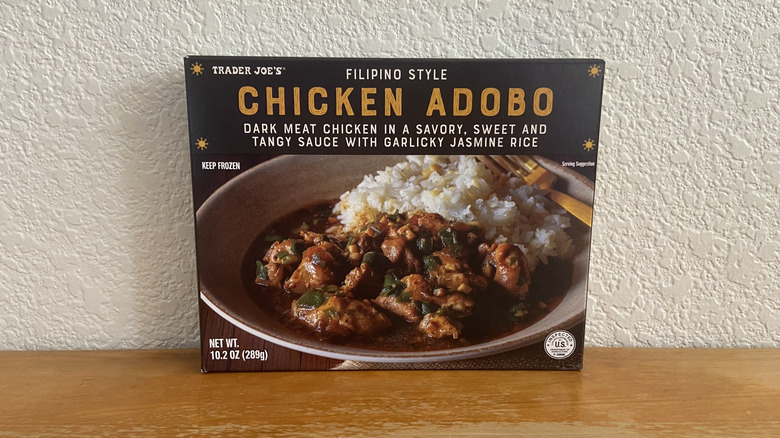
I included Trader Joe's chicken adobo in my selection of frozen Asian foods because it was the sole Filipino product in my local store's freezer aisle. One package contains a single meal — more of a snack, really, at 270 calories — with seasoned jasmine rice on one side of the microwavable tray and a small portion of chicken adobo on the other.
The only quality of the chicken adobo I found somewhat worthy of praise was that it felt like a good-faith attempt at replicating a Filipino flavor. Rather than rely on a mere soy-dominant base, perhaps safer for American palates, the adobo sauce was pretty vinegary. It was not, however, very tasty, lacking an identifiable flavor beyond a sort of vinegary umami. Adding to my negative impression was the fact that the adobo sauce was watery.
Furthermore, the chicken pieces were either a little cardboard-y or, in a couple of cases, gristly to the extent that I had to throw them out. I tried to chew through the gristly pieces, but they were genuinely not fit for human consumption. This is effectively a product for no one, failing to deliver on a satisfying chicken adobo experience for fans of the dish, and lacking any sort of appeal for those who may be trying Filipino adobo for the first time.
8. Pad See Ew
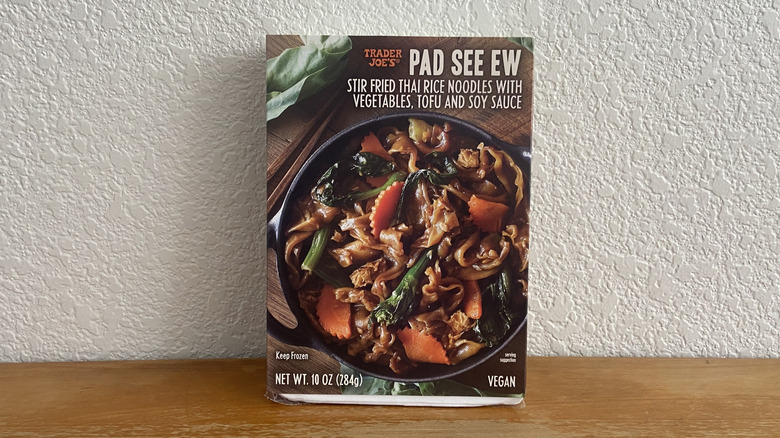
Trader Joe's has stocked some additional frozen Thai products in the past, but at the time of my visit, pad see ew was the cuisine's sole representative in the freezer aisle. Like the chicken adobo, the Trader Joe's pad see ew is packaged as a single, microwavable meal. It is, however, more substantial than the chicken adobo, totaling 600 calories.
While I didn't find my pad see ew off-putting, I thought it fell into the safest, most boring territory possible for a frozen meal. Texturally, the crunchy veggies contrasted with excessively soft noodles. That was the most exciting thing my pad see ew had going for it, with a general sort of soy sauce character providing the dish with its only flavor. The nutrition from the vegetable content and the simplicity of the taste may appeal to some, but the Trader Joe's pad see ew certainly isn't anything special.
7. Kimbap
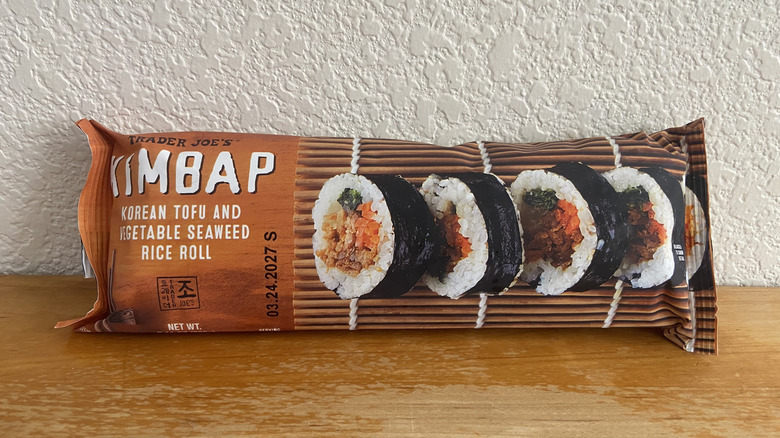
Kimbap is something of a recent Trader Joe's classic, thanks to its viral popularity in 2023, leading to stores selling out of it nationwide. While it's simple enough to prepare an easy kimbap recipe at home, the list of ingredients required is somewhat lengthy, so buying it readymade from Trader Joe's is a more convenient option. The store's version includes fried tofu, braised burdock root, carrot, pickled radish, and spinach.
The biggest hurdle preventing me from loving the Trader Joe's kimbap is the fact that it comes frozen, with instructions to heat it in the microwave. While some fans of the product just let it thaw and eat it at room temperature, I wanted to follow the instructions on the package. Ultimately, eating kimbap warm is a little strange. The experience made me want room temperature kimbap from a Korean market more than it satisfied on its own merit.
With that said, the classic combination of rice, seaweed, soft-cooked veggies, and crispy pickled veggies was still one I appreciated, even if it wasn't presented in its ideal form. As a healthy-ish snack, the Trader Joe's kimbap offers some value, but it falls plenty short of even just a baseline version of the real thing.
6. Cha Siu Bao Steamed Pork Buns

One package of cha siu bao steamed pork buns from Trader Joe's contains four bao at about a $4 price point. So, just as it's served in a small plate format during a dim sum meal, the Trader Joe's version of this dish is more of an appetizer or side than a main attraction. Each bao simply consists of chopped barbecue pork in oyster sauce, housed in soft, steamed dough.
The Trader Joe's website recommends pairing the cha siu bao with a dipping sauce, but I had mine plain. Whereas some pork bao I've had in the past were a little bland, I was surprised to find the Trader Joe's version sufficiently flavorful on its own. Most notable to me was the texture of the outer dough, which remained satisfyingly gummy without veering into excessively chewy territory. The meat inside was both savory and sweet. It didn't blow me away, but the quality of the outer bun did a lot to make that meat as satisfying as possible. While I wouldn't consider the Trader Joe's cha siu bao a showstopper, it was altogether pleasant.
5. Okonomiyaki Japanese Vegetable Pancake
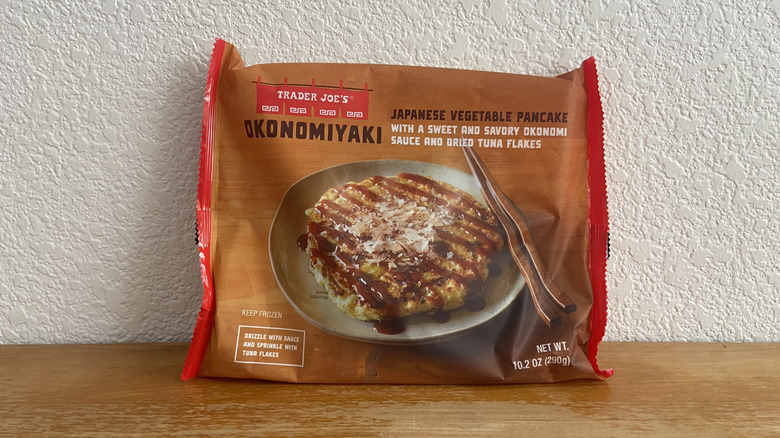
Okonomiyaki is a dish I prepare with some regularity at home. While I wouldn't say that makes me a connoisseur, per se — I have it home-cooked far more often than prepared by a professional chef who truly knows what they're doing — I'm well familiar with an at-home, easy okonomiyaki recipe, at least. In each Trader Joe's package, you'll find two modestly sized cabbage pancakes, complete with okonomi sauce and shaved bonito. All in all, there were some qualities I appreciated about the Trader Joe's okonomiyaki and some I thought fell short of my home-cooked version.
First and foremost, Trader Joe's manages to balance a crisp bottom with a soft, battered cabbage body, resulting in a nice textural contrast. The okonomi sauce was perfectly fine and notably ginger-forward, but it fell short of regular old Otafuku okonomi sauce. The shaved bonito, meanwhile, was not substantial enough to make a difference one way or another. Probably as a result of its precooked, frozen state, the cabbage in the okonomiyaki was quite a bit mushier than if the dish were made fresh. At the same time, each cabbage pancake had some solidity to it, adding a bit of a processed character. I certainly wouldn't consider this a great version of okonomiyaki, but it's a decent, vegetable-forward execution of a dish not often found in American food spaces, and that's worth something.
4. Japanese Soufflé Cheesecakes
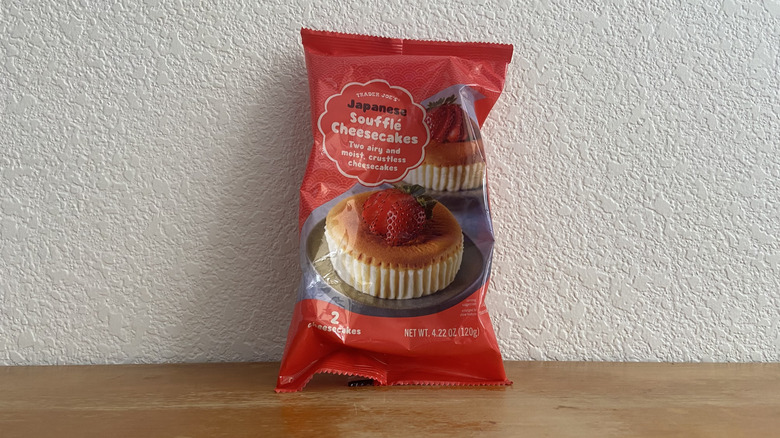
There are a number of notable differences between New York cheesecake and its Japanese (and Spanish) cousins. Japanese cheesecake doesn't have a crust, for example, and it's a little more bread-like in consistency than the creamier New York style. Trader Joe's sells Japanese soufflé cheesecakes in packages of two at around a $3.50 price point.
Texturally, the Trader Joe's Japanese cheesecake does a good job at splitting the difference between softer cream cheese and straight-up bread. I found the flavor lightly sweet, with the sugar content complementing a subtle cream cheese flavor rather than dominating the experience. Japanese cheesecake typically isn't boldly flavored, so the subtlety of the Trader Joe's version was a plus, and didn't come at the sacrifice of my enjoyment. With that said, as is the case for plenty of frozen items at Trader Joe's, I thought this store-bought version of Japanese cheesecake fell short of the real deal from a bakery, or even a Japanese market. I'd say that it's a good dessert all the same, even if it's a somewhat lower-level execution.
3. Steamed Chicken Soup Dumplings
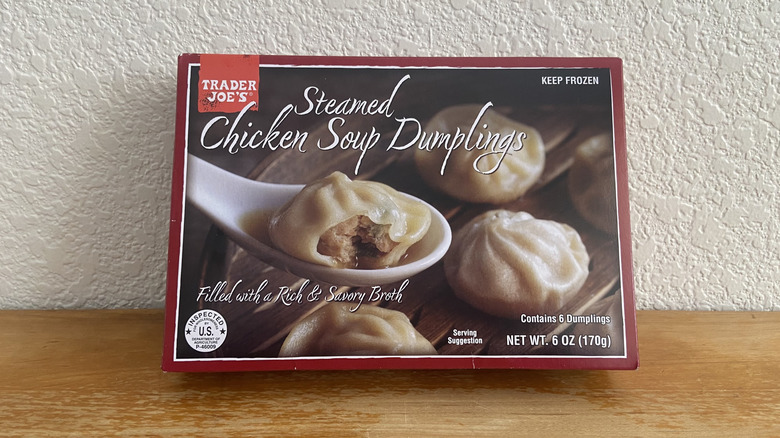
My expectations for the Trader Joe's steamed chicken soup dumplings before trying them were relatively low. I associate soup dumplings with dining out at restaurants like Din Tai Fung, which is one of 10 Asian restaurant chains you'll see more of in 2026. Replicating that dining experience in a frozen product seemed to me like a tall order. Maybe my low expectations were to the product's credit, because I thought these soup dumplings were surprisingly delicious.
Just as I found the dough to be a standout feature of the Trader Joe's cha siu bao, I thought the dumpling wrappers on my soup dumplings were nice and gummy, lacking excessive toughness. The chicken soup filling hit the same sort of hearty, comfort food notes as a classic American chicken soup. In dumpling form, that chicken soup flavor was quite a bit more satisfying than it would have been in a boring old bowl. The product's sole negative quality was the fact that one package just wasn't enough, containing six chicken soup dumplings in total. I was left wanting more.
2. Tteok Bok Ki
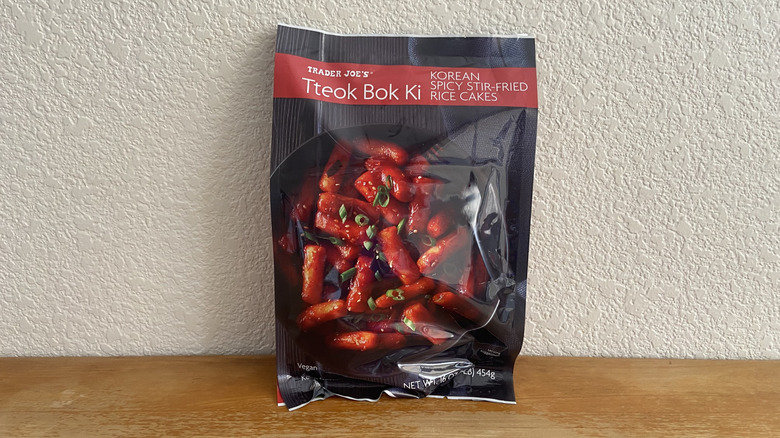
In the past, I've had tteokbokki — Trader Joe's labels its product tteok bok ki, but I've more often found the name transliterated with no spaces — from restaurants, prepared from grocery store ingredients at home, and made from prepackaged grocery store kits. As a spicy food lover, it's something I tend to get whenever it's available to me. I thought there was no way Trader Joe's, of all places, was going to do tteokbokki well.
While I would describe the Trader Joe's tteokbokki as a basic version of the rice cake dish, it certainly didn't disappoint. What surprised me most was the fact that it was spicy. Most tteokbokki is spicier, for what it's worth, but this is still probably among the spiciest products available at Trader Joe's. That's counterbalanced by a sweetness that dominates the flavor up-front, and some soy sauce umami. Texturally, the rice cakes were nice and gummy. Trader Joe's only includes cylindrical rice cakes and sauce, leaving plenty of room to bulk up the dish with, say, a hard-boiled egg or green onions. Still, as is, this frozen tteokbokki is a nice, spicy snack that does a serviceable job of approximating the real thing.
1. Mandarin Orange Chicken
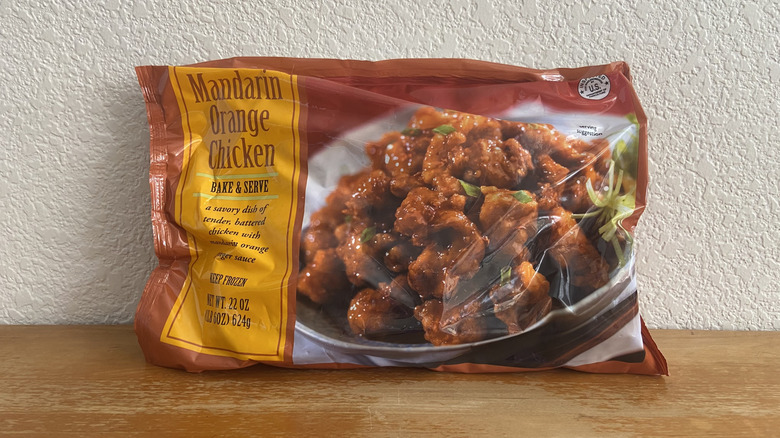
No assessment of the frozen Asian food selection at Trader Joe's would be complete without mandarin orange chicken. Sure, it's the one Asian dish on this list that is squarely Asian-American, but that's no reason it can't still fall under the broad umbrella of Asian food. Furthermore, backing up my perception that orange chicken is among the most iconic Trader Joe's products was the amount of freezer space my local store dedicated to the product. As far as I could tell, it took up more real estate than any other single frozen entree.
Simply put, the Trader Joe's orange chicken is popular for a reason. To start, each piece of chicken approaches textural perfection, balancing tender dark meat with a firm, crispy exterior. The sauce, meanwhile, nicely paired a sweet orange glaze with a pronounced ginger tang. Altogether, the experience was big and bold, revolving around a cornucopia of flavors and textures. Whereas every other product on this list wasn't quite up to par with a fresh version of the same dish, I would rather have orange chicken from Trader Joe's than from most restaurants. For that reason, I think it deserves the number-one spot in this ranking of frozen Asian food from the popular chain.
Methodology
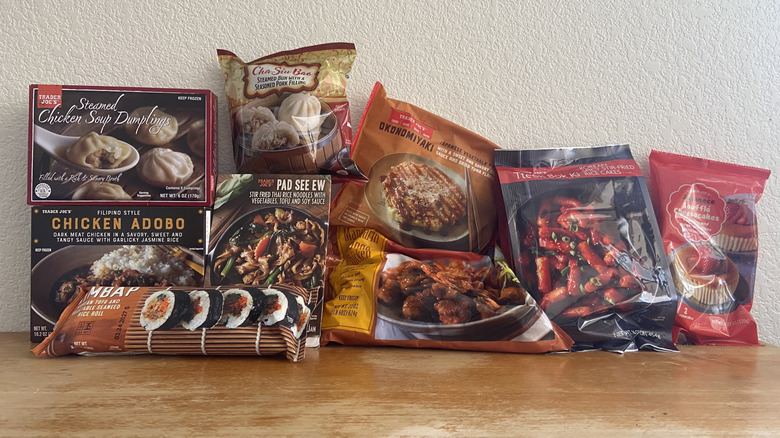
Ranking every single frozen Asian item from Trader Joe's would have been infeasible, so I started putting together an outline for this ranking by scrolling through every frozen item on the Trader Joe's website and narrowing down what I thought would make for the best selection of Asian foods. One of my priorities was highlighting cuisines from different countries, resulting in one Thai item, one Filipino item, two Korean items, two Japanese items, two Chinese items, and one Chinese-American item. I was able to find everything on my initial list, save for a second Thai item, which I subbed out in-store for the chicken adobo. I also prioritized the dishes that interested me most, simply because I thought I would have the most to say about them, based on both past experience and interest. That meant that, say, cha siu bao steamed pork buns earned a spot in the lineup over ginger shrimp lo mein.
I split my tasting of my chosen nine products between two days, so that I could spend adequate time trying each item. I ate some leftovers of products I hadn't already finished on a third day, but my opinions of the leftovers didn't significantly impact my rankings. Only after I tried every product and ranked them against one another did I start writing. My opinions are based solely on this tasting experience and no prior thoughts on any of the featured items.