

The Coney Island Bar Where Al Capone Earned The Name 'Scarface'
We may receive a commission on purchases made from links.
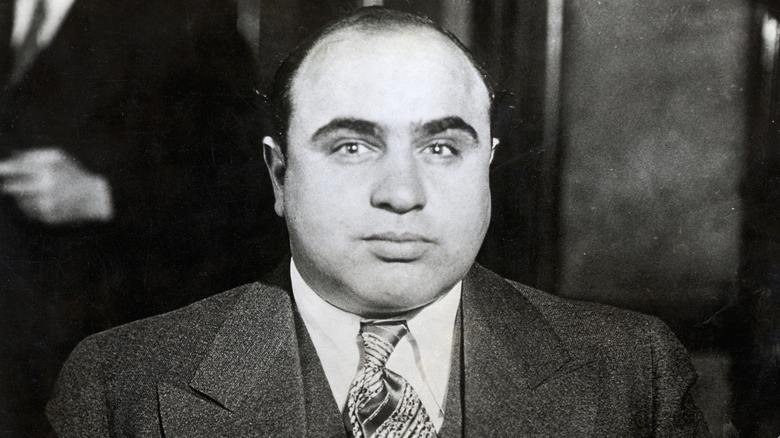
Of all the restaurants Al Capone enjoyed in the US, Brooklyn's Harvard Inn is among the most notorious. And it's not because of the drinks — it's where Capone got his nickname, "Scarface."
Johnny Torrio, an organized crime pioneer, brought Capone deeper into the gangster world after meeting in Park Slope in the early 1900s. After keeping a few on-the-books jobs and assisting Torrio with errands, Capone was introduced to gangster Frankie Yale, who worked at Coney Island's Harvard Inn. Capone was eventually hired as a bouncer and bartender. One night, he made a lewd comment to a woman at the establishment. Her brother, Frank Galluccio, gave him a wallop. Capone was allegedly unfazed, and Galluccio responded by slashing his cheek and neck out of fear. The resulting scars earned him his infamous moniker.
The altercation made a bloody mess on both Capone and the bar floor, says Laurence Bergreen's 1994 biography, "Capone: The Man and the Era" (via the New York Post). Surprisingly, some say Galluccio gave Capone a job later on to bury the hatchet. The future mob boss reportedly despised his injuries. It's the reason most post-incident photos of him were taken from the side of his face without scars, and why folks knew not to use his nickname within earshot.
The Harvard Inn has a dark, fascinating history
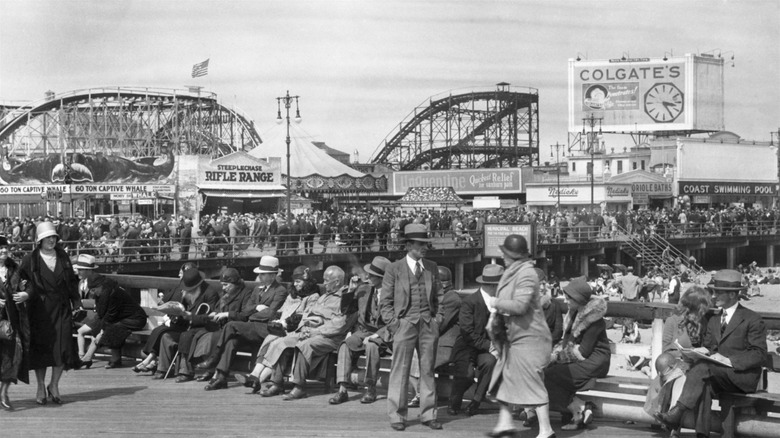
The Harvard Inn, where Al Capone made his mark, was part of what was once referred to as Seaside Walk, an area of Coney Island along the Bowery, steps away from the boardwalk. It was a no-frills dance joint that advertised cabarets, a 19th-century French tradition of intimately set theatrical performances that took off in the U.S. in the 1910s.
While sources say John Cannava was the owner, it's speculated that he leased the Inn (namely the dance hall) to Frankie Yale for his illicit operations (via My Al Capone Museum). That said, Cannava was no angel. He, his brother, and a Harvard Inn server were arrested for pouring highballs and Manhattans to undercover Prohibition agents in 1920. With so many big-time mobsters frequenting the venue — Capone included — it became a hotbed for crime and violence. In fact, gangster Ernesto Melchiorre was murdered in 1921 after allegedly being lured to the Harvard Inn.
Merely five years later, the Harvard Inn burned to the ground in a fire. According to a New York Times article from 1925, the two-story establishment went ablaze in the wee hours of the morning. The fire was so massive that it spread to other buildings, although firefighters eventually contained it and spared neighboring businesses. The estimated financial toll was at least $15,000, nearly $281,000 in today's money.