

The Food Delicacy Elizabeth Taylor Loved That's Now Hard To Find In The US
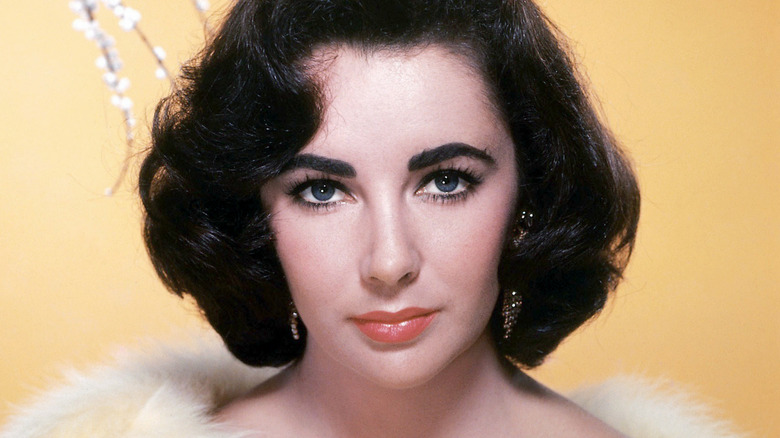
Few actresses embodied old-school Hollywood glamour like Elizabeth Taylor, whose body of work captivated audiences across four decades. A woman of taste in every sense of the word, she amassed a legendary jewelry collection and established herself as a fashion icon throughout the course of her career. Those fine tastes would also be reflected in her food choices. Taylor's favorite foods and drinks included an item often seen as the height of gustatory luxury.
Writing for the Huffington Post in 2012, Vicky Tiel — a fashion designer who worked with Taylor and attended her parties — shared that the actress was especially fond of Iranian beluga caviar, which she called her "grey babies." She often enjoyed what she referred to as "caviar sandwiches": hollowed-out baked potato skins filled with crème fraîche and topped with beluga caviar and chopped onions.
Beluga caviar is one of the world's rarest foods, and is primarily harvested from beluga sturgeon in the Caspian Sea, which borders Iran, Russia, and Kazakhstan, among other countries. The prehistoric fish can take as long as 25 years to reach reproductive maturity, making its caviar a food with a supply cycle that often can't keep up with demand. Thankfully, Taylor's tastes weren't strictly as glamorous as the delicacy — she was also known to enjoy fried chicken and cornbread, and paired her chicken with a glass of Jack Daniels on the rocks.
Why Elizabeth Taylor's favorite caviar is so rare these days
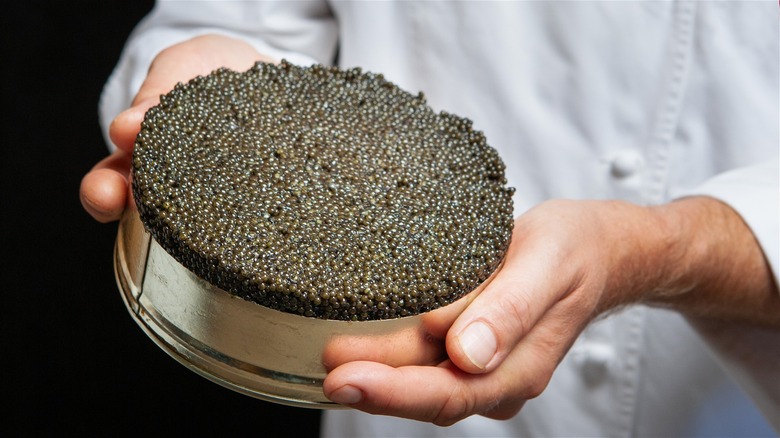
Beluga caviar is already a rare delicacy to begin with, but it's particularly hard to find in the U.S. because the beluga sturgeon has been overfished and illegally traded to the brink of extinction. According to the UN, the wild beluga sturgeon population in the Caspian Sea dwindled by 90% in a span of 20 years, with demand for its caviar driving much of the crisis.
In 2004, the U.S. Fish and Wildlife Service categorized beluga sturgeon as a threatened species. A ban on the importation of its eggs, meat, and other products from the Caspian Sea region followed in 2005 as part of a conservation effort. Not all types of caviar were affected by the restriction; popular options like ossetra caviar are still legal provided they come from farmed sturgeons rather than wild ones.
Considering how much beluga caviar the U.S. has historically consumed, the 2005 ban was absolutely necessary. According to a 1983 story in the New York Times, the U.S. imported so much of this luxury good that it drove down the luxury good's value. In some cases retail prices plummeted from as high as $400 for a 14-ounce tin to $145 (a nearly 64% decrease). The National Wildlife Federation (NWF) reported that, as of 2005, the U.S. was also the world's biggest consumer of beluga caviar, buying around 60% of global exports.
You can now buy the delicacy legally in the US, but it's going to cost you
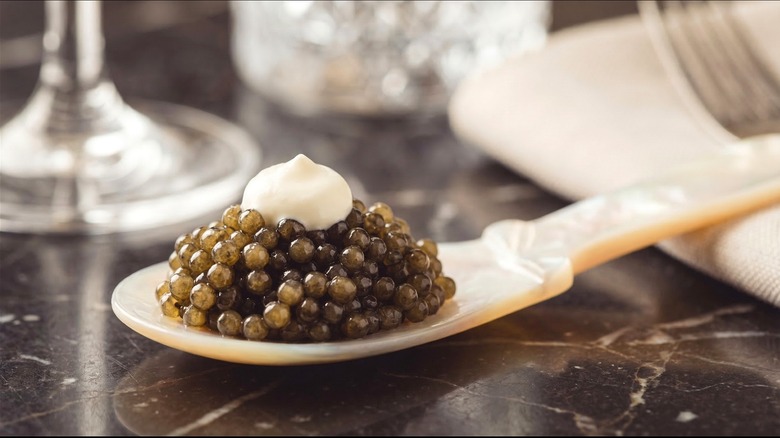
While the ban on importation remains in place, other developments have led to the legal return of beluga caviar to the U.S. market. Domestically farmed options are now commercially available via Marky's Caviar. Prior to the 2005 ban, company owner Mark Zaslavsky established Sturgeon Aquafarms in Florida in an attempt to sustainably grow beluga sturgeon. He was able to produce caviar after nearly two decades.
The immense amount of work it took to farm beluga sturgeon domestically gives the caviar a hefty price tag. Speaking with Forbes in 2019, Zaslavsky explained that his company essentially had to first recreate the conditions of the Caspian Sea in its 120-acre aquafarm. It then took 13 flights to ship the live broodstock from Europe to Florida, and nearly 10 years to grow the fish to maturity. As of writing, a one-ounce tin of Marky's highest-grade beluga caviar goes for $535 on the company's website.
According to the NWF, an ounce of beluga caviar cost roughly $200 at the time of its banning, putting today's domestic caviar at more than twice the price of what Elizabeth Taylor would have paid for her grey babies. Still, the price pales in comparison to the most expensive caviar in the world: the Almas variety, which is harvested from incredibly rare albino beluga sturgeon off the coast of Iran. According to the Guinness Book of World Records, a kilogram of this delicacy cost $34,500 (nearly $1,000 per ounce).