

The Military Innovation That Helped Influence McDonald's McRib
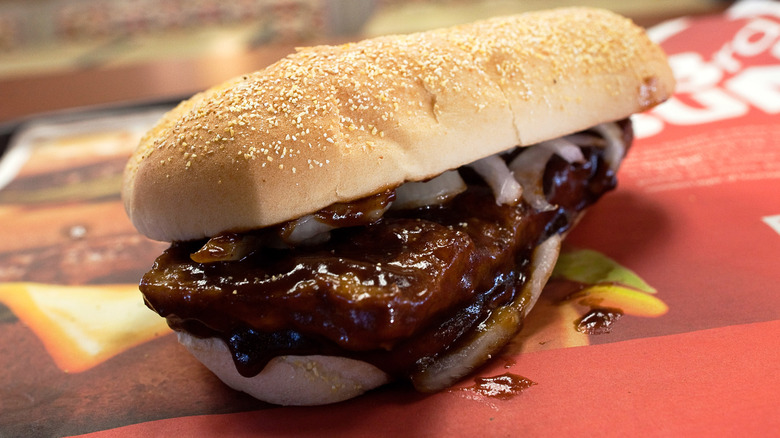
The history of government and military innovation is filled with game-changing ideas and discoveries, but it's also full of unexpectedly convenient side effects that can revolutionize private industries. That's precisely what happened in the case of one of McDonald's most talked-about sandwiches: the McRib. This beloved, sporadically available meal is a result of the military's discovery of restructured meat.
Research into the concept started as far back as the 1960s, when the military was seeking a way to improve the efficiency of its food operations. One of the ways this occurred was by making the most of former trimmings and other perfectly edible pieces that were discarded as scrap meat. These were cut into small pieces, processed, then reassembled with added fat and binders to create a mixture that holds together and can be pressed or shaped as needed.
Although the military designed this technique to create more appealing protein options for its MREs (meals, ready-to-eat — rations for servicemembers), it was equally applicable to the fast-food industry. McDonald's first used the process to create the now-iconic chicken McNugget in the late 1970s. This process helped inspire chef and recipe developer René Arend to pioneer the McRib in 1981, pushing for the restructured patty to have the rib-like shape it's come to be known for.
Unappealing process, popular results
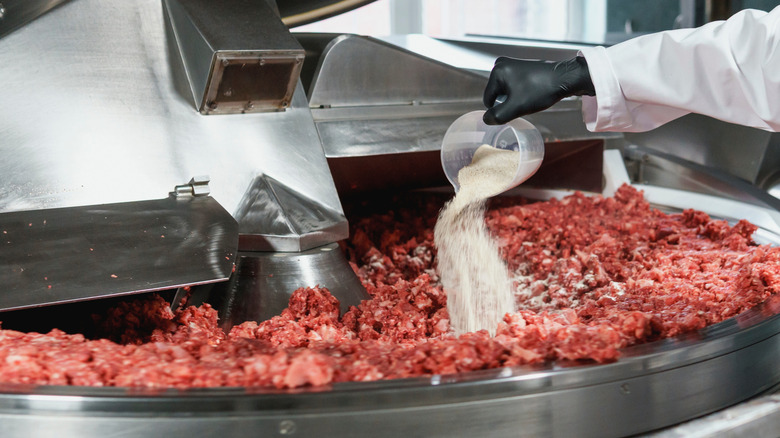
It's worth noting restructured meat is distinct from general reconstituted meat. The former preserves larger pieces or flakes of the protein for textural purposes, while the latter results in a paste or liquid-like product. Even so, some customers appear to be floored by videos of how the McRib is prepared, with the process generating skeptical comments and criticism of the patty's unusual, obviously artificial appearance. This is a side effect of the production process, where the ground pork shoulder meat is pressed into a mold to mass-produce identical patties. It's then immediately flash-frozen, locking in the freshness (and shape) until it reaches the restaurant.
Still, customers often find it hard to argue with the final results. On Reddit, diners described the sandwich as "quite tasty," with one customer stating, "There's something craveable about it that makes you want one every once in a while." Although another Redditor said, "It's really good. But it probably wouldn't be as good if it was available all the time."
Restructured meat (if not the McRib specifically) is far from the only old-school military food we still eat today. So, the next time you order a McRib (or enjoy our homemade copycat McRib recipe), spare a thought for the scientists of the U.S. military. By developing a technology to keep soldiers fed while reducing food waste, they unknowingly created one of the most distinctive sandwiches in fast food.