

What's The Difference Between Johnnie Walker Black Label And Double Black?
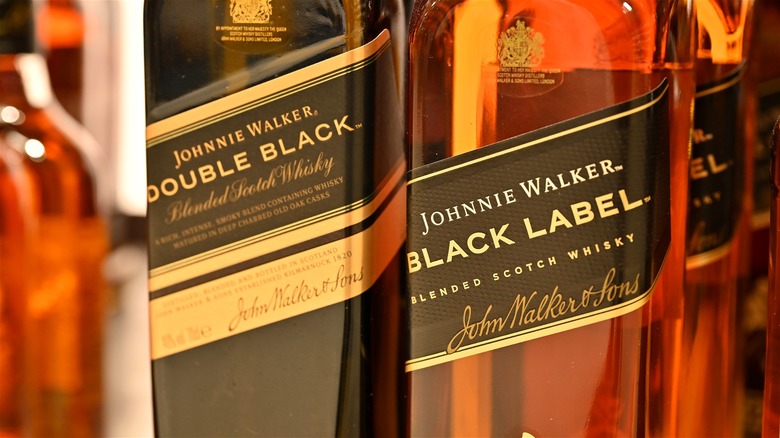
Johnnie Walker is one of the most recognizable Scotch brands in the world, and its Black Label whisky is almost synonymous with the brand itself. When Double Black rolled around in late 2011, it was hard to ignore the "Black" in its name — was it really claiming to be twice the whisky we already knew and loved? The answer is that these varieties are related yet distinct from one another, and each serves a different purpose.
The chief difference between the two whiskies lies in Double Black's more intense profile. In a 2019 interview with Scotchwhisky.com, Johnnie Walker master blender Jim Beveridge shared that Double Black was developed to make a smokier yet still balanced version of Black Label. Nuances in the whisky's blend were tweaked to work with the added smoke, resulting in a drink that turned out a deeper, darker, more amped-up version of its inspiration.
This naturally also translates to a slight price difference. While a 750-milliliter bottle of Johnnie Walker Black Label costs around $35 at Walmart, placing it in the range of a casual, everyday whisky, the same size bottle of Double Black will set you back about $42. Despite its position as a more premium version of Black Label, it's good to know that the price of Double Black isn't too far off from its globally best-selling older sibling. The $7 bump is just enough to make a celebration feel a little more special while still remaining accessible, unlike the brand's Blue Label, which goes for a little over $200 on Amazon.
What makes Johnnie Walker Black Label the world's most popular Scotch whisky?
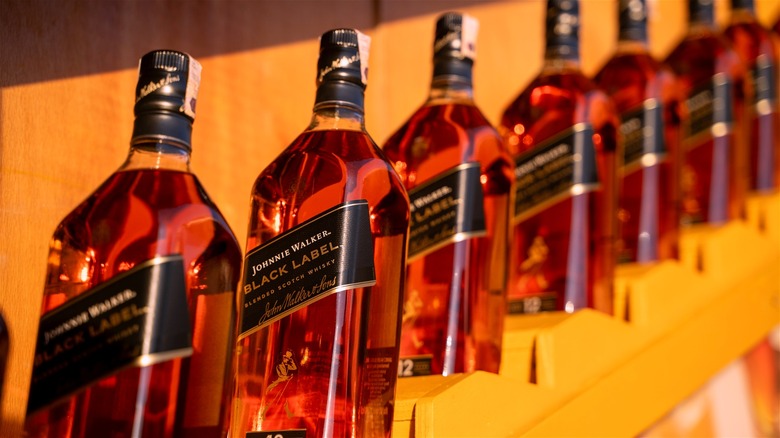
A whisky doesn't become the top-selling Scotch in the world without having something special, and that something is approachability. Johnnie Walker Black Label is widely regarded as one of the more beginner-friendly whiskies on the market, with a smooth, uncomplicated palate that doesn't really challenge the drinker. It's easy to sip neat, and it's balanced enough to serve as the foundation for even the most obscure, long-forgotten whisky cocktails.
These qualities are the result of literal centuries of development and refinement. Johnnie Walker traces its origins all the way back to 1820, when a grocer named John Walker began blending whisky for his store. Black Label as we know it officially debuted in 1908, with nearly 90 years of history, knowledge, and blending techniques already backing it.
The Scotch itself is meticulously blended from a number of single malt and grain whiskies that were aged for at least 12 years in casks. While the Johnnie Walker website doesn't specify which Scotch regions these whiskies hail from, Difford's Guide identifies Talisker, Cardhu, and Lagavulin as some of the distilleries behind the brand. As these are based in Isle of Skye, Speyside, and Islay, respectively, it's safe to assume that Black Label features representation from across Scotland. This likely contributes to the whisky's balance, with each region's flavors harmonizing on the nose and palate.
Key differences in how Johnnie Walker Double Black is made
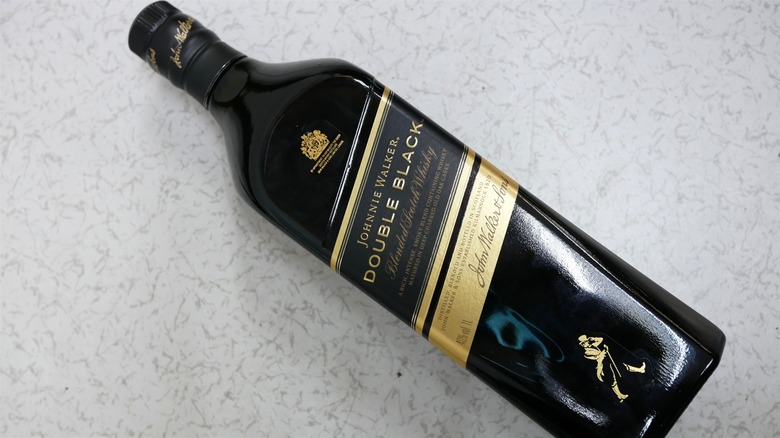
To achieve the boost in smokiness Johnnie Walker was aiming for in Double Black, the brand leaned on whiskies from Scotland's western coast, suggesting heavier usage of peat-forward Islay varieties. The brand also uses double malt whiskies instead of single malt for its Double Black formulation, meaning the Scotch was previously blended from two different distilleries, each chosen for its impact on the final flavor profile.
For even more smokiness and complexity, Double Black is also aged in charred barrels. Unlike Black Label and its 12 years, Double Black doesn't feature an age statement, so it's unclear how long it or its component whiskies have been stored. This suggests the formula may also include some younger varieties, which tend to have a freshness that helps balance older blends' depth and complexity.
All these steps work together to produce a whisky that tastes bolder than its predecessor, with a handful of notes reminiscent of Black Label. The flavors are technically the same, but Double Black intensifies everything, both on the palate and in the finish. For instance, you'll taste layers of vanilla in both, but Double Black adds a roasted quality to those flavors. Both whiskies contain some spice, but Double Black's stays longer on the finish. Because of this, it's better to sip it neat, on the rocks, or paired traditionally with water to more fully appreciate its double-ness — it won't play as nicely with cocktails as Black Label.