

What These Popular Fast Food Burgers Cost In The Early 2000s Compared To 2026
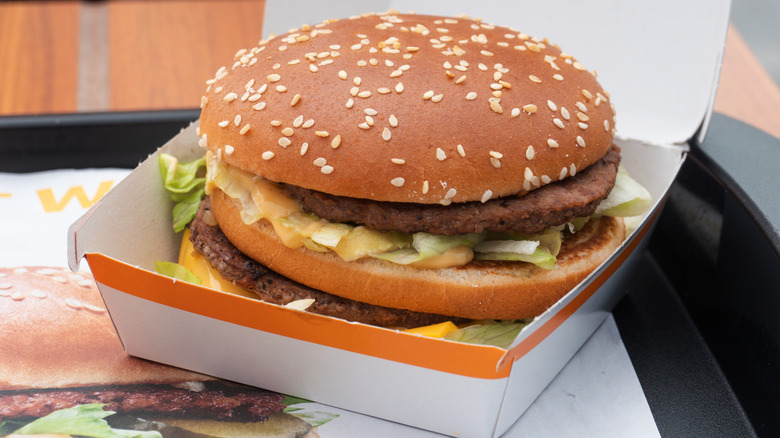
Cast your mind back to the halcyon days of the year 2000. The world had just partied like it was 1999, and after bravely surviving the Y2K virus, the celebration seemed destined to continue forever. What better way to celebrate than by popping some Destiny's Child on your new MP3 player and scarfing down an amazingly cheap burger from your local fast food joint?
Alas, times change. A quarter of a century later, a quarter pounder with cheese is going to set you back more than a handful of dimes. But, is the massive increase in burger prices due solely to inflation? Or is there some other reason why a Big Mac might cost three times as much in 2026 as it did in 2000?
It's not just Big Macs, however. Across the board, fast food burgers have seen a significant increase in price over the past 20-plus years. Of course, prices and participation may vary, meaning the cost of a Whopper or Big Buford might be very different depending on just where in the United States you live. In order to determine just how much burger prices have risen, where possible, we took a look at representative fast food locations in a typical median-cost city, St. Louis, and compared them to burger prices from the early 00s. The results may have you wondering how you ever managed to fit into those early 00's low-rise jeans in the first place when there were so many cheap burgers to be had.
McDonald's
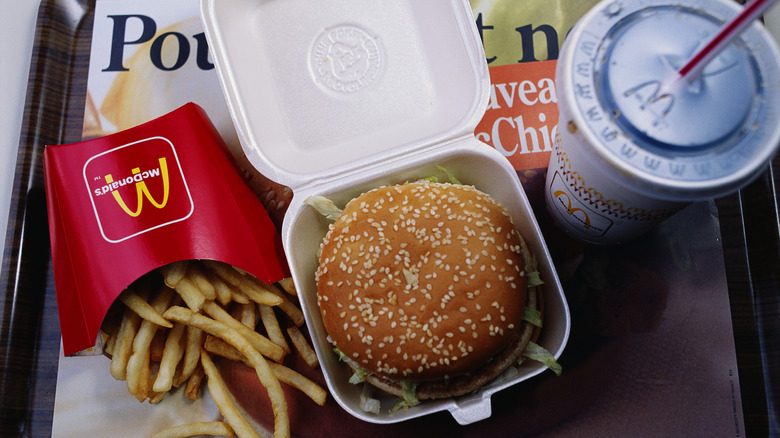
The price of McDonald's iconic Big Mac isn't just a matter of intellectual curiosity. It's actually a matter of international financial importance. The Big Mac Index was created by The Economist in 1986 as a way to showcase the strengths and weaknesses of international currencies relative to each other using the Big Mac as the point of comparison thanks to the prevalence of McDonald's restaurants in almost every country around the world.
The Big Mac Index also provides a year-by-year snapshot of just how much the cost of fast food has gone up in the United States over the past four decades. The answer: A lot. According to The Economist, the average price of a Big Mac in the United States in April 2000 was just $2.24. By comparison, in January 2026 the average cost of a Big Mac had soared to $6.12. That cost increase has far outstripped inflation. Fast forward to July 2026, and, according to the U.S. Bureau of Labor Statistics, that $2.24 from January of 2000 only had a buying power of $4.43.
Some locations are even pricier. In May 2025, Food & Wine reported that Big Macs in Seattle, Washington were already topping the $7 mark. Maybe the real reason we never see Ronald McDonald anymore is that he's scrounging for change in Grimace's couch cushions so he can try to afford a Big Mac.
Wendy's
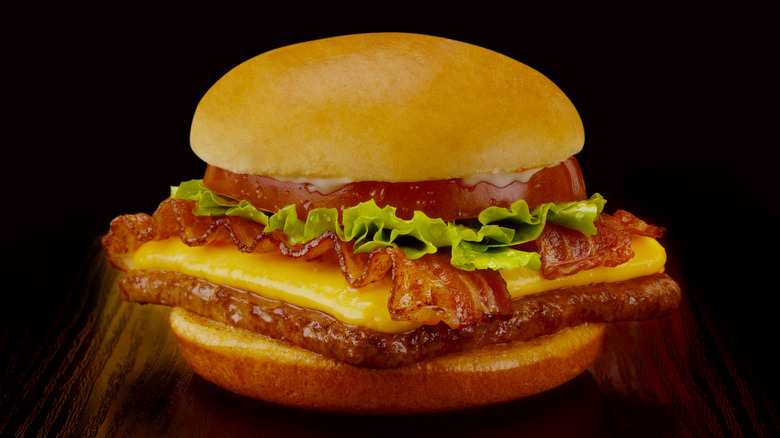
The early 2000s were a time of seismic change for Wendy's. On January 8, 2002, Wendy's founder and owner Dave Thomas passed away from liver cancer. Known to a whole generation of Americans, Thomas starred in over 800 Wendy's commercials, making him the public face of the company as well as the private power driving the business (even if he was officially retired at the time of his death).
One thing that didn't significantly change as a result of Thomas's death, though, was the price of burgers at Wendy's. According to a menu display from 2001 featured on Cockeyed, a classic single burger at Wendy's cost $1.99, with a cheeseburger costing $2.25. As per Business Insider, in 2002 — the year of Thomas's death — the price of a Wendy's burger was also $2.25.
Since then, Wendy's has renamed their classic base cheeseburger the Dave's Single in honor of Thomas. In 2026, a Dave's Single will generally set you back around $5.49, just over double what it would have cost a quarter century earlier. That price jump is also in line with price increases for the Jr. Hamburger and Jr. Cheeseburger — $1.59 and $1.99 respectively today compared to $.79 and $.89 in 2001. One thing that that hasn't changed over the decades though: Those Wendy's hamburger patties are still square. Never change, square burger!
Burger King
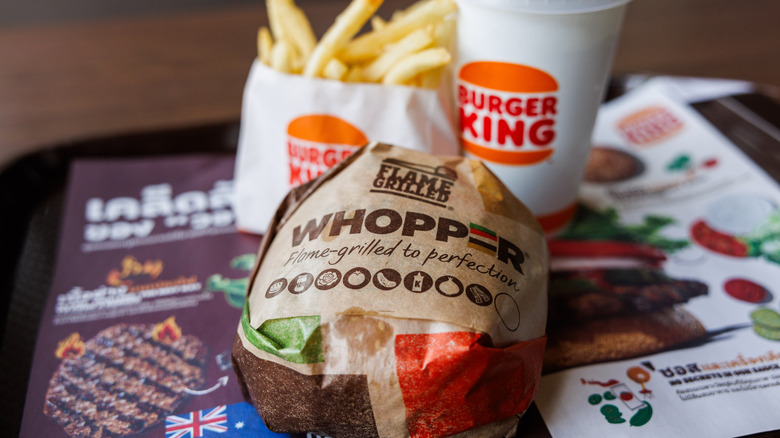
The early 2000s provided one of the most enduring ad campaigns in fast food history when Burger King debuted its "Creepy King" line of ads in 2004. The ads featured the Burger King himself, complete with an unchanging, horror movie-style grinning mask. It won't come as any surprise to anyone who lived through this era that the chain ultimately retired "Creepy King" because he was literally scaring customers away.
Or, maybe it was rising burger prices? At the beginning of 2000, Wendy's advertised that a Whopper Jr. with cheese and bacon ran customers $1.49. As reflected on a menu posted on Reddit, an adult size Whopper in the early 00's was $1.99 (or $2.39 with cheese), but by 2005 the average price of a Whopper had risen to $2.17, according to Business Insider. It might not seem like much of a price jump, but the wheels were in motion and once this burger started rolling downhill, it really picked up momentum: By the summer of 2026, that same Whopper might cost you $6.29, with a Whopper Jr. clocking in at $3.99.
Those prices have some former Burger King fans seeing red — the red on a McDonald's bag, that is. "It's what made me shift from a Burger King kid to a McDonalds adult in the past year," one Redditor wrote. "McDonalds actually still has some decent deals if you're not picky about what you eat. Burger King is just terrible value-wise."
White Castle
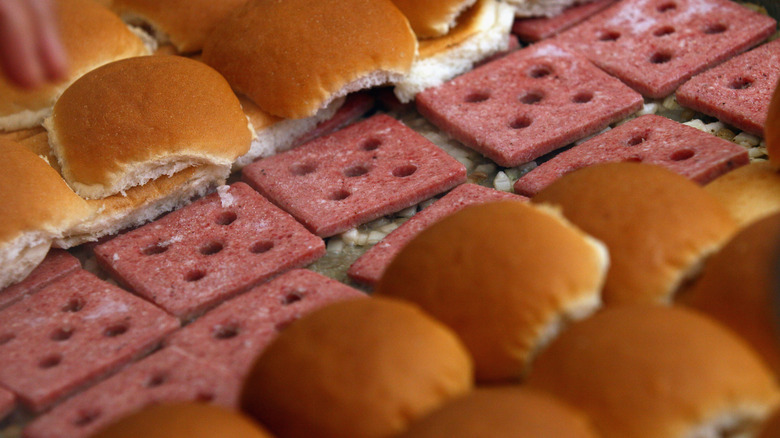
When it comes to White Castle, there's before 2004 and after 2004. That was the year that "Harold and Kumar Go to White Castle" turned the chain — which had been previously known for its undersized, soggy burgers — into a pop culture phenomenon. Suddenly, everyone wanted to go to White Castle. The only question was how much they would have to pay for their own "Harold and Kumar" experience.
Sadly, meeting Neil Patrick Harris wasn't on the normal White Castle Menu. But, the iconic sliders, which you could order either individually or in sacks of 10, were already the chain's signature item. According to Business Insider, in 2000, you could get a bag of 10 sliders for $4.40, for an average of $.44 each — and, if you're lucky, you might even get a bonus like a free pair of comedy chattering teeth. By the time Harold and Kumar were satisfying their late-night cravings in 2004, though, the price had gone up to $4.90 for a bag of 10 — you can even see the price on advertisement posters in the movie itself.
Nowadays, though, you'll have to fork over a fresh Hamilton and then some for the same bag of tiny burgers, with a sack of 10 sliders running around $11.99 — and that doesn't even include any comedy teeth. What would Neil Patrick Harris think?!
In-N-Out
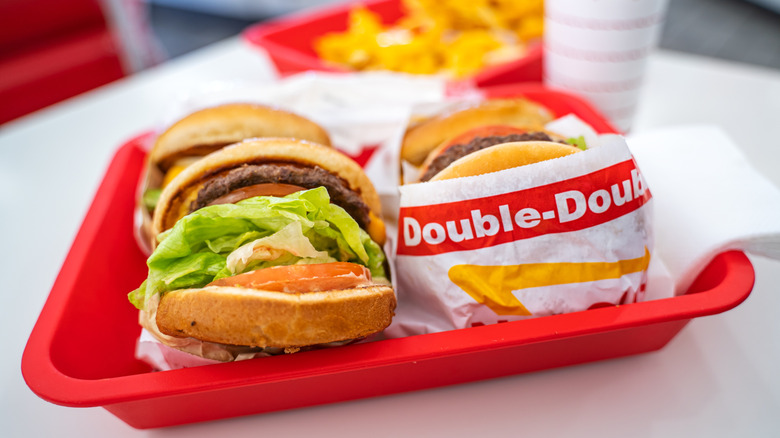
There are a lot of unwritten rules you should know for eating at In-N-Out, the iconic west coast fast food chain that has been serving up delicious burgers since 1948. Of course, In-N-Out burgers aren't available to everyone, as, despite its loyal following, the chain only has locations in 10 states. But, the untold truth of In-N-Out that only its dedicated fans know is that despite its uniformly low prices, the cost of In-N-Out burgers have still risen as much, or more than, competitors on a percentage basis.
Let's jump in the wayback machine to take a look. As reflected in an an image of the 2001 menu board on Cockeyed, a basic hamburger at In-N-Out was priced at $1.45, with a cheeseburger running $1.65 and the Double Double cheeseburger $2.50. Three years later, a snapshot of 2004 prices on Facebook shows barely any change at all: Still $1.45 for the hamburger, while the cheeseburger is a nickel more at $1.70, and the Double Double is a dime more at $2.60. So far so good.
But, if you look at 2026 prices, well, the picture doesn't seem quite so rosy. The average price for a hamburger is now $3.60, with a cheeseburger running $4.10 and a Double Double $5.90. And, some locations skew even higher. That means a hamburger at In-N-Out has gone up by roughly 150% since 2001 — fairly comparable to the nearly 173% price hike a Big Mac has experienced since 2000.
Carl's Jr.
When it comes to major burger brands, Carl's Jr. has arguably had the twistiest, most interesting path to success. Founded in California in 1941, the western chain ended up having a soft merge with the east coast burger chain Hardee's in the 1990s when both restaurant groups were bought by the same parent company. Then, in 2023, there was an amicable divorce between the two brands after more than two decades of shared menu items and advertising.
Along the way, Carl's Jr. also made a point of differentiating itself from the competition by emphasizing the value of its cheaper burgers. In 2002, the chain introduced the sarcastically named Six-Dollar Burger, which was actually priced at $3.95. The pointed joke was that other burger chains cost way too much, as Carl's Jr. could deliver the same quality burger for a lot less.
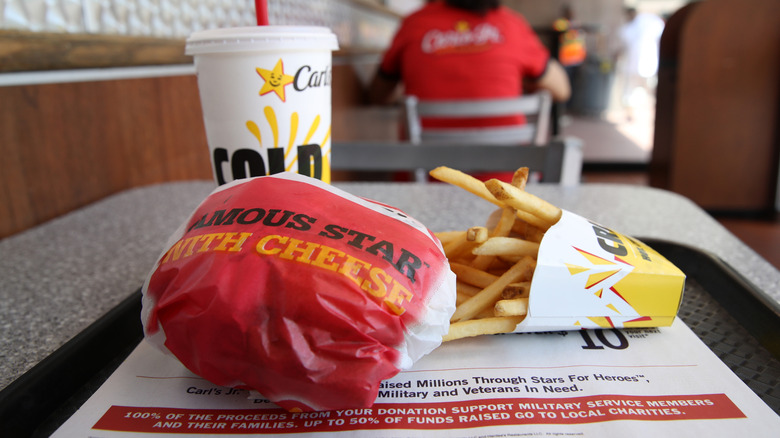
The joke ended up being on Carl's Jr., though, because over the years the chain was forced to raise the price of the Six-Dollar burger over and over. Eventually, they even had to rename it Thickburger because it was more than six dollars! The Thickburger has since been discontinued, but that price increase is reflected in the regular Carl's Jr. Menu as well. In 2001, the signature Famous Star burger was just $.99, with a small surcharge to add cheese, as seen on a menu posted to Cockeyed. Today, a single Famous Star with cheese will run you $6.29 or more, depending on location.
Five Guys
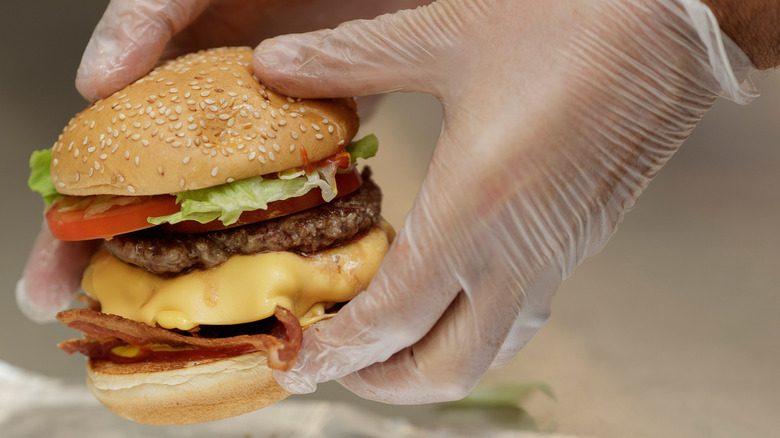
Founded in Virginia in 1986 as a little mom and pop burger joint, Five Guys has expanded rapidly since it began franchising in 2003. Now a dominating force in the global burger marketplace with over 1900 locations worldwide, Five Guys made its mark by offering a more hand-crafted burger experience than your typical fast food joint.
Like its competitors, though, Five Guys has known the severe sting of rising inflation over the past two decades. In 2004, the Washingtonian stated that the chain was known for the cheap price of its burgers: A single-patty burger (or Little Hamburger) cost $2.69, while a burger with two patties (considered the regular option) would run hungry customers $3.69. Prices still varied by location, though: In 2006, while the cost of a Little Hamburger was slightly up, at $2.79, you could actually get a regular double burger for just $3.49 depending on where you were eating, per a menu posted to Reddit.
20 years does a lot of damage to a wallet, though. In 2026, that basic double pattie burger costs around $10.99 at a typical location, while the Little Hamburger is now $7.39 — not so little after all. Considering some patrons believe that the quality at Five Guys has decreased, even as prices have increased, those prices seem even steeper.
Whataburger
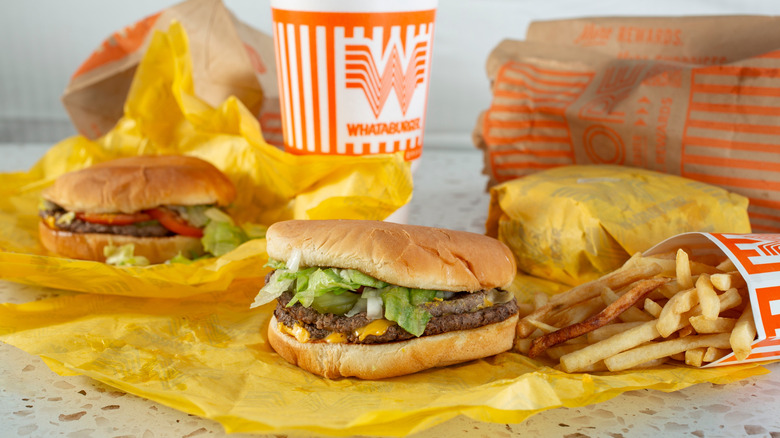
Back in the early 2000s, the Texas-based burger chain Whataburger took an unusual approach to their advertising campaigns: Many of them didn't mention price at all. Instead, they focused on the size, variety, and customizability of the burgers, selling the idea that you could get exactly what you want. Price, though, was apparently no object.
In fact, though, prices at Whataburger were pretty much in line with industry standards for the time. A regular Whataburger in 2000 cost $2.09, according to a fan page on Instagram. Over the past quarter of a century, naturally that price has gone up, but, the rate it's going up seems to actually be slowing. In 2010, a Whataburger was $3.29, an increase of 57% over the decade. And in 2020, it was $4.99, an increase of only 51% for the decade.
Today, a Whataburger will cost you around $5.99, depending on location, meaning the price has only increased by 20% in the past six years despite soaring inflation during the COVID-19 pandemic. Maybe Whataburger should have been promoting its price all along!
Shake Shack
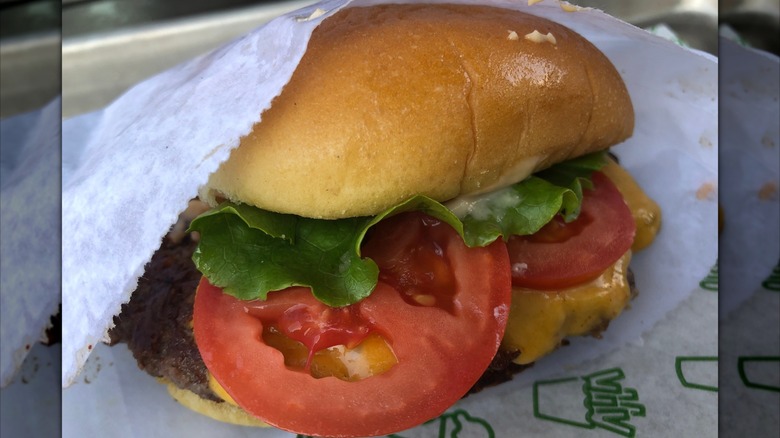
Since opening its doors back in 2004, Shake Shack has gotten a reputation for having some of the most expensive fast food burgers anywhere. That's a bit ironic considering Shake Shack originally began in 2001 as a humble hot dog cart. Once that first shack was built three years later, though, the menu got an upgrade reflected in the prices.
But, does Shake Shack deserve that expensive reputation? Looking back at the original 2004 Shake Shack menu on Gothamist shows that 20 years ago, the restaurant was already notably more expensive than its fast food burger peers. For example, a Shake Shack double cheeseburger in 2004 cost $5.65, compared to just $2.60 for a double cheeseburger at In-N-Out that same year (as reflected by an image of the menu on Facebook). Even the $3.10 for a single hamburger was steep for 2004.
Jump ahead to 2026 and, unsurprisingly, those prices have all risen significantly. That single hamburger now costs around $6.99, with a double burger coming in at $9.29. Add cheese, and that double cheeseburger is now $9.79, depending on location. It sounds like a lot, but that represents just a 73% increase in the price of a Shake Shack double cheeseburger over the past 22 years. In comparison, a Big Mac has more than doubled in price over the same time frame. Not so bad after all!
Checkers / Rally's
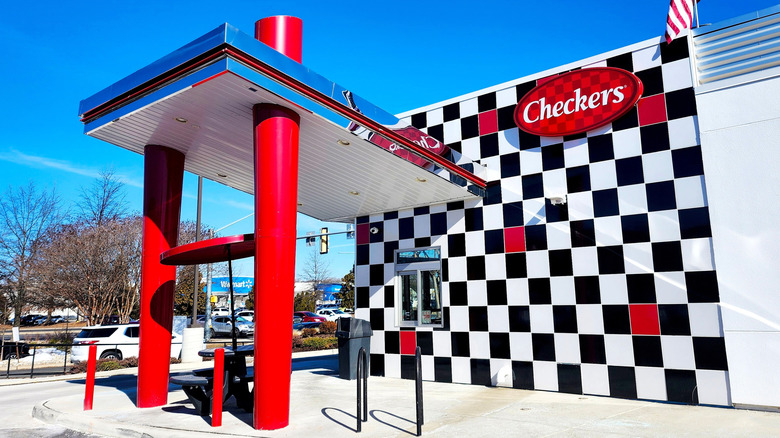
If you've ever wondered why Checkers and Rally's are functionally identical restaurants, the answer is simple. Originally two different regional fast food chains, Checkers and Rally's merged in 1999 and have shared just about everything from menus to advertisements ever since. As a result, there's one other big thing they share: Pricing.
For instance, in 2002 Rally's offered a special promotion: Two of its signature Big Buford burgers for $3. A year later, Checkers was running ads for the exact same promotion, only featuring its signature burger, the Champ. The chains even sometimes shared the exact same ads, only with the name of the restaurant changed, though the hilariously uninspiring "You Gotta Eat" slogan remained the same for both.
Those prices have changed over the years, though. While Checkers eventually discontinued the Champ burger, you can still get a Big Buford at Rally's. In 2026, though, it will set you back roughly $6.49 — more than four times what a Big Buford cost during those promotional deals in 2002. Forget the checkered flag, that's enough to have your wallet waving the white flag for good.
Culver's ButterBurger
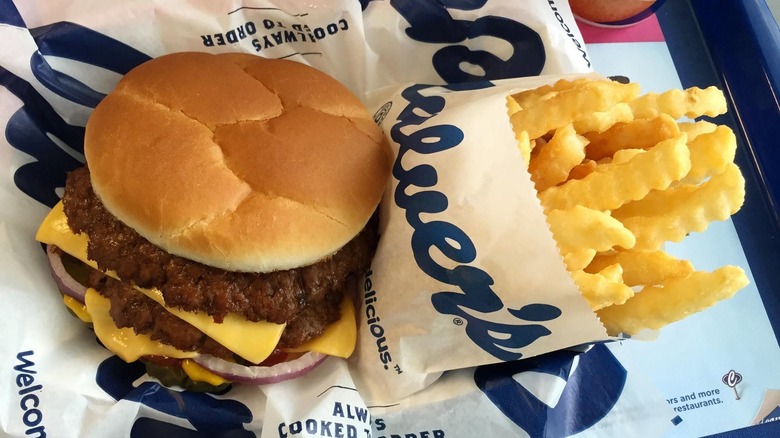
When it comes to the best fast food burgers, everyone's got an opinion. Celebrity chef Andrew Zimmern, for instance, is on record as being a massive fan of Culver's iconic ButterBurger, singing its praises during an appearance on the YouTube show "Hot Ones." Probably the only thing that could make fans of the ButterBurger love it more was if it cost less — which, of course, it once did.
Back in the summer of 2001, for instance, a Culver's ButterBurger cost just $1.69 for a single, $2.59 for a double, and $3.29 for a triple if you were really hungry, according to a menu posted on Reddit. And, it didn't cost much more to upgrade with cheese: The prices were $1.79, $2.99, and $3.49, respectively.
In 2026, though, those prices have changed significantly. A single ButterBurger now costs roughly $4.49, nearly three times as much as it did a quarter of a century ago. A double, meanwhile, is $6.69, while a triple ButterBurger is $8.89. And the price of cheese has gone up as well: The ButterBurger cheese options are now $4.89, $7.49, and $10.09, respectively. What a difference 25 years makes!