

Why Is Your Refrigerator Freezing Food (And How Can You Fix It)?
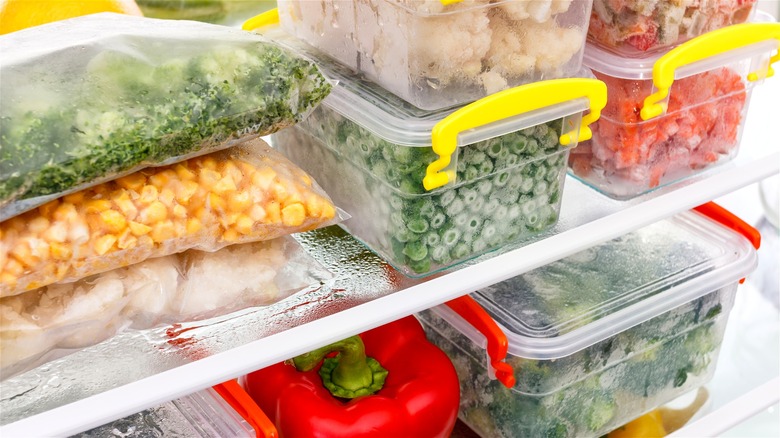
It shouldn't be the case that a refrigerator's main compartment freezes food, but it does happen. Thankfully, it can often be chalked up to a few mistakes everyone makes with their fridges. One of the simplest fixes is to make sure your fridge's temperature isn't set too low. If raising the temperature a notch or two above its current setting fixes the problem in a couple of days, then everything should be fine.
If that doesn't work, see if anything's too close to the air vents. These allow the cold air to circulate, and any blockages can restrict airflow, creating spots that reach freezing temperatures. It's also possible that your refrigerator just doesn't have enough food in it. The items inside your fridge help absorb the cold and regulate the appliance's internal temperatures. Keeping your fridge well-stocked — but not overloaded, since that can also end up disturbing the airflow — should help maintain the USDA's ideal storage temperatures of at or below 40 degrees Fahrenheit.
Lastly, regular cleaning can help prevent the fridge from freezing over, since dust and other buildup can cause its compressor to overwork. Cleaning often-overlooked refrigerator parts like the condenser coils once or twice a year should help too. And make sure to clear any frost buildup inside the fridge, as this can also restrict airflow and lead to frozen spots.
When to call in for refrigerator repairs
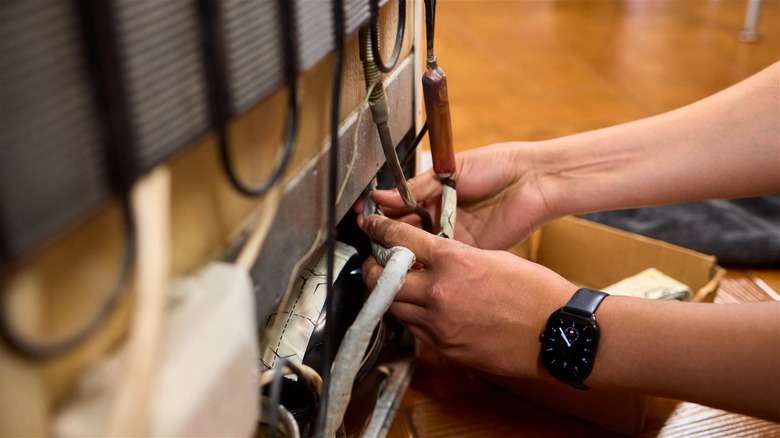
If none of the earlier solutions work, then it might be a problem better left to the experts. It's possible, for instance, that your refrigerator's thermostat is broken , which is why temperature adjustments don't work. You can test this by putting a glass of water with an appliance thermometer in it inside your fridge for a few hours. If the thermometer reading doesn't match the refrigerator's setting, call a technician to get the thermostat replaced or recalibrated.
Your fridge might also be freezing food because its door is no longer airtight. When cold air constantly escapes through tiny cracks in the seal, the compressor will work harder to hit its target temperature. Check the rubber gasket seals on your door for any tears or loose bits. You can also test the door's seal by closing it with a piece of paper between the gaskets and seeing if a light tug opens it more easily than normal. Any of these could be a sign that you need the seals replaced.
Frozen food could also be the result of another sort of failure involved with the circulation, defrosting, or cooling systems of your fridge. Sometimes, parts just break and need to be replaced; in the absolute worst-case scenario, a faulty compressor could even cause a fridge to explode. A technician can evaluate whether the cost of repairing the fridge outweighs replacing the appliance altogether. A refrigerator at the end of its lifespan might not even be worth fixing in the first place.