

5 Ways To Make Store-Bought Frozen French Fries, Ranked From Worst To Best
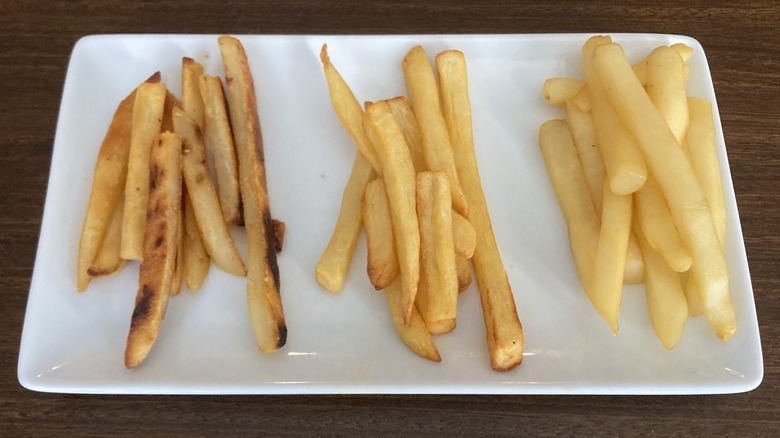
When it comes to convenience and cost effectiveness, even the best fast food fries can't hold a candle to frozen fries you can make at home. The easiest way to get frozen french fries from the freezer to your plate is to toss them onto a baking tray and slide them into the oven. It's the method that gives you the most bang for your buck — or in this instance, the most fries for your labor — and it certainly gets the job done. But is it possible that some other heat-apply gadget in your kitchen might have an edge on the good old-fashioned range? It's a question worth asking, especially for aficionados of fries who favor just the right crisp-to-tender finish in their fries.
To see which cooking method might work best on frozen french fries, I investigated common cookers in my kitchen and put the to the fry-making test. Everything from the microwave to the toaster oven came into play, each with its own unique considerations and special requirements to ensure a proper plate of fries. Though each delivered something edible in the end, not every method was equally palatable. And while quickness and convenience are definitely hallmarks of the most workable technique, they didn't always equate to fries to go with your best grill-master quality burger recipes, or even make a proper fast-food style snack.
5. Microwave
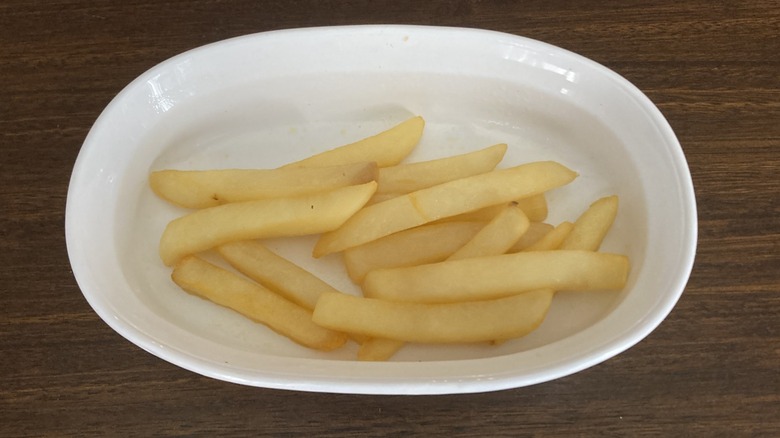
Ah, the microwave oven — that quick cooker that always gets the job done in short order but doesn't always provide the right finish, especially on fries. The microwave is notoriously dodgy when it comes to creating crispness on food that was fried once then reheated, and it's only ever the choice for reheated restaurant food when you want something greasy and floppy. But I've never tested a frozen french fry in the ol' kitchen reactor, and I was curious to know how it would fare without having a metal surface to help add a crisp finish. I don't have any tricky microwave cookers to use on this one, so I consulted the internet and crossed my fingers that they'd be edible at the very least.
As expected, there was no crispness to these fries. They were hot and soft — not to the point of being rubbery, but more the texture of boiled potatoes. I cooked them for 20 seconds, flipped them, did another 10 seconds, flipped them again, and finished them off for a final 30 seconds. They were still hot for a few minutes after they came out, which gave them time to cook further without becoming overdone. Still, they were pale and sort of greasy, perfect for lovers of soggy rather than crispy fries. Unless it was an absolute emergency, though, I wouldn't repeat this method.
4. Toaster oven
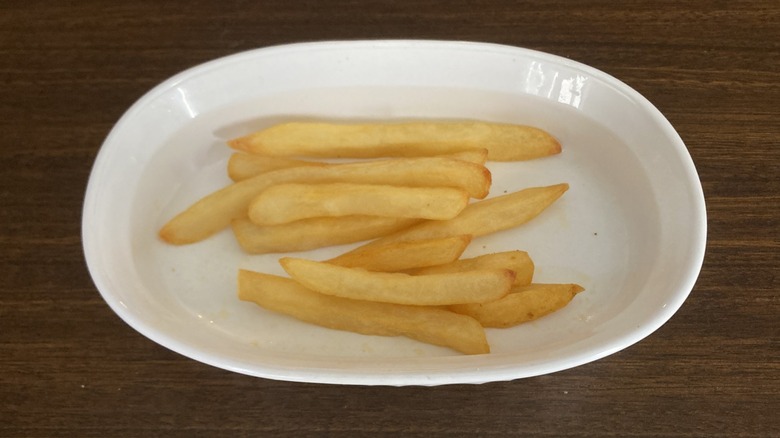
If frozen fries are a unique item you've never thought to put in a toaster oven, it's probably best to keep thinking that way — unless you're up for a bit of experimentation to get the technique fine-tuned. Most toaster ovens rely on radiant heat to cook food, which offers a second albeit more restricted version of the standard method to work with. Fancier toaster ovens may offer a convection setting, but mine is a simple workhorse that toasts and broils. The tray is less than a third the size of the usual baking sheet, and I wrap mine in foil to avoid cleaning the tray itself every time. These conditions changed the calculus for my fry-making enterprise, but the tighter space didn't alter the cooking conditions: I set the oven for the time and temperature of a standard oven and crossed my fingers for a burn-free finished product.
I got a burn-free finished batch of fries, all right; in fact, they were the second-lightest finish after 20 minutes under heat, second only to the microwaved fries. I'm sure I could have gotten them more to my liking with a little tinkering, but if simplicity is king in the kitchen when it comes to making fries, tinkering isn't in the cards. Maybe heating up already-cooked fries is a better use for such a small cooking device. It's definitely not a top choice in making fries straight from the freezer.
3. Pan-frying on a stovetop
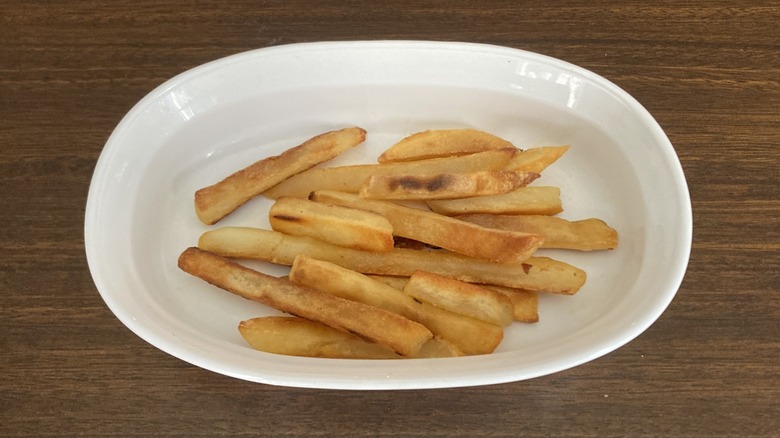
I don't usually think of using pan-frying as a technique for making french fries; it just seems to add extra oil and splatter to the situation. I used a large frying pan to give every piece its own cooking space and added just a splash of oil at the bottom to keep them from sticking, a step I didn't include in any other process. If I'd used a nonstick pan, I would have skipped it; if I'd thought of cooking spray before I started in, I would have used that instead. But this gave me more of a real-world, last-minute fry-making angle that everyone could tap into — only if it worked properly, though, and only if it didn't make a mess that didn't occur with the other methods.
This was a very touchy process that required constant watching to ensure the fries didn't scorch. The quantity you can make at one time is limited by the size of your pan, and there's little chance of not getting at least a little stovetop mess from the sizzling grease. But the finished fries were phenomenal, with a proper sear on most of the strips and just a few that overcooked in spots for added crunch. I did turn the heat down a little to make sure they all finished cooking evenly. The extra greasiness from the oil wasn't a good feature, but all in all, this is a great process for controlling the crispness from start to finish.
2. Conventional oven
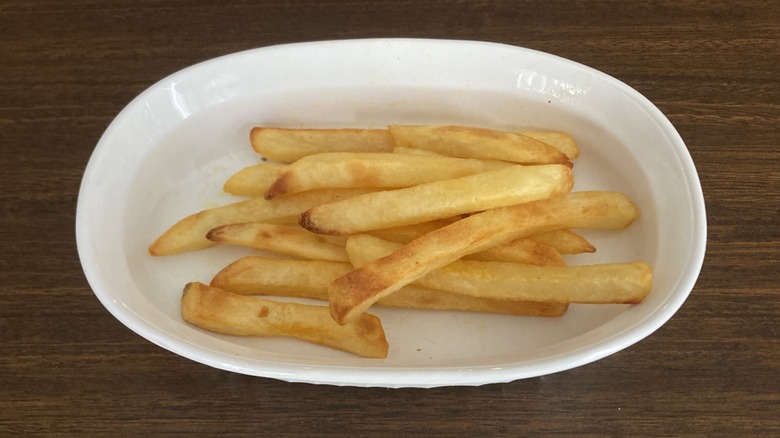
The purists who need a mass quantity of fries to feed a hungry household or a peckish party crowd will always opt for conventional oven heating to get their needs met. And why wouldn't they? It's the preferred method for cooking pretty much everything, and the first process listed in the instructions on the back of almost every bag. The advantage of having plenty of space to work with — plus a sizable, flat metallic surface to ensure every fry gets the kind of exposure that results in exterior crispness — has worked for generations. But how does it hold up when you zoom in on the finished fries and really examine their doneness?
This method took the longest — 20 minutes total, with a flip at the 10-minute mark. It did produce the largest quantity of fries of any method, thanks to the expansive size of the sheet pan and the double rack, which would allow multiple batches in a single go. It was also almost as fuss-free as air-frying, with no need for double-checking after the midway flip. All fries on the pan turned out perfectly golden with a bit of crunch and a whole lot of fluff in the center. It's my go-to method even for a small batch, given the can't-miss nature of the step-by-step process. It's even easier if your oven has a shut-off timer to prevent accidental burning.
1. Air fryer
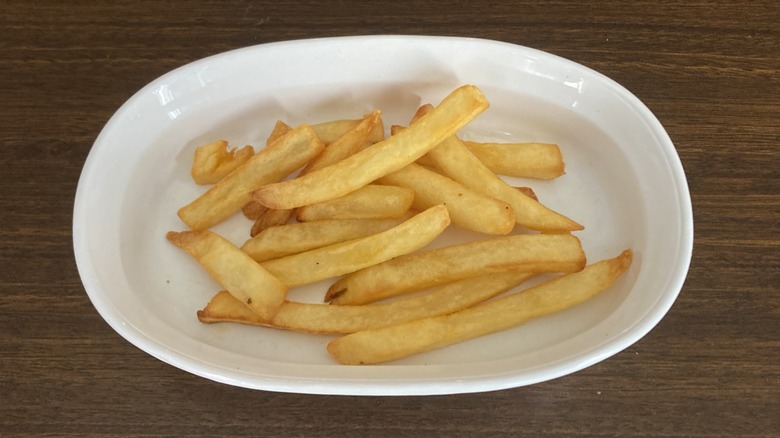
Though there are plenty of unique things you should make in your air fryer, frozen fries should be one of the more obvious possibilities. I'm late to the air fryer party, having only gotten my first as a Christmas gift in 2025, but I've jumped in at the deep end and discovered why everyone went so wild for this compact convection cooker. I'd only tried reheating restaurant fries in it up to the point of this experiment, so I was eager to see what an order of from-the-freezer fries would be like when the timer beeped.
This was the simplest method I tried; I just laid the fries in the silicone liner, preheated the fryer to 360 degrees Fahrenheit, then dropped the liner in for a 12-minute heat bath. When the timer beeped at the halfway point, I turned the fries over and popped the tray back in. Once the last six minutes had finished up the cooking, I let the fries cool for a minute and tried them out. They were crispy and tender as expected, though they didn't have quite the darker finish on the exterior as some of the pan-based methods. But every fry in the basket was dependably delicious, and the fryer didn't heat up my kitchen — a huge bonus in the swelter of an Arizona summer. For hitting on all fronts — dependability, convenience, less heat, and a tasty finished product — the air fryer is the top method for me.
How I tested and rated these methods
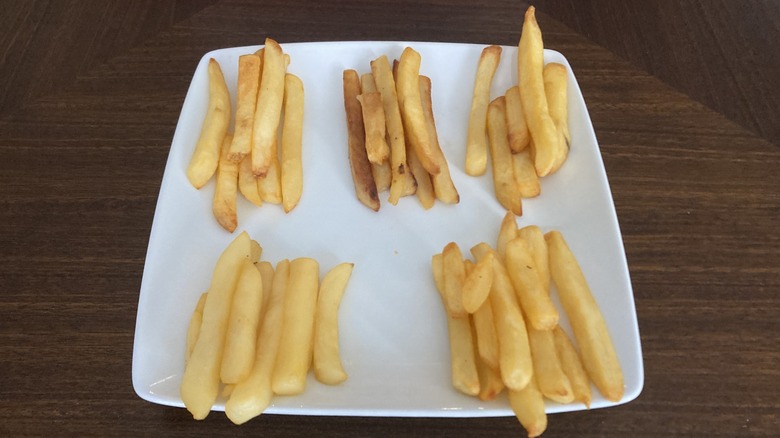
I used popular Kroger restaurant-style fries to test all methods, opting for a single serving each time. I chose not to try the deep-frying method, since this requires a specialty cooker and isn't readily accomplished for the average home cook. To ensure proper heating results closest to what the manufacturer intended, I followed the instructions on the label for conventional oven, pan frying, and air frying. For my toaster oven test, I used the instructions for the conventional oven, and for my microwave test, I improvised by heating and checking the fries to make sure they were cooked without overheating.
To determine which method worked best, I gauged doneness, texture, and taste across the entire batch. I also taste-tested the fries to find out which methods produced the least greasy fries. The processes that required least babysitting of the fries while producing the best balance of crispness and tenderness ended up being the most favorable.