

6 Trader Joe's Steaks, Ranked Worst To Best
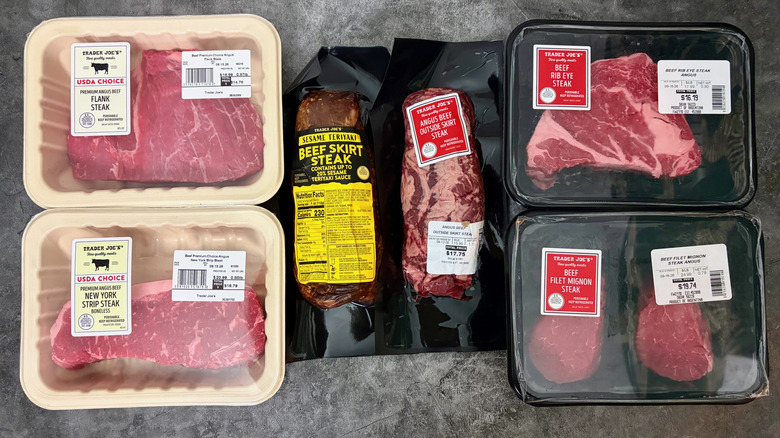
Chicken may be the most popular meat consumed in the U.S., but Americans haven't lost their taste for beef. Despite fluctuating grocery prices and availability, Statista reports that Americans still consumed roughly 58.4 pounds of beef per person in 2025. For those who don't have a local butcher of choice nearby, many grocery stores offer quality steaks in their meat departments, which makes grabbing everything for grilling or a nice steak dinner incredibly easy.
Aside from its wildly popular frozen meals, underrated specialty cheeses, and unique seasonal produce offerings, Trader Joe's offers a small but convenient and well-appointed selection of steaks that are all perfect for cooking in your own kitchen. Whether you're in the mood for grilled steak fajitas, teriyaki steak and broccoli, a classically comforting meat-and-potatoes meal, or an elevated date night at home complete with filet mignon, TJ's has you covered.
We picked up six steaks from Trader Joe's to cook and taste at home to find out exactly which cuts are worth picking up on your next grocery run. Spoiler: there are no wrong choices here — but some are definitely better than others. In the process, we found steaks that run the gamut from tough and chewy or blissfully tender to buttery and beefy or mild and lean. For more on how we chose, cooked, tasted, and judged each steak, see the methodology section at the end of the article. Paying special attention to flavor, texture, and price, here's how six Trader Joe's steaks rank from worst to best.
6. Flank Steak
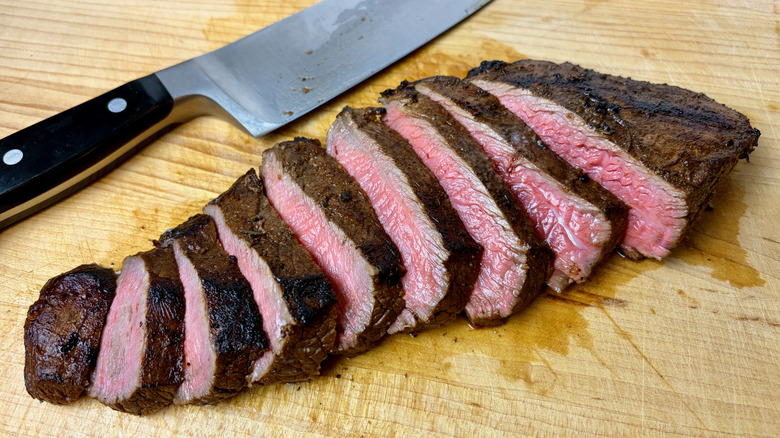
Trader Joe's Premium Angus Beef Flank Steak is rated as USDA Choice, one step below the USDA Prime steak you'd find in a fine-dining restaurant, but still considered high quality. The boneless flank steak has less marbling than some higher-end cuts and has more connective tissue, which can make it tougher to chew. While not as popular, it's known for its excellent beefy flavor that stands out even with stronger seasonings and its lower fat content.
For the flank steak, I made a quick marinade with olive oil, balsamic vinegar, chopped fresh rosemary, minced garlic, freshly ground black pepper, and kosher salt, then left it to marinate in the refrigerator overnight. The 1-inch-thick cut was cooked in a hot cast-iron skillet for about five minutes on each side to reach rare to medium-rare, with additional butter and rosemary added to the pan about halfway through cooking. The resulting steak was surprisingly juicy and absorbed a fantastic amount of flavor from the marinade, although it was still noticeably tough to chew.
While easy to cook and flavorful, this is the chewiest of all the steaks we tested and has the highest potential to be tough if overcooked. For the best results, marinate this cut to tenderize it, cook it no further than medium-rare, add finishing salt when it comes out of the pan, let it rest for as long as you can to keep it juicy, and slice it against the grain to make it easier to eat. At $16.99 per pound, the .87-pound flank steak cost me $14.78 and easily served two, with a little left over for steak and eggs the next morning.
5. Sesame Teriyaki Beef Skirt Steak
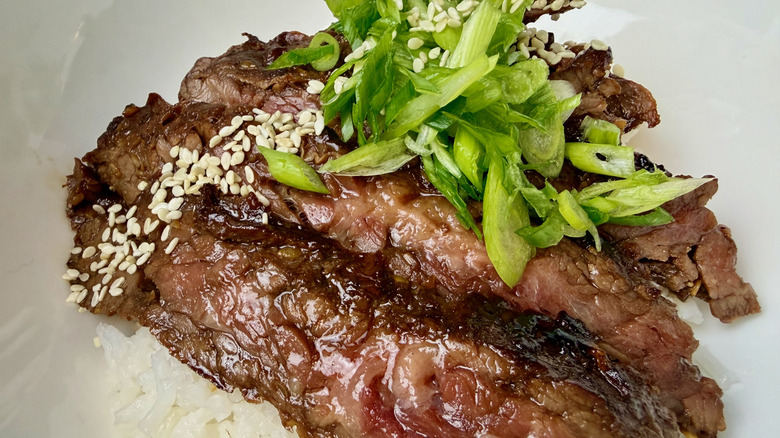
Trader Joe's Sesame Teriyaki Beef Skirt Steak might not be the "best" steak you can find at the grocery chain, but it's got a lot going for it when it comes to convenience. Pre-marinated, the meat comes in several pieces, making it easy to cook all or part of it at once. Zero preparation is required — aside from heating up your skillet — and the whole thing takes five minutes or less to cook. Turning it into a full meal is as simple as adding rice and veggies to your plate, which can also be prepared in less than 15 minutes.
More sweet than savory, the teriyaki marinade clings to the skirt steak, helping it caramelize during the cooking process. On medium-high heat in a hot cast-iron pan with a small amount of cooking oil, the steak takes about two minutes to cook per side for a nice char without burning the sugar-based teriyaki sauce. Served with plain rice, the beef's flavor is easy to enjoy, although not particularly prominent. The teriyaki flavor also isn't as strong as I would have liked, so it's a good idea to have some additional sauce on hand or soy sauce for a savory, salty boost. Sriracha or chili oil are also great additions, along with scallions and sesame seeds for garnish.
The teriyaki skirt steak costs $16.99 a pound, and the package I picked up from my local store weighed about 1.25 pounds. At $21.24 for the package, it's not the cheapest steak option, but most of the work is done for you, and it's still a cost-effective way to feed two to four people without dining out.
4. Outside Skirt Steak
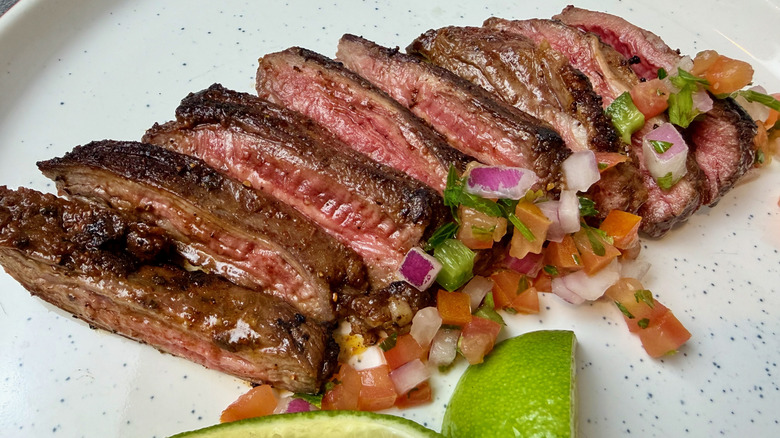
Trader Joe's also sells an undressed Angus beef outside skirt steak, packaged similarly to the sesame teriyaki beef skirt steak. What's special about this "outside" cut is that it's what you'd likely find in a restaurant setting as opposed to an "inside" skirt steak, which is the usual cut available in grocery stores. It's typically the more tender of the two skirt cuts, with noticeably more marbling and better overall flavor. And for $15.99 per pound, that feels like a big win.
Packaging may vary depending on what your local Trader Joe's stocks, but the 1.11-pound bagged steak that I picked up contained roughly three skirt steak portions instead of one long piece. Starting with the largest cut, I simply seasoned the steak with salt and pepper on both sides and let it sit while the cast iron skillet heated up. Skirt steak is a great cut for grilling, but I just gave the meat a quick sear of about two minutes per side, bringing the thickest portion to about 135 degrees Fahrenheit before removing it from the pan to rest.
Because skirt steaks' fibers run across the short width of the cut, you'll likely be slicing it with the grain, or diagonally across the grain, but not fully perpendicular to it. Even so, Trader Joe's Outside Skirt Steak is still tender enough to comfortably chew and bite through, and plenty juicy with a pronounced beefy flavor. The cuts were not quite as clean as flat-packed skirt steaks often are, but that may be one of the reasons why this outside skirt steak is priced a little nicer than what you'd expect.
3. New York Strip Steak
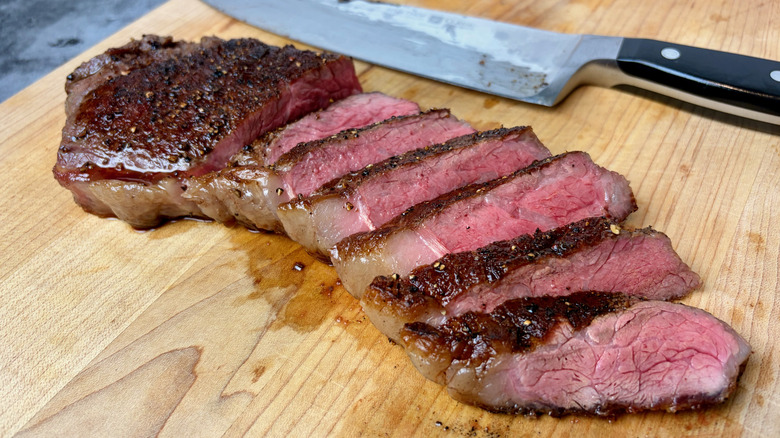
A steakhouse staple, Trader Joe's New York Strip Steak is definitely a more economical option than splurging on a fancy dinner out — and it doesn't require all that much effort to make at home. I prepared the strip steak by seasoning both sides with kosher salt and freshly ground pepper, then let it sit at room temperature for an hour. Cooked in my cast iron skillet for about four and a half minutes on each side until medium-rare, the New York strip steak comes out juicy, tender, and decidedly easy to enjoy.
The biggest selling point for this particular cut is its texture. It's tender and very easy to chew, but substantial enough to stay juicy. Its beefy flavor is more subdued than a rib eye, but that may be a pro instead of a con depending on your preference. Additionally, the New York strip steak has a pronounced fat cap that helps keep it nice and juicy, although it doesn't contribute as much rich, buttery flavor as the fat marbled into the rib eye. Steak sauce or compound butter are optional but nice additions if you're feeling ambitious. While the texture and flavor are both great, this pick is not quite as tender or as flavorful as the next two options.
Depending on what your local Trader Joe's has in stock, you may find the USDA Choice Premium Angus Beef New York strip steak for $20.99 per pound (which is what I tasted here). There is also a lower-priced New York strip steak on the grocery store's website for $15.99 per pound that is not marked as USDA Choice.
2. Filet Mignon
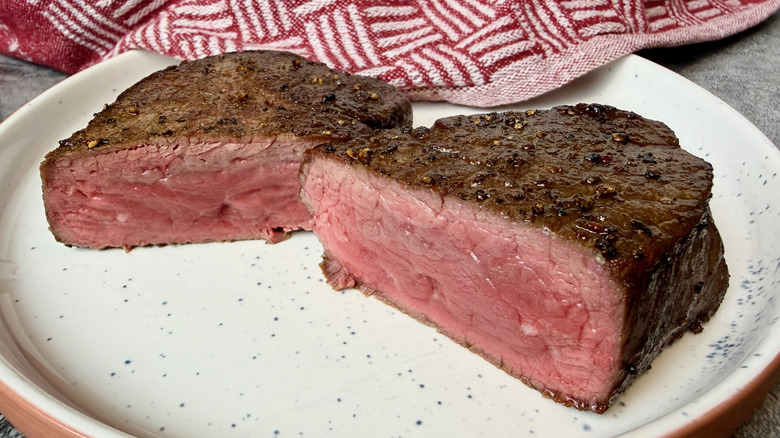
Filet mignon is one of the most expensive cuts of beef on restaurant menus everywhere, so it's no surprise that Trader Joe's offering comes in at $24.99 per pound. Two generous medallions of filet mignon from my local Trader Joe's came to .79 pounds and just $19.74.
Cooking a filet mignon is slightly trickier than some other steaks only because you want to cook the rounded sides to the same crispy finish as the tops and bottoms without overcooking the entire cut. Season the filet mignon with salt and pepper and let it rest in the fridge for about 45 minutes to keep the steak's core cooler. In a hot cast iron skillet with cooking oil, I seared the filet for about two minutes on each side, then spent another two to three minutes searing around the steak. It was removed from heat when the internal temperature reached 135 degrees Fahrenheit.
There's no denying that this is by far the most tender steak in this lineup, with so little chew that you could probably cut it with a fork. For someone looking for the smoothest texture, this is a very satisfying choice. On the other hand, it's missing the bigger beefy flavor and buttery richness that you'd find in either the New York strip or the rib eye — which is, again, entirely a matter of personal preference. While I might personally skip it in favor of a more flavorful cut, I'd absolutely reach for these filet mignons next time I'm inspired to make smaller beef Wellingtons.
1. Rib Eye Steak
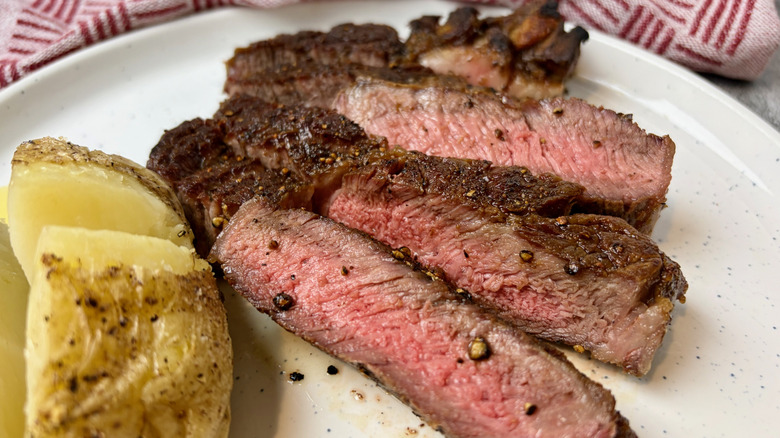
Whether you spell it "rib eye" or "ribeye," this is generally considered one of the higher-end cuts of beef you can order, often dry-aged, at upscale steakhouses. But Trader Joe's offers a rib eye as part of its curated steak selection for those who want to enjoy a little luxury at home. While Trader Joe's refers to the cut as "restaurant-quality, 100% Angus beef," it is not explicitly labeled USDA Prime. Nevertheless, the boneless steak comes cut about 1-inch thick and clearly has generous marbling throughout.
Rib eye is one of Samin Nosrat's favorite steaks to cook, so I followed her instructions from "Salt, Fat, Acid, Heat" for preparation and cooking. I began by pulling the steak out of the refrigerator and seasoning it about an hour before cooking, letting it come to room temperature and allowing the salt to tenderize and enhance flavors — the meat seasoning technique Nosrat swears by. I then cooked it about five minutes per side in a preheated, ripping-hot cast iron skillet until it reached medium-rare, before letting it rest.
Trader Joe's Rib Eye Steak is just as tender, juicy, and buttery as you'd expect from a steakhouse and absolutely packed with flavor. It was hard not to eat the entire thing straight off the cutting board. Don't overthink the preparation of this substantial steak — but make sure to ventilate your kitchen before, during, and after cooking. This offering costs $17.99 per pound, making the .90-pound steak I purchased a relatively modest $16.19.
Methodology
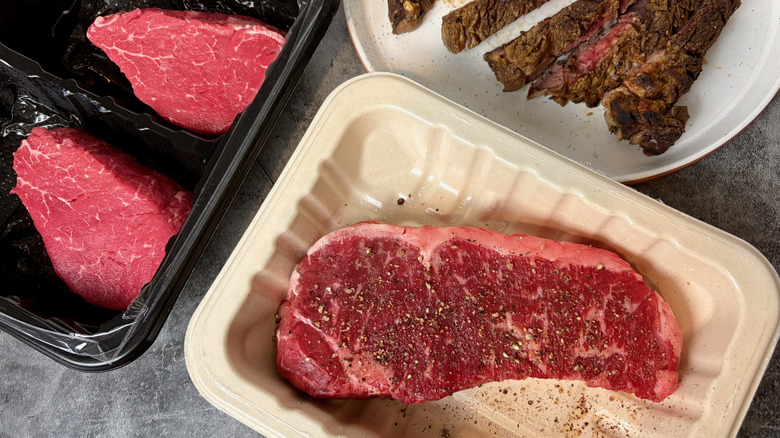
Trader Joe's currently offers nine steak options. Aside from the six chosen here, you can also find all-natural shaved beef steak, balsamic rosemary beef steak tips, and Premium Angus beef tenderloin steak tips. For this roundup, we stuck with whole cuts of beef for greater consistency.
Each steak was prepared with minimal seasoning beyond kosher salt and freshly cracked black pepper to get the clearest taste of each cut of beef — aside from the sesame teriyaki skirt steak, which comes pre-marinated, and the flank steak, which practically requires a marinade before cooking. Additionally, each steak was cooked in a very well-seasoned cast iron skillet, as close to medium-rare as possible for continuity when comparing options. Tasted over several days, with assistance from my husband (a professional chef I met while working in an NYC steakhouse), each steak was directly compared with the others to cement their place in this ranking.
The primary considerations were each steak's texture and flavor, including fat, marbling, and connective tissue. Steaks with bolder flavor profiles got more consideration, followed by each cut's overall texture and tenderness. Finally, cost was considered in relation to overall value, from portion size to the meat's general quality.