

How Much Should You Spend On A Good Bottle Of Merlot In 2026?
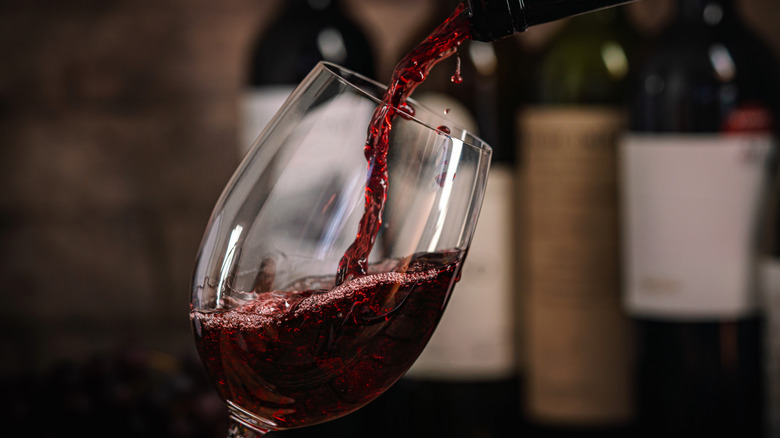
In the early aughts, merlot was inadvertently maligned by the popular movie, "Sideways," (based on Rex Pickett's novel of the same name). After audiences watched Paul Giamatti's character, Miles, deride the wine, exclaiming, "I am not drinking any f**king merlot!", sales of the varietal tanked. However, over two decades later, interest in the wine has experienced an upswing. In fact, Robb Report named La Jota 2022 W.S. Keyes Vineyard Merlot as both the Best Merlot and Best Wine of the Year in 2026, and to get it, you'll need to drop $225. But as with any wine, there's a wide range of price points for merlot, and you can find a number of well-rated bottles from $14.99 to $50.
WSJ Wine recommends Spanish Mirlo Merlot 2024 at that lowest price point, citing its smoothness and pleasant mouthfeel. The publication points to another option from California that's just $4 more that sports layers of flavor: Cooper Point Merlot 2023. Or for a taste of Bordeaux, it also has a handful of options that clock in between $29.99 and $59.99. Similarly, VinePair shows you needn't break the bank with its 2026 Best Merlot roundup that lists at least five with prices that hover between $20 and $29. There are also a few between $33 and $42, including two (DuCard Vineyards and Veritas Vineyard and Winery) that hail from Wine Enthusiast's 2023 Region of the Year, the Monticello AVA.
Finding your favorite merlot
If you enjoy red blends, there's a good chance you've had merlot — it's common for rounding out flavor or acidity in other reds. But if you haven't had it on its own, try sampling some to learn the styles you prefer — just as the cost of merlot can vary greatly, so can its flavor.
Overall, merlot tends to be a balanced wine — you're unlikely to find it has too much acid or is overly tannic. What you will encounter is a silky mouthfeel and fruity flavors that can become more pronounced depending on the climate the grapes are grown in. If you're looking to go straight to the home of merlot, choose one from Bordeaux, which is likely to lean less jammy. For bigger wines that are fruit-forward, reach for a bottle from the United States' West Coast. While both of those regions are popular, you can also try options from Italy, Spain, Chile, Argentina, and Australia.
Do a tasting in one of two ways: Either choose several from the same region or dive into diversity by contrasting wines from various origins. While you'll probably want to try them on their own first, these are some wine and snack pairings we can't live without. (Spoiler alert: You're going to want some cookies with your merlot). And if you manage to have leftover merlot, remember affordable wines can also be a beautiful base for sangria.