

The Difference Between McDonald's And Burger King's Beef Patties
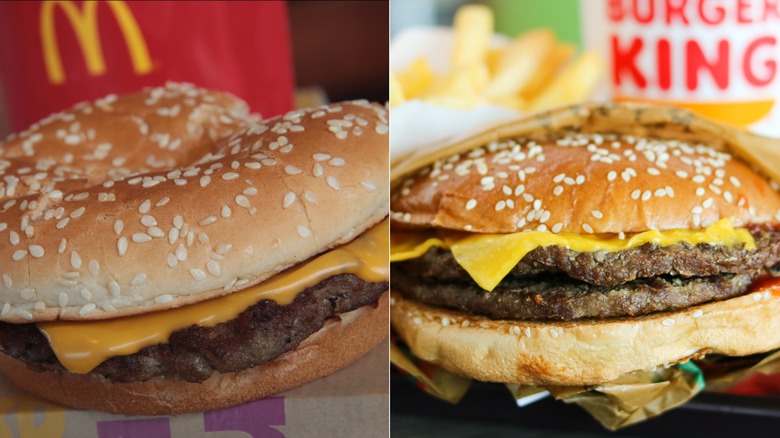
"Fast food burgers are really all the same, aren't they?" To some, this sentence will provoke a strong, perplexed reaction, as if the claim were suggesting that a monsoon and a sunny afternoon are basically the same weather. And for good reason: Fast food burgers are, in fact, quite different from chain to chain, not because of what's in them, but because of how they're made. This certainly rings true for McDonald's and Burger King's beef burger patties.
Though their provenance and ingredients are near-identical (except for Burger King's light touch on seasoning), each chain's patties are transported and cooked in different ways. McDonald's burgers are formed and flash-frozen in a factory, then cooked from frozen on a griddle that cooks both sides at once. Burger King's patties are also transported to restaurants premade and frozen, then passed over a flame on a conveyor belt-driven broiler.
How do these differing cook methods affect the burgers' taste? In Mashed's own taste tests, we noticed a clear distinction between the patties when comparing McDonald's Quarter Pounder to Burger King's Whopper. McDonald's griddled burger is seared and lightly caramelized on the outside, giving it a slight crust. Meanwhile, some customers swear by the flame-broiled taste of Burger King's offerings. Ultimately, it's up to your taste buds — but knowing more about their differences can inform that decision.
McDonald's uses a hinged griddle to cook its burgers
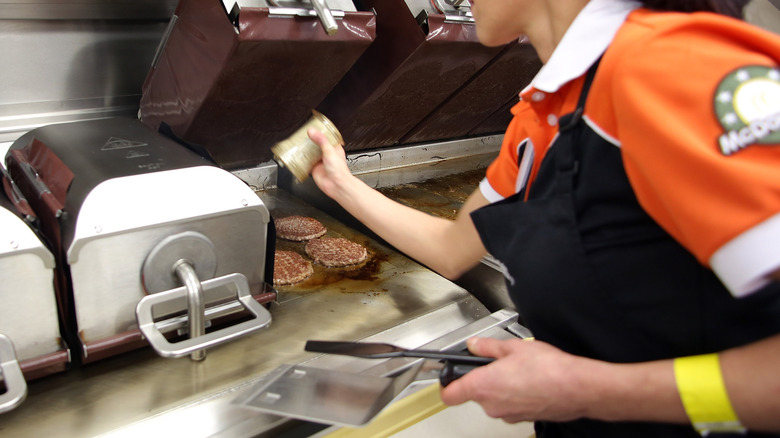
The meat in a McDonald's burger is pretty standard fare. It consists of trimmings from cuts like chuck, round, and sirloin, according to McDonald's website. The patties are all-beef — no fillings, additives, or preservatives, just salt and pepper the restaurants add when cooking. Keystone Foods and Lopez Foods are the longtime industrial suppliers who provide McDonald's with beef, which is ground, packed, and flash-frozen before being shipped to restaurants. From there, McDonald's distinguishes itself through how it chooses to cook the meat.
The company uses a hinged clamshell-style grill — basically a flat-top griddle with a lid that's another flat-top to get its patties customer-ready. After a cook places burgers on the grill, a second hot surface is swung on top of them, allowing both sides to cook simultaneously. This method is more similar to a panini press than a typical griddle.
The two-sided cooktop defines the McDonald's burger. These clamshell grills cook much faster than a regular flat-top, helping McDonald's provide swift customer service despite the patties cooking from frozen. The clamshell grill also heats patties evenly, ensuring uniformity in each batch. As a finishing touch, the flat-top surface gives the burgers a pleasing crust, which is what our taste-tester liked about the Quarter Pounder.
Burger King uses a conveyor-driven broiler — but not always salt
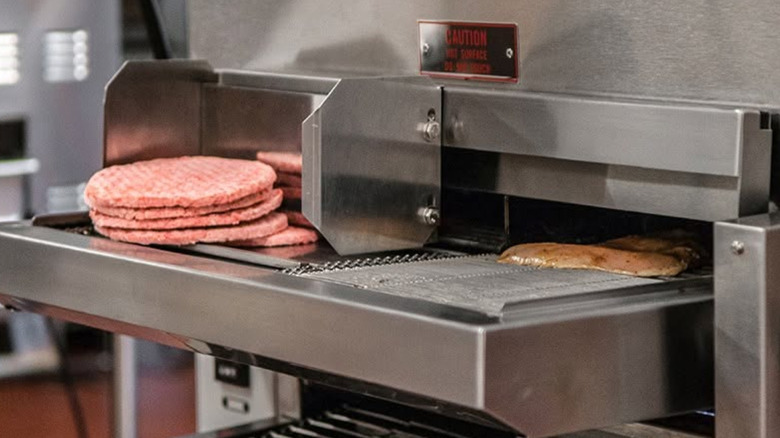
Burger King's actual meat patty isn't that different from McDonald's. Both burgers are 100% beef and supplied by large industrial meat processors such as Cargill. Unlike McDonald's, Burger King doesn't specify what cuts of meat go into its burgers or if all its patties are seasoned. Customers and employees are divided on whether the chain salts its patties during cooking. Burger King's website doesn't list salt and pepper as ingredients on standard burgers, but Whoppers (and similar premium items) are made with a salt and pepper blend that also includes canola oil and an anti-caking agent.
When it's time to cook the patties, Burger King and McDonald's really diverge. Burger King uses a proprietary broiler equipped with a conveyor belt. The meat slowly passes over a flame to fully cook, with the broiler timed for the exact cook time of each type of patty. So while it's true that the burgers are flame-grilled as Burger King advertises, the appliance getting the job done is not like the grill in your backyard.
Some fast-food enthusiasts are certain that the flame-broiled cooking process produces a clearly superior burger to the McDonald's approach, which, of course, is a matter of personal taste. Reddit commentary suggests that burgers lacking the desired charred look or taste probably didn't broil long enough, an occasional problem that doesn't affect every BK location.