

9 Frozen Salmon Fillets, Ranked Worst To Best
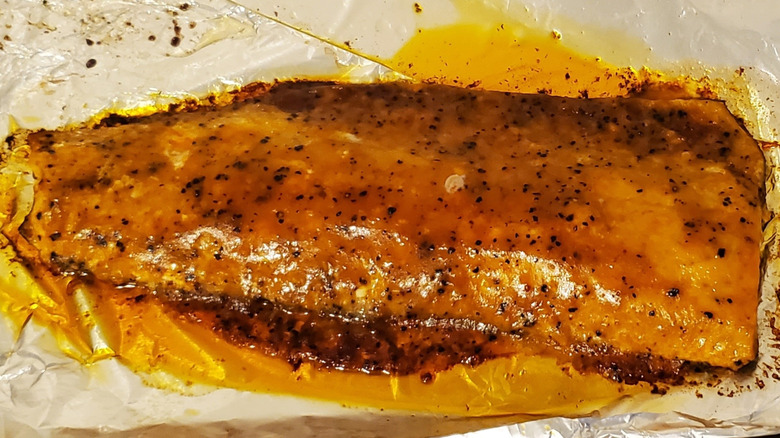
When it comes to dinnertime, salmon is one of the most popular types of fish in America. And for good reason. The truth about salmon is it's one of the healthiest fish options around. Add in the fact that it's also delicious and plentiful and it's easy to understand why there are so many kinds of frozen salmon fillets on the market — especially since there are so many different ways to prepare salmon. Buying a pre-made salmon fillet that's already been seasoned to suit your taste is a great way to make salmon accessible to everyone while also taking the guesswork out of the cooking process.
At least, it should. But anyone who has cooked frozen rather than fresh salmon fillets knows that there's actually a lot more to it than there seems. Salmon can be a finicky fish, and just a couple minutes too long in the oven or on the grill can take your perfect meal and turn it into a perfect culinary disaster.
So when evaluating just which salmon fillet to buy at the grocery store, there's more to it than meets the eye. Finding the flavor you like best is important, yes. But being able to trust the brand's cooking instructions is also key, not to mention other little things such as, you know, the price. Don't worry, though, that's where I come in. Like a mighty grizzly bear astride an Alaskan river, I am eating every salmon I can find to determine which frozen salmon fillets you should buy — and which you shouldn't.
9. Sea Cuisine Teriyaki
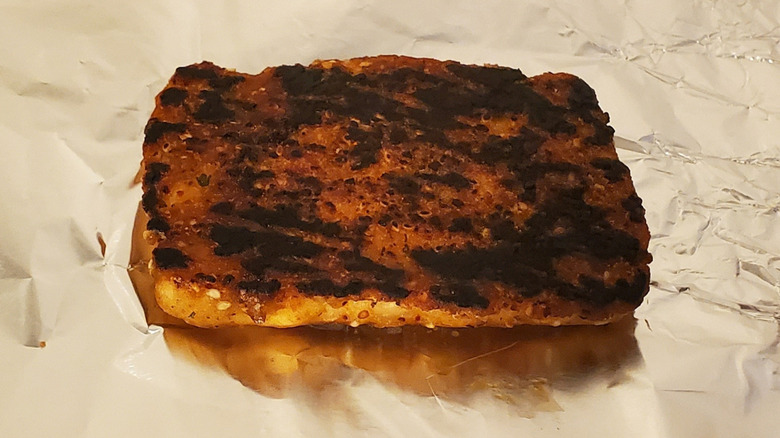
There's nothing like a perfectly pan-seared salmon fillet. And that's exactly what I got by following the preparation instructions on the box of Sea Cuisine's Teriyaki Salmon: fish that was nothing like a perfectly pan-seared salmon fillet. Instead, this sad fillet came off the skillet torched almost beyond recognition. The thick, burnt-black crust on the exterior of the salmon made it look less like a meal and more like something archaeologists dug up at Pompeii. Fish also shouldn't make a dull clanging sound when dropped on a plate. It reminded me of an NHL face-off.
The package says that using a skillet is the preferred cooking method, but let this be a warning to you to either adjust the timing or use the baking instructions instead. It's true that the burnt exterior gave the fillet an unusual textural element, if you happen to want a hard, sooty crunch on your fish. Underneath the crust, the interior somehow had retained just enough moisture to be edible, though I couldn't classify it as moist. And it definitely packed a flavor punch, with an unexpected spice level I don't typically associate with teriyaki marinade. So at least it had those things ... going for it, I'll say?
Still, while the finished result was at least novel, I wouldn't have it again — except possibly during the Stanley Cup Finals. You might be better off just getting salmon from an ATM instead.
8. Morey's Steakhouse
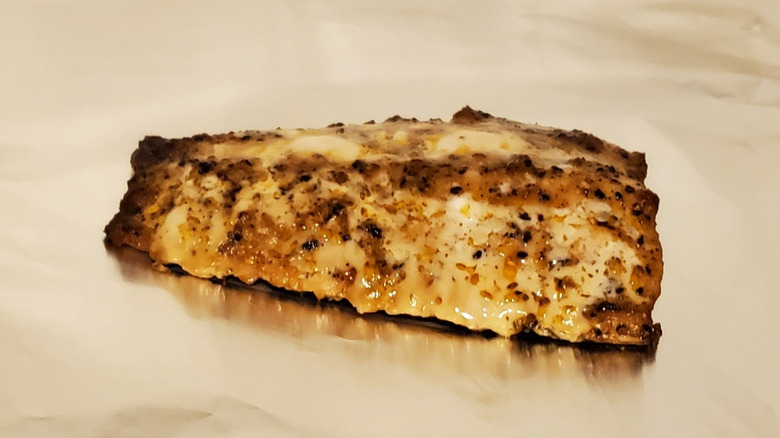
Morey's FineFish and Seafood, which is distributed by the same parent company that owns SeaPak, has a robust line of differently seasoned salmon fillets available. The one that caught my eye, though, was the Steakhouse, a delightful vague name. Close inspection of the box reveals that Steakhouse indicates the salmon is prepared "in a spicy pepper marinade with hints of garlic & onion." According to the company website, the Steakhouse salmon also features "notes of jalapeño and rosemary." That's a lot of flavor notes.
So did it live up to the billing? While I found it difficult to tease out every individual flavor note promised, the blend overall was indeed flavor forward, providing a spicy kick that — unlike other spicy salmon fillets I tried — hit more on the tongue than in the throat. The marinade also browned up nicely in the oven, making the fillet appealing to look at before taking those first bites, and giving some bites a welcome textural crunch.
It wasn't all sunshine and rainbows, though. You may need to experiment with the factory settings in this Steakhouse in order to achieve the best cook on your salmon. Following the exact instructions on the box left me with a slightly overcooked fillet that, while still providing a nice flavor profile, was slightly tough and rubbery to eat. Maybe next time.
7. Trader Joe's Norwegian Blackened Salmon
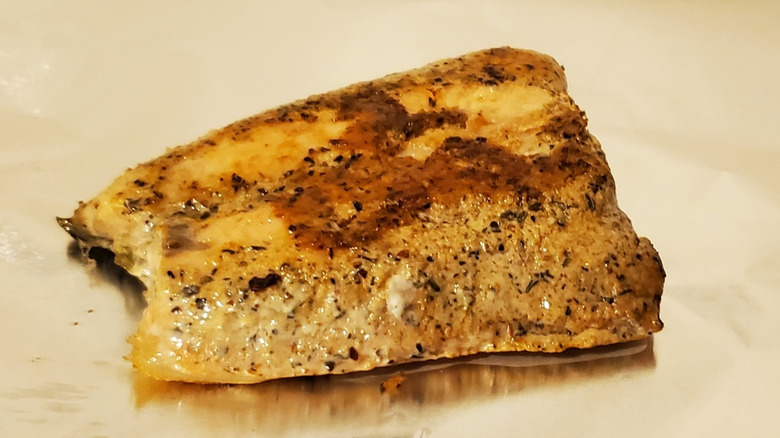
Sometimes, in order to learn how to fly, a baby bird has to be pushed out of the nest. That's not usually how you learn to cook, though, so imagine my consternation when I discovered that Trader Joe's Norwegian Blackened Salmon has no instructions included on how it's meant to be prepared. The only vague nod to directions is a single line that reads "pan fry, bake, or broil." Oh, no kidding? Thanks for the insight, Joe.
In fact, when I Googled "Trader Joe's Norwegian blackened salmon" it auto-completed with "cooking instructions." Rather than have another existential crisis, though, I decided the best way to sample this fillet as it was intended to be eaten was to follow the advice of the professionals. In other words, I used the cooking instructions from our own Mashed recipe for pan-seared blackened salmon.
The result gave the fillet a nice, crisp sear on the skin. That crispy skin was also the strongest flavor note for me, followed by the fish itself. I appreciated the fish being the star, but the blackened seasoning was a bit too mild for me. It was present, and it pleasantly lingered a little in the back of the throat. But ultimately, this fillet needed stronger flavors — and actual cooking instructions.
6. Sea Cuisine Honey Chipotle
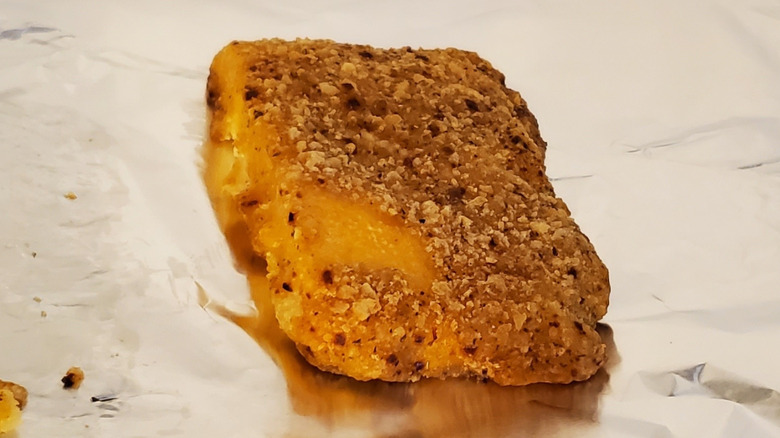
One nice thing about the Sea Cuisine line of salmon fillets is the ease of preparation, especially convenient for diners who don't have time to meal plan a day in advance by thawing fish overnight. The package came with two vacuum sealed fillets, and it was a simple task to pop just one of them out, toss it on a pan, and put it in the oven. It's not quite set it and forget it, though; the instructions for the Honey Chipotle do call for a short burst of broiling at the end of the cook time to finish the fillet off correctly.
It turned out to be worth the effort. The chipotle seasoning is a slow build. While the first couple of bites give just a hint of spice, that spiciness stays and builds through the meal so that by the end, there was a rich and satisfying burn in the back of my throat. A sweet touch of honey also cut through the chipotle as a nice counterbalance to create a satisfyingly complex bite.
The one warning is that the fillet wasn't particularly moist. It was balanced right on the edge of dryness, so taking care with the cooking time is paramount, as just a few extra seconds in the oven could make the difference between a very nice fillet and a disappointing meal.
5. Cedar Bay Applewood, Orange, and Ginger
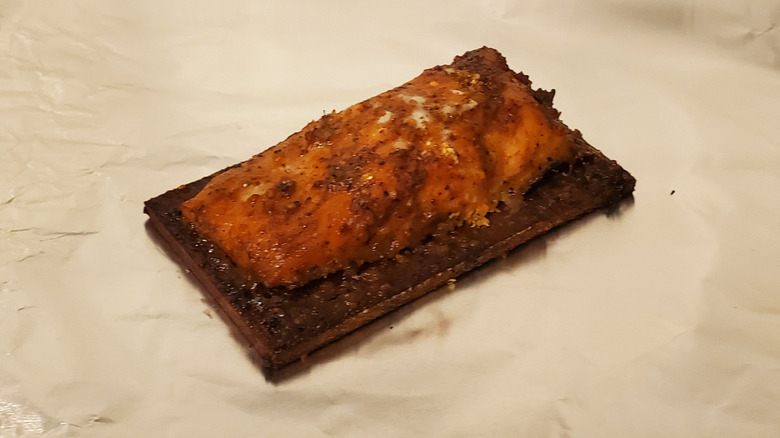
Cedar Bay's line of planked salmon serves up an interesting twist on frozen fish. Each fillet comes laid out on an individual little plank of cedar wood, which the label announces has been pre-soaked to make it safe for oven or grill. It's like the fish comes with its own tiny coffin for cremation: Simply pop the whole kit into the stove, wood and all, and enjoy.
Wrestling the wooden plank out of the freezer bag can be an adventure; expect to get coated in marinade, and be extra careful to avoid splinters, because this plank is rough-hewn. You also need to pay extra close attention to the thickness of the fillet. The brand's Applewood, Orange, and Ginger was a truly husky fillet, short but stout, and required significantly longer in the oven than the recommended cooking time in order to hit the required 145 degrees Fahrenheit internal heat demanded by polite society.
As the fillet itself was a bit lopsided, though, this resulted in an uneven cook. While the thickest part was right on, the tapered end was near to hammered. As for flavor, the first note was, perhaps surprisingly, the orange. This was followed by a mild ginger kick. The taste was good, but underscored by a faint burnt undertone throughout. It was unclear whether this was intentional, from the plank, or an unintentional side effect of the marinade burning from the overlong cook time. Either way, it prevented the filet from being as good as it could — or perhaps should — have been.
4. Aquastar Smoky Peppercorn Salmon
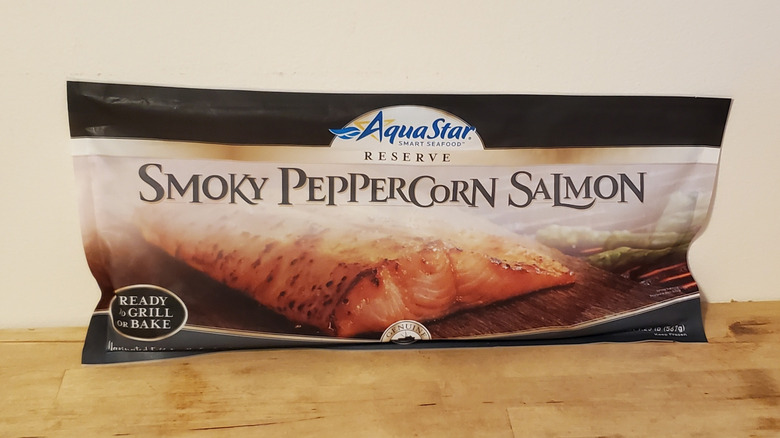
Planning to entertain several hundred of your closest friends? Then Aquastar has the Smoky Peppercorn Salmon for you. I exaggerate, but only slightly: This enormous fillet weighed in at 1 ¼ pounds, and was so long it barely fit on the baking sheet. Eat one of these suckers and you'll have Omega-3 up to your eyeballs. And at just $9.99, it wasn't just the largest fillet I sampled, but also the cheapest per ounce.
For all of that, the instructions were nice and simple: Plop it on a pan and throw it in the oven, no thawing necessary. The size did have one downside: With a recommended baking time of 23 to 27 minutes, this salmon took the longest to cook. Still, the wait was worth it. The resulting fish was very moist to the point of juiciness. It was also nicely flaky, easily falling apart at the touch of my fork. And the flavor was pleasant. Slightly sweet and a little spicy, it's a mild flavor that almost seems a little underseasoned at the start. But it sticks with you and builds as you go to become ultimately satisfying without going overboard.
If you don't want half a fish, Aquastar does offer up smaller portions which may be available at your local store. It should also be noted that this whopper is intended to be cooked on a grill; if, like me, you don't have one available, alternate cooking instructions for an oven are provided.
3. Trader Joe's Atlantic Salmon with Lemon Herb Butter
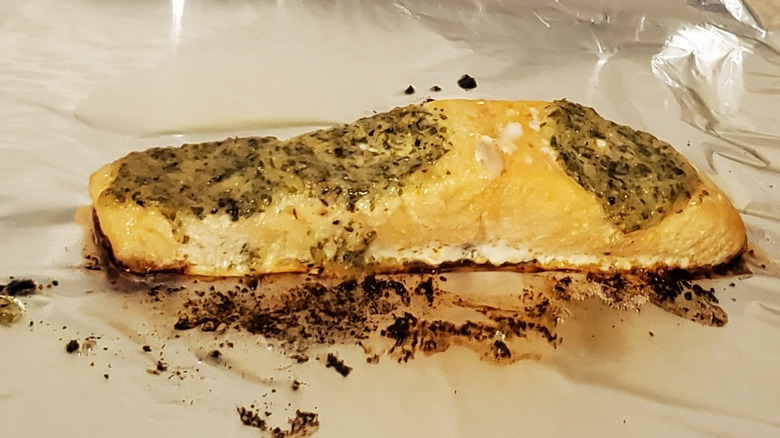
Trader Joe's Atlantic Salmon with Lemon Herb Butter has about the simplest presentation possible. It's just a nice cut of salmon topped with three large pats of lemon herb butter. That's it, no fancy sauces or marinades, no exotic herbs or wacky concepts to try and distract you from the fish itself. It's just simply fish baked in butter, the end.
For all that, there is a fair amount of forethought required, as the salmon needs to be thawed overnight, rather than cooked frozen. So this isn't a fish to necessarily buy at the store when you're looking for tonight's meal. But once it's thawed and cooked, the elegance of the fillet shines through. The garlic butter really makes the dish, adding a refreshing cravability to each bite. It also doesn't melt off in the way you might expect, but instead bakes on in a thick disc that still remains soft enough to spread around to suit your taste.
The simplicity also allows the salmon itself a deserved moment in the spotlight. Flaky and moist, each bite is satisfying on its own. Getting a dollop of the butter just elevates things to a higher plane. The generous amounts of butter also adds notably to the fillet's calorie count, but it's a small price to pay for a clean and crisply executed salmon dish done right.
2. Cedar Bay Hickory Maple
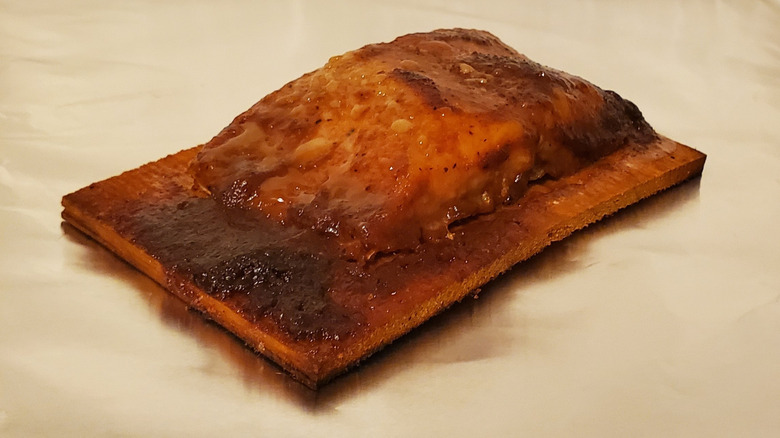
Are you ready to walk the plank? Like the other Cedar Bay offerings, the Hickory Maple salmon comes on a little slab of pre-soaked cedar that you pop right into the oven to add some extra smokiness to the dish. And it pays off. Before the fillet is even done cooking, you can smell the difference coming from the stove. That smell carries through into flavor, as the plank imbues the fish with a wood fired note that adds a bit of contrast to the dish, allowing the primary flavors to sing.
The primary note I got up front biting into the fillet was the sweet maple, which played nicely against the smoky backdrop. That smokiness is elevated by the hickory. There's also a bit of a spicy twist in the tail, a welcome tang in the back of the throat that balances the sweetness well. That balance is needed, as it should be noted that the fillet has a fairly high added sugar content; one 4 ounce serving delivers a third of the recommended daily value for sugar. This is reflected in the ingredient list as well, with the top five ingredients being salmon, brown sugar, water, sugar, and maple sugar.
Thanks to the smokiness and spiciness, though, you don't need to have an overdeveloped sweet tooth to enjoy the Hickory Maple salmon. It's a well composed bite that serves as the perfect center for a delicious meal.
1. Cedar Bay Bacon Bourbon
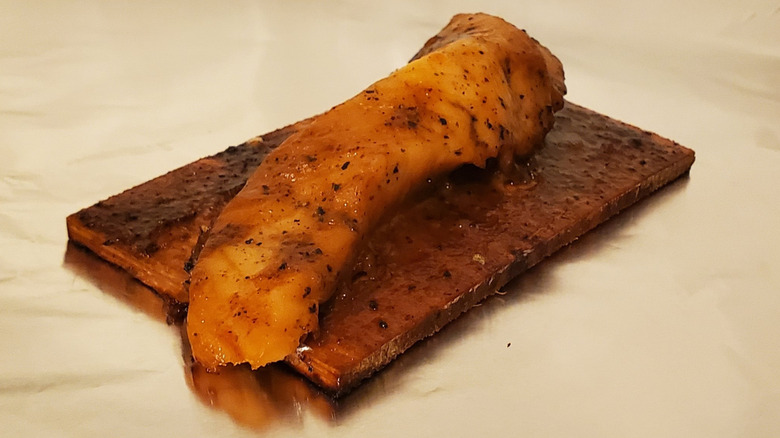
Salmon fillets come in all shapes and sizes. The Cedar Bay Bacon Bourbon planked salmon fillet I sampled was a long and slender fillet. Like the other Cedar Bay fillets I sampled, it came pre-loaded onto a little cedar wood plank, but in this case the fillet was notably longer than the plank. It dangled off the side, like Jack in "Titanic" trying desperately to hang onto that door.
Unlike Jack, though, this fillet avoided disaster and didn't slip off the plank into the abyss of my oven. Instead, it delivered an award winning performance in my mouth. The flavor profile's nicely complex. The bacon notes hit first, but are immediately contrasted with a sweet undertone from the bourbon. There's also a depth and richness to the flavors provided by the smoky foundation, which permeates the fish and enhances the entire profile.
Taste, of course, is subjective, and some might prefer a bolder spice level. I found the flavors to be extremely well balanced; sure, there could have been more heat, but I didn't miss it. Instead, I appreciated the nuances of the presentation, nuances that could have been overshadowed or overwhelmed by bolder notes. Sometimes in cooking, subtlety works better than brute force. Cedar Bay Bacon Bourbon planked salmon is one of those times.
Methodology
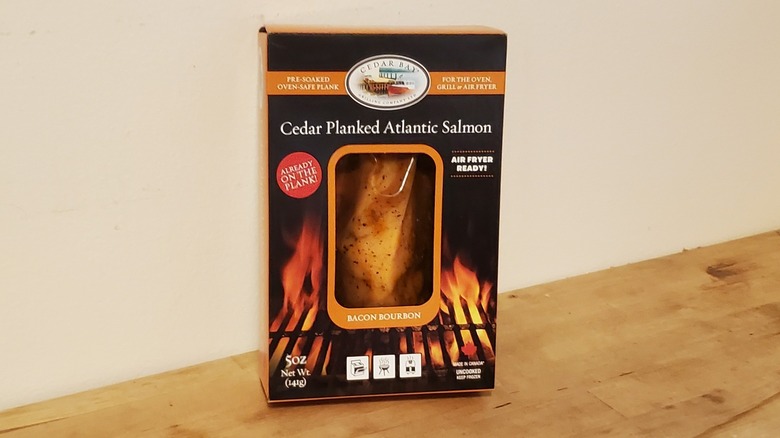
Consistency is key in an experiment like this, but with so many different styles and brands, how do you achieve it? In order to remove myself as a variable, I prepared each salmon fillet exactly as instructed on the packaging; for the Trader Joe's Norwegian Blackened Salmon, which had no instructions, I used the cooking guidelines from the Mashed recipe for Pan-Seared Blackened Salmon.
Cooking instructions are particularly important for evaluating these fillets not just because it affects the eating experience, but because it also directly affects the cost of the fish. If the fillet turns out badly when those instructions are followed, you can certainly try again with another fillet until you get it right, but this kind of trial-and-error costs money. Correct cooking instructions mean you only pay for the fish one time, instead of multiple times as you try to suss out how the fillet should actually be cooked.
Once each fillet was cooked, I then sampled each and scored the fish on a variety of measurables. The fish itself is the key thing, so I looked at the flakiness and juiciness of the salmon first and foremost. I then considered the taste of the seasoning as well as the ease of preparation and how well (or poorly) the resulting fillet was cooked according to the provided directions. Once I had assigned a score for each of these factors, I tallied them up to get a final score for each fillet, which resulted in these overall rankings.