

Why Omelets Are Always Better At A Restaurant
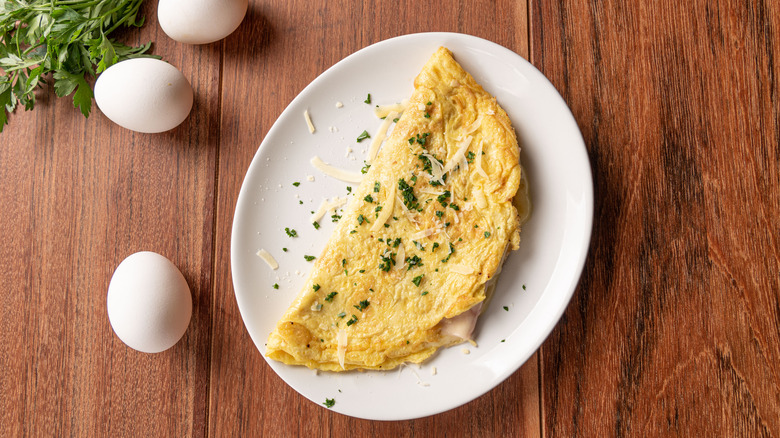
An omelet is one of those dishes that seems simple, but there's a lot of technique and nuance that go into making a good one. In fact, it's something that chefs are often asked to make when doing a trial shift in a kitchen to see how they handle it. If you're wondering why omelets are always better at a restaurant compared to the ones you whip up at home, there are all manner of small things that add up.
Whether attempting a perfect French omelet or a classic American version, everything from the tools you use to timing and technique make a difference to the finished dish. So, it's not like chefs have some big professional secret. Rather, there are many small differences that add up to a better final result. And then, there's the issue of preference. Everyone may have a slightly different idea about what makes a perfect omelet, so it can be a case of trying things out until you discover what you like.
Once you understand the differences that make good restaurant omelets better than homemade, you can start to improve your own. It can take a little time to perfect your timings and technique, so don't get disheartened if it isn't restaurant-quality the first time. Like they say, you can't make an omelet without breaking a few eggs.
Chefs start with the right tools
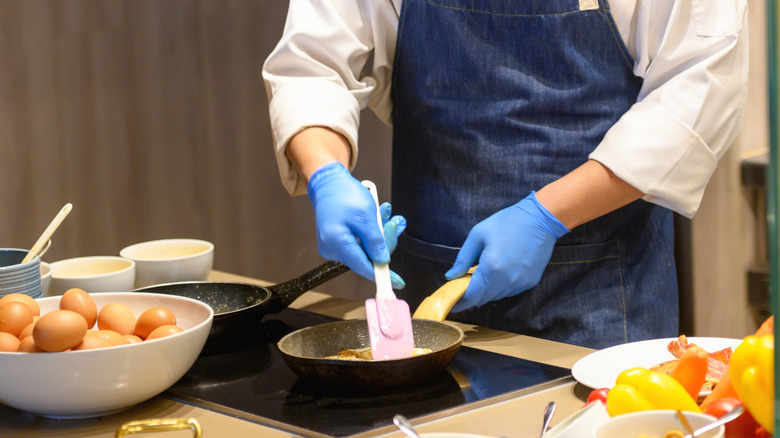
It might seem basic, but chefs start with the right tools to cook omelets, which can make more of a difference than you'd imagine. You don't need anything complicated, but if you're trying to make it work with the wrong equipment, it's no wonder you aren't getting the results you want.
If you cook regularly, you should already have what you need to make a restaurant-quality omelet. A heatproof rubber or silicone spatula is a must for moving the eggs around the pan. If you try to do this with a wooden spoon, you'll make a mess of it. And, naturally, you'll need a skillet. An 8-inch skillet is ideal for a three-egg omelet. If it's too small, the egg will take too long to cook through, while a too-large pan will leave you with a thin omelet.
Restaurants often use hard-wearing stainless steel pans, but you can end up having your eggs stick if you don't have the knack for cooking on stainless steel. For home use, a nonstick pan is a good choice. You may also need a lid for your skillet to help the middle cook through, unless you prefer your omelets runny.
Home cooks don't always whisk the eggs correctly
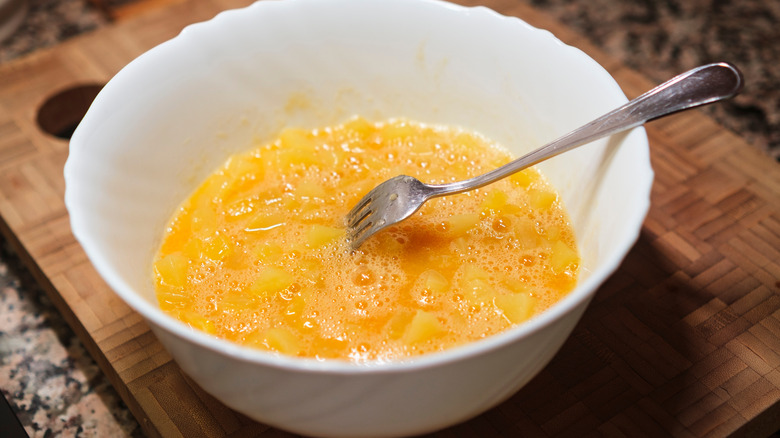
Home cooks often get the whisking stage of making an omelet wrong, leading to eggs that don't meet restaurant standards. You might assume that the more you whip your eggs the better, but that's not the case. You actually don't want to introduce too much air, as the resulting omelet should be creamy and a little dense rather than overly fluffy. However, if you don't beat your eggs enough, that leads to issues too.
While you might think to pick up a whisk for this task, chefs generally advise using a fork. Just like overwhipping, a whisk can introduce too much air to the mixture and ruin the classic omelet texture. It might seem pretty old-school to do the mixing with a fork, but it's the perfect implement for the job.
Using the fork, whip your eggs until they're fully mixed, with the yolks and whites combined. When making scrambled eggs, it's okay to have a bit of textural contrast that you'd get from streaks of white, but this isn't the case for omelets. You want the eggs blended together without any streaks. This will give you the kind of uniform omelet you'd expect to get from a restaurant. It can be tricky to find the perfect balance between perfectly mixed and overmixed, but the fork helps keep you from overdoing this.
Restaurants cook omelets in butter
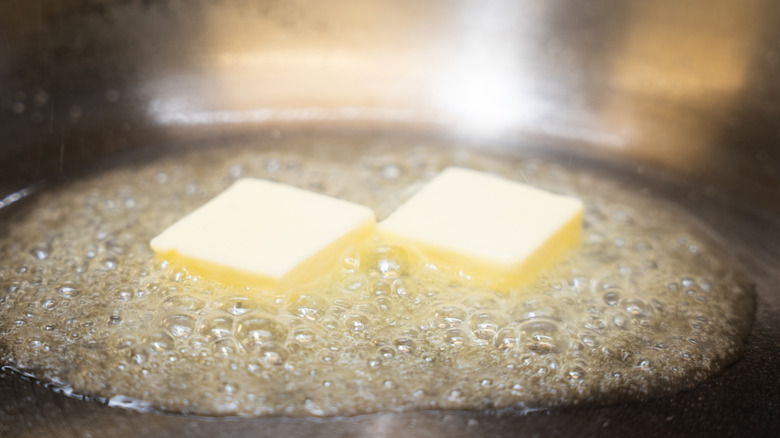
If you want to take your omelets to the next level, cook them in butter. This is the way that chefs often do it, and it makes a big difference to the flavor compared to cooking in a neutral oil, such as grapeseed or canola. While there are some omelet recipes that may call for something like olive oil, you'll get the most traditional, restaurant-worthy results by cooking with butter.
Butter helps keep the omelet from sticking to the pan, but that's not its only job. It also brings rich, savory notes to the dish. If you're feeling fancy, a quality European-style one, or even cultured butter, brings the most flavor. However, you should avoid using salted options. Between this and the seasoning, you might end up oversalting your omelet.
A tablespoon of butter is about right for a single omelet, though you don't have to be overly precise. Spoon it into a hot pan and let it melt. It shouldn't get to the point where it's sizzling, as this is a sign that your pan's too hot. And while brown butter is delicious, that's not what you're aiming for here. Add your eggs as soon as the butter has melted rather than continuing to heat it until it has color. If you've been forgoing butter, this might be one of the reasons why your homemade omelets aren't up to par with your restaurant faves.
Timing is important, so chefs have everything prepared in advance
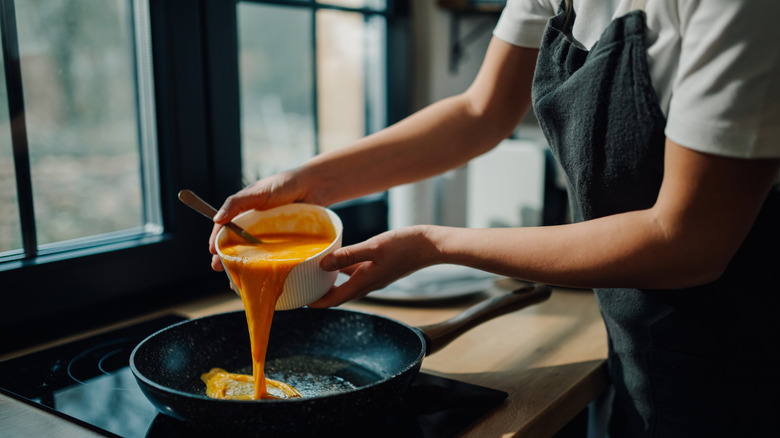
For a great, restaurant-quality omelet, getting the timing right is important, and once you've got everything prepped and ready to cook, the process is a fairly quick one. Therefore, chefs make sure they have everything they need on hand. Not preparing in this way means you're more likely to burn or overcook your omelet, or miss out an important step.
What you need are your whisked eggs, butter, salt, and a plate alongside your skillet. After heating the skillet, add the butter. When it's ready, pour the eggs in. You need the salt on hand to season the egg mixture while it's still liquid in the pan. Finally, you need the plate ready to go because once your omelet is perfectly cooked, it can easily venture into overcooked territory unless you get it out of the pan right away.
It might seem dramatic to say you need to have everything ready to go or you risk ruining your omelet, but it's true. This is also just a great habit to get into in the kitchen. If you prepare everything you need, it's easier to stay organized and avoid missing a step or ingredient. So, why not start doing so with an omelet — something you don't need an overwhelming number of ingredients or pieces of equipment to make?
A good omelet goes easy on the seasoning

A classic omelet recipe isn't elaborately seasoned, which is where some people go wrong trying to emulate their restaurant favorites. Sometimes the best dishes are the simple ones with minimal ingredients. You might think you could improve them by throwing in all kinds of herbs and spices, but sticking to the basics is what you want from an excellent omelet.
Salt is the main seasoning to rely on. It's often added once you've got the eggs cooking in the pan, but before they're too set for the salt to mix in. A reasonable pinch, or around ⅛ teaspoon, is all you need for a single omelet. Then, there's the question of pepper. Some chefs use black pepper, whereas others believe this is too strong and overpowers the eggs, instead opting for white pepper or forgoing it altogether. It's worth trying all three options over time to work out what you like best. But that's about it for seasoning.
That said, there are always exceptions. For instance, a masala omelet is a traditional Indian variation on the classic dish that uses a range of herbs and spices. These vary by region but may include the likes of turmeric and garam masala. Still, if you're trying to recreate a straightforward French or American omelet, you should keep seasoning to a minimum.
Chefs know how to stir eggs for the best omelet
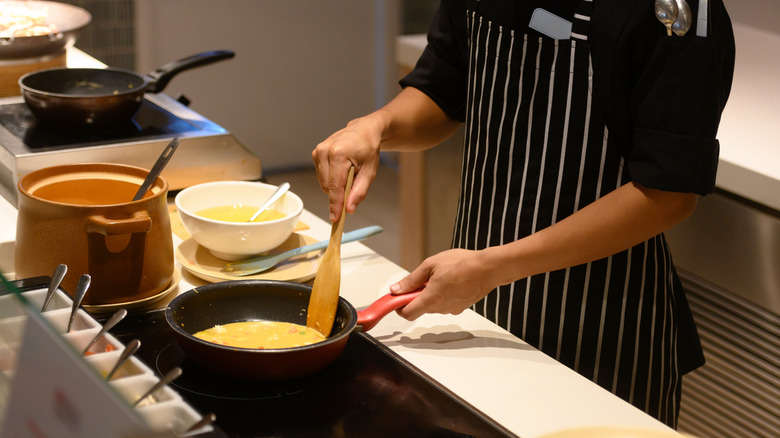
There are all kinds of mistakes people make when cooking omelets, but a common one is stirring the eggs wrong when they hit the pan. Chefs know exactly how to move the eggs to get the best possible results, whereas many home cooks just let them sit in the pan or give them a quick stir and hope for the best. Restaurant omelets are often made in the classic French style, which has a particular method that starts out not unlike scrambled eggs.
Not every chef has exactly the same technique, so there isn't one perfect way of doing it, but the important thing is to keep the eggs on the move at first. Some chefs use their spatulas to pull the mixture in from the edges as they start to set since the outsides cook before the center. Additionally, they'll stir the center intermittently to keep this from overcooking or turning brown underneath. Others stir in figure-eight motions, occasionally scraping the sides to keep the omelet from getting stuck and burning there.
The pros also move the pan around, which helps account for hot spots. If the eggs seem to be cooking more quickly in one particular spot, they'll move the pan to redistribute the heat. Once the eggs are starting to form large curds all over, it's time to stop stirring so that they can form a solid mass. Go any further and you'll end up with scrambled eggs.
Chefs stop cooking omelets before the eggs are fully cooked through
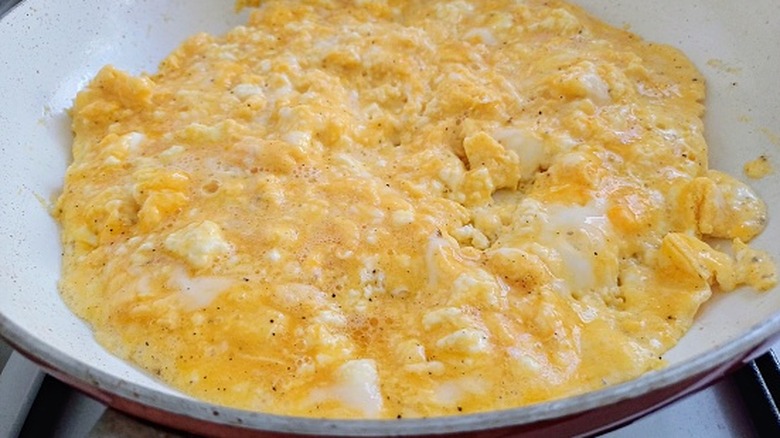
A good restaurant-quality omelet is soft, creamy, and certainly not overcooked. If you've been struggling to get this consistency at home and end up with firm or rubbery eggs, you've probably been cooking them for too long. Chefs tend to stop cooking omelets before the eggs have fully set. The residual heat will keep cooking and firming them up, so really you need to stop when the eggs are a little underdone.
At this point, the omelet should look runny on top but set underneath. You can use your spatula to lift it up to check that it's holding together, which signals that it's done. If it falls apart, keep in on the heat a little longer. If it holds together, it's almost done. Turn off the heat and leave it to sit for a minute or two before filling.
However, this method can leave omelets a little too loose for some preferences. If you like firmer eggs, there's a steamy way to avoid a runny omelet. When your eggs are at the point of holding up at the bottom but are still runny in the middle, turn your burner down as low as it will go and put a lid on your pan. This will steam them so that they're more set in the middle but don't end up burned or overcooked underneath.
Professionals know how to adjust the seasoning depending on mix-ins

Have you ever ended up making an omelet that was way oversalted, whereas your brunch spot favorite is always perfectly seasoned? This might be because chefs think about the balance of an omelet and know how to adjust seasoning levels depending on the mix-ins they use. It's easy to think of a recipe as a rigid, unchanging thing, but really it should be adaptable enough to work in different scenarios. Learning the nuances of this can be tricky, but once you do, it's a game changer.
Say you usually add ⅛ teaspoon of salt to your eggs when making an omelet. This might work perfectly every time, until one day you decide to add cheese or sun-dried tomatoes and suddenly that ⅛ teaspoon makes the mixture inedibly salty. The reason is other ingredients can add salt to the dish, meaning you need to reduce the amount you add to the mixture.
If you're incorporating a lot of cheese or have made a well-salted filling to go inside your omelet, you might find you don't need to add salt to the eggs at all. Or, if you do, it might be half or a quarter of your usual amount. Learning how to adjust these levels reliably will help you on your journey to restaurant-quality omelets.
Restaurant omelets contain thoughtful cheese choices

When you're making a cheese omelet at home, you probably just toss in whatever you have in the fridge, whether that's cheddar, mozzarella, feta, or anything else. Chefs, on the other hand, make careful choices when it comes to cheese, aware of the difference it makes to the finished dish. Some cheeses work beautifully, while others overwhelm the eggs.
It also makes a difference which style of omelet you're making. If you're whipping up a French version, a simple addition of Boursin can be a nice touch. It's fairly mild in flavor and doesn't get gummy and ruin the texture. French cheeses like brie or camembert would also be delicious. In a classic omelet, sharp cheddar can overwhelm the other flavors. However, in something more heavily spiced, like a masala omelet, the other ingredients can hold their own against the bold cheddar.
If you're hoping your cheese will have an ooziness, the variety you use also matters. Something like feta or halloumi won't melt much, so you won't get any kind of gooey texture. There isn't a single correct choice, but when you're served an omelet at a restaurant, it will have been a conscious decision based on what the chef is trying to achieve. So, at the very least, give it some thought before throwing in a handful of whatever shreds you have in the fridge.
Omelets from restaurants are finished with extra ingredients

If your omelet seems a little lackluster compared to your favorite restaurant version, it might be down to how you finish it. Chefs often use extra ingredients to finish omelets, even if the dish itself is kept simple. Knowing the perfect way to do this, or at least a few options you could use, will help you get that professional quality.
Chefs who want to keep things classic might finish omelets with a pat of butter and a sprinkling of chives. However, you can go more elaborate than that if you aren't a total purist. There are some fillings you should never put in an omelet, but there are plenty that work beautifully. Sauteed mushrooms or spinach are popular options, and fresh herbs of all varieties can work well for finishing, chosen depending on what you'll be eating with the dish. For instance, cilantro is ideal if you're eating an omelet as part of a Mexican-style brunch plate, whereas parsley is a more versatile choice that will go with plenty of flavor profiles.
You can spend time figuring out exactly how you like to finish your omelet, but the main thing is not to plop it out of the pan and call it done. The right finishing touches can make or break it.
Chefs understand that a good omelet takes time
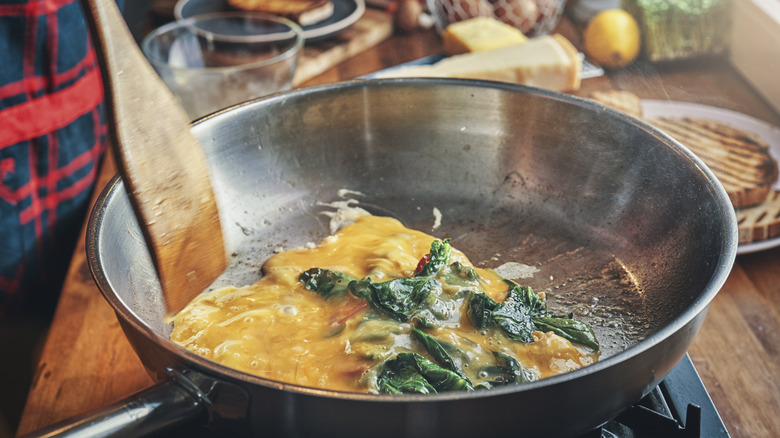
Chefs understand that omelets shouldn't be rushed. It's not that they take a long time to make in restaurants. This is still a quick dish. But setting the heat on the low side and taking your time gives much better results, which is something that a good restaurant puts into practice.
A well-executed omelet takes some patience along the way. You need to whip the eggs for long enough to make sure they're properly combined, and some pros even strain them after mixing to get rid of any lumpy or under-beaten parts that might have been missed. The pan needs to go on a medium-low to medium heat and the mixture should be stirred and watched throughout the whole process. It's not a dish you can throw in the pan and attend to something else while it cooks.
After turning off the heat, it also needs a minute to set using the residual heat before you plate it up. And you'll also need to pre-cook any fillings before folding them into the omelet. So, although there are some people who claim you can whip up a good omelet in 30 seconds, it's something that benefits from being taken slowly along the way.