

Does Pan Thickness Matter When Cooking On An Induction Stovetop?
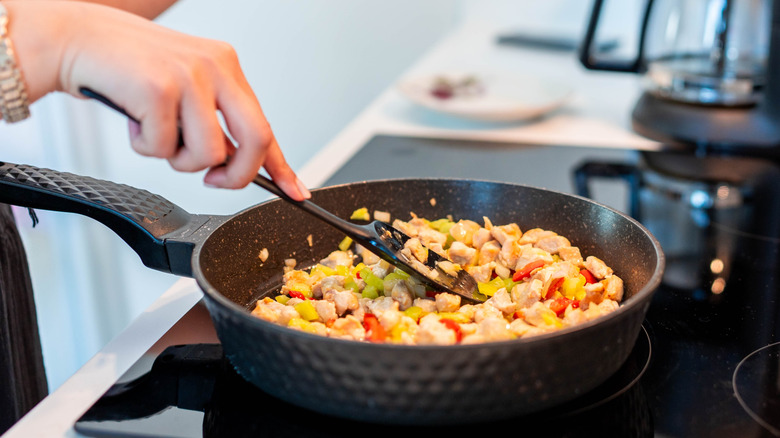
We may receive a commission on purchases made from links.
It feels like everything matters when it comes to induction stovetops. Unlike electric or gas stoves, induction is notorious for its specialty requirements — from the types of cookware you can't use down to the amount of electricity needed to power it. The reason is in the heating process. Forget the electric coil or an open flame; an induction stovetop uses electromagnetism to make the cookware the heat source. This leads to potential challenges for some of your existing kitchen equipment. Induction-compatible cookware must be magnetic, ultra-flat pans are needed for optimum heat diffusion, and of course, there's an ideal pan thickness.
Pan thickness matters on induction stovetops. The good news is this only works one way: the thicker the pan, the better. A too-thin pan may overheat, spread heat unevenly, or warp over time, while a thicker pan evenly (and slowly) distributes heat and is less prone to warping. As long as the pan is at least 3 to 5 millimeters thick (as a guide, two stacked quarters are 3.5 millimeters thick) and contains ferromagnetic material (like enameled steel or cast iron), it's a good match for your induction stovetop.
To measure pan thickness, you could use a precision tool (like a caliper) or measure manually with a ruler. In lieu of a caliper or ruler, there are a few buzzwords to look for when determining a pan's thickness. Here's everything you need to know.
What type of pans work best on induction stovetops?
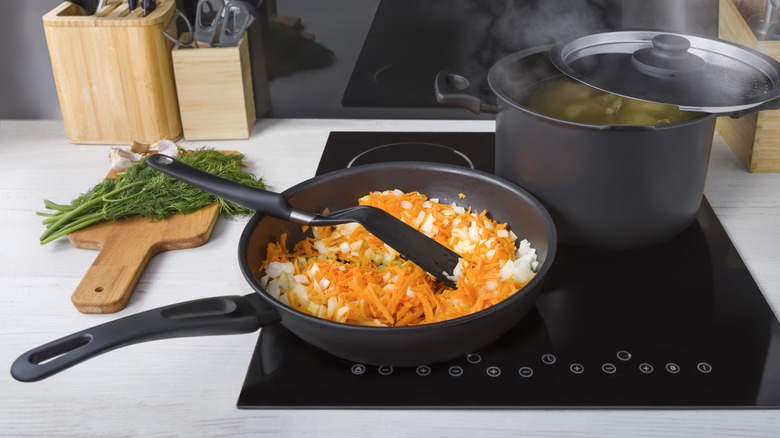
One of the more common induction stovetop mistakes is forgetting to use magnetic pans (i.e., ferromagnetic). These ranges cook with magnetism, sending an electromagnetic current from under the glass to the pan, incurring electron resistance and, as such, heat. Not all aluminum, copper, and stainless steel vessels will work. Ferromagnetic cookware includes cast iron, carbon steel, and magnetic stainless steel. To confirm whether your stainless steel pan is fit for induction cooking, try this simple magnet trick: If a magnet sticks to the bottom of your pan, you're good to go. Newer pans may have "induction compatible" etched into the base, along with a looped symbol resembling a coil.
Even if a pan is induction compatible, this has nothing to do with its thickness. Most product descriptions won't show thickness measurements, but one way to get around this is to look for pans described as "five-ply" or "tri-ply" and fully clad. This suggests there are multiple layers of metal supporting the pan everywhere, not just the base.
On a final note, you may want to avoid pans with embossed bases, as they can heat unevenly and cause inconsistencies in your cooking. The gaps between the pan's raised pattern and the glass cooking surface may also provoke a humming sound. Overall, you can't go wrong with tri-ply, induction-friendly cookware, like the All-Clad D3 stainless steel set or Cuisinart Chef's Classic 7-Piece stainless steel cookware.