

The Biggest Food Recalls In Aldi's History
In March 2024, Aldi issued a major product recall after its Village Bakery Tortilla Wraps were suspected to contain pieces of metal. According to the U.K. Food Standards Agency, the substance might have ended up in the flatbread due to tampering. While the human body requires small amounts of minerals such as iron and zinc to function, authorities have advised against eating the metal-laced tortilla wraps.
This isn't the first time Aldi has issued a concerning food product recall. In its history, the company has had to announce bigger (and sometimes more shocking) recalls to ensure customer safety. For instance, there was one about dangerous cheese, and another about 130,000 pounds of dangerous meat that affected 35 states. There was even an incident of horse meat that suppliers tried to pass off as beef. Read on if you want to know the biggest food recalls that have ever affected Aldi products.
Frozen peas recalled in 7 states
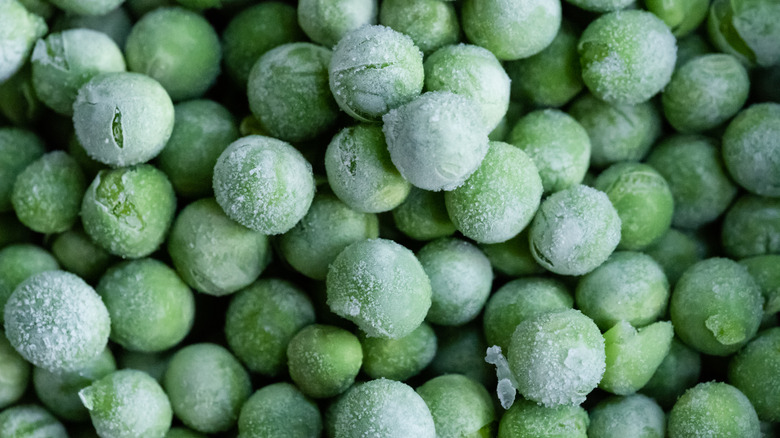
In April 2017, Aldi recalled over 2,000 packages of Season's Best Frozen Sweet Peas from stores in seven states, namely: Florida, Illinois, Iowa, Kentucky, Michigan, Ohio, and West Virginia. In a statement, Aldi said that it decided on the recall as a precaution and quickly removed the affected product from their store shelves.
The cause of such a recall in so many places? An outbreak of listeriosis, an infection caused by eating food contaminated by listeria bacteria. According to the Centers for Disease Control and Prevention (CDC), every year around 1,600 people contract listeriosis, with the most vulnerable groups being pregnant women, newborns, senior citizens, and those with compromised immune systems.
While listeria is not as prevalent as other foodborne bacteria like salmonella and E.coli, it is the deadliest. Of the 1,600 infected annually, 260 die from it. In the case of the Aldi's recall, there weren't any reports of anyone getting sick from the peas.
40,000 pounds of barbecue pork products
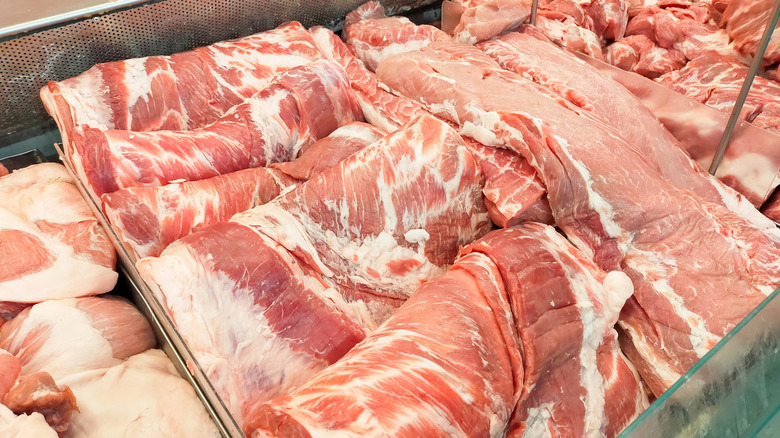
That's a lot of pork ribs. In May 2023, Eastern Meat Solutions Inc., which supplies pork products to Aldi and Walmart, recalled 40,763 pounds of pork that were not inspected by the U.S. Department of Agriculture's Food Safety and Inspection Service (FSIS).
The items that Aldi stocked, namely Park Street Deli Sweet Chipotle Boneless Pork Ribs with Sauce and Park Street Deli Hawaiian Style Boneless Pork Ribs with Sauce, originated from Ontario, Canada and entered the United States without being thoroughly inspected by the FSIS. Without these inspections, food items — especially meats — cannot be guaranteed safe for consumption.
There were no reports of anyone getting sick from eating the pork products, but customers were nonetheless advised to return or throw away the items. If you're unsure about the freshness of the meat you're about to eat, it's better to skip it. Authorities warned that eating undercooked or contaminated pork can lead to trichinosis and hepatitis, among other infections.
Meat products with bone fragments recalled in 35 states
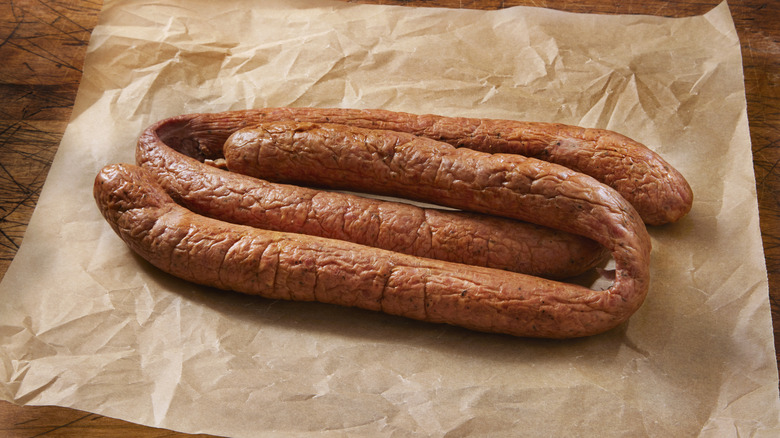
In January 2024, in cooperation with its supplier Salm Partners, Aldi recalled over 130,000 pounds of turkey kielbasa. There was so much of it that the recall affected stores in 35 states, totaling 2,972 Aldi stores nationwide. The reason for such a massive recall was bone fragments, which led to many unpleasant dining experiences and one minor oral injury.
There are different reasons why bone particles could end up in your kielbasa. For instance, with so much work involved in the slaughter process, it's hard for butchers to avoid overlooking bits of bone. Another is that many factories separate the meat from the bones using machines, which are not always so accurate, and this inaccuracy sometimes leads to pulverized bone bits in cuts like ground beef or sausages.
It's unclear though how exactly the bone fragments ended up in Aldi's Parkview Turkey Polska Kielbasa. According to the company, affected items were all contained in 13-ounce vacuum-sealed packages and labeled with the UPC code 4099100078954. So, for those who have been saving one of these in the freezer in anticipation of a future barbecue, it would be best to dispose of the kielbasa to save you and your BBQ guests a trip to the dentist.
Charcuterie meats that led to a salmonella outbreak
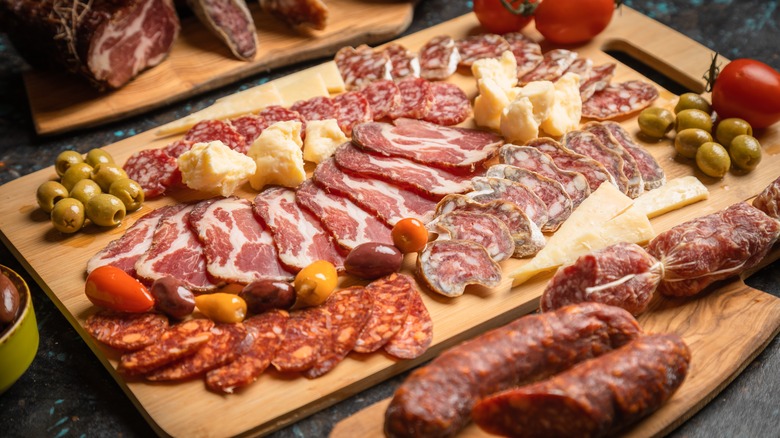
Skip the coppa at your next dinner party. In January 2024, Fratelli Beretta USA, Inc. recalled its charcuterie meats, particularly packages that contained coppa. According to the USDA, the contaminated items had the salmonella bacteria as a result of under-processing.
Aldi, which sells Fratelli Beretta's charcuterie meat products under its Appleton Farms Gourmet Deli Selection brand, recalled affected items from its stores in 39 states. If you bought coppa from Aldi at the start of the year, there's a chance that it could still be in your fridge, given its long shelf life. The product comes in a six-ounce plastic tray, has a best-before date of "7/3/2024," and has the UPC code: 4099100038149. If you do have the item in stock, the company has advised you to "discard it immediately or return it to their local store for a full refund."
In a report, the CDC concluded that the outbreak was over, but not before infecting 104 people from 33 states. 27 of those who fell ill were hospitalized, but fortunately, there were no reported deaths.
Six deaths and 159 hospitalizations from cantaloupe
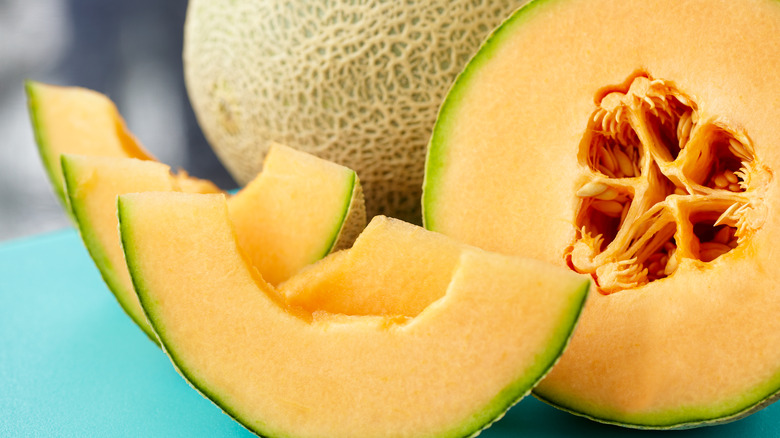
When you hear about salmonella, you typically think of contaminated eggs or meat, but did you know that it could also come from fruit? In October 2023, the CDC cautioned the public about eating pre-cut cantaloupe after a salmonella outbreak affected 407 people. Of that number, 159 were hospitalized and six died. The agency, however, added that those statistics were likely underreported because there were victims who recovered from salmonella without going to the hospital or getting tested.
The contaminated cantaloupes were distributed and sold in 44 states, leading to huge recalls involving many restaurants and retail chains. Aldi, for its part, issued a recall notice for its cantaloupe, cantaloupe chunk, and pineapple spear products in its stores in Illinois, Indiana, Iowa, Kentucky, Michigan, and Wisconsin.
There are many ways that cantaloupes can get infected, from coming in contact with animal feces or dirty irrigation water to improper handling by farm workers. The bacteria could also spread when the fruit isn't washed thoroughly. The cantaloupe's nubby surface acts as an ideal environment for bacterial growth, and when that tainted rind gets cut, the salmonella could move to the inner flesh. This is one reason it's best to avoid pre-cut fruit.
Stone fruits that left one person dead
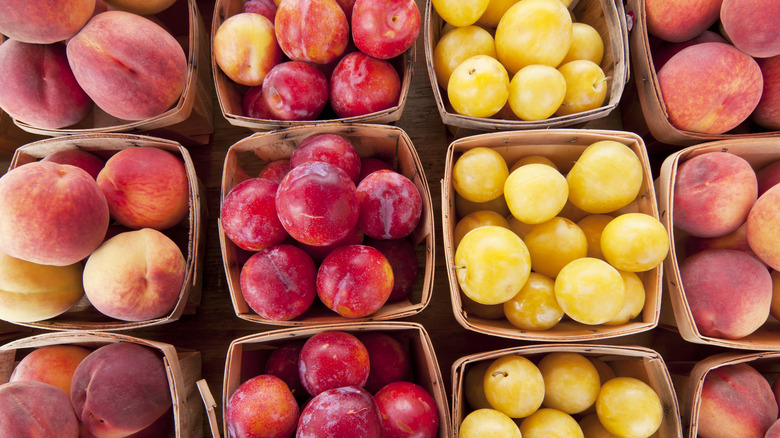
The last few months of 2023 weren't great for fruit lovers. In October of that year, there was the salmonella outbreak involving contaminated cantaloupes. Then, a month later in November 2023, the FDA warned the public to be wary of peaches, plums, and nectarines that carried the listeria bacteria.
The new outbreak resulted in 10 hospitalizations and one death in seven states. There was even a case of a woman going into early labor after contracting the illness. To contain the problem, HMC Farms, the supplier of the contaminated stone fruits, issued a recall affecting retailers Publix, Walmart, Albertsons, and Aldi. 29 Aldi locations across the country disposed of their fruit stocks.
If you recently stored peaches, plums, or nectarines in your crisper drawer, don't forget to wash them before eating because cold temperatures cannot kill the listeria bacteria. And if there's a recall notice related to the fruits you bought, discard the produce immediately and don't even bother making a smoothie.
Over 80,000 cases of Kraft Singles
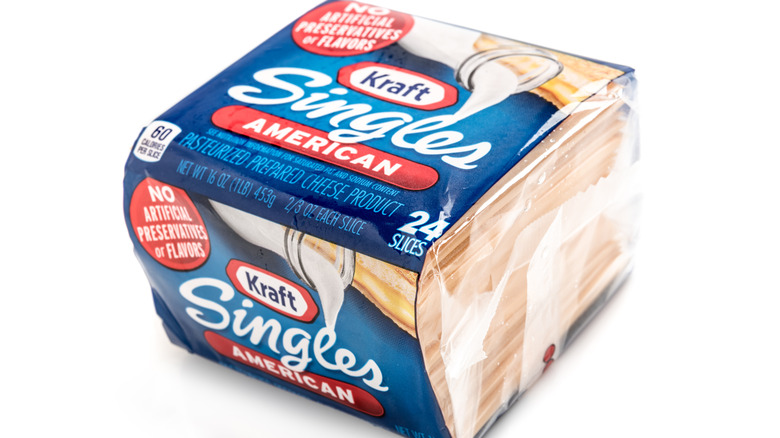
There was nothing to smile about for retailers like Aldi when Kraft Heinz announced a recall of about 83,800 cases of its individually wrapped Kraft American Singles processed cheese slices in September 2023. In a statement, Kraft Heinz explained that it had received complaints from customers who had choked on the cheese's thin plastic film. After an investigation, it was found that the issue was due to a manufacturing error wherein tiny strips of plastic remained on the cheese slice even after removing the wrapper.
There were no deaths or serious injuries from the incident. Kraft Heinz also assured the public that it had repaired the broken wrapping machine and checked others for similar errors. With the cheese slices being a popular grocery item that's stocked nearly everywhere, Aldi was heavily affected by the recall. The grocery store chain had to remove the Kraft Heinz product from its stores in 38 states.
38,909 cases of contaminated pineapples
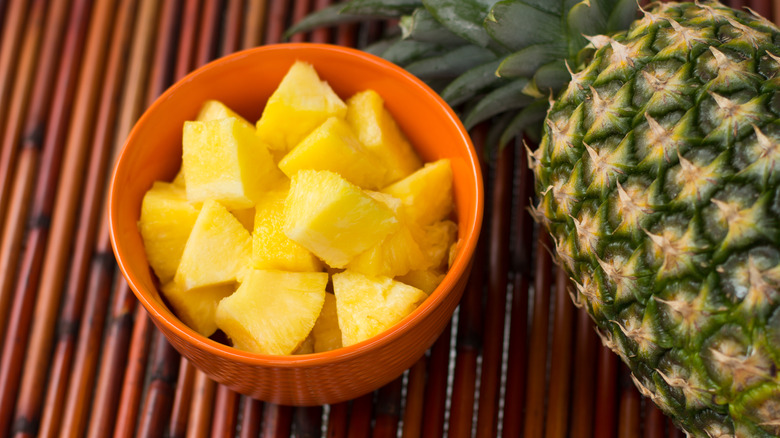
By now, you know that listeria is one persistent parasite. It not only caused outbreaks related to frozen peas, peaches, plums, and nectarines, but in July 2023, it also led to pineapple contaminations.
How pineapples transmit listeria is quite similar to how cantaloupe is contaminated. If the fruit is improperly handled, the bacteria clings and proliferates in the many nooks and crannies of its rough outer surface. And because a pineapple's rind is difficult to wash, unsuspecting victims tend to skip or hastily do this preventive health measure. The end result is the same: The bacteria transfers to the inner parts of the fruit during the cutting process.
Aldi, in cooperation with its supplier SunOpta, recalled its Season's Choice brand of frozen Mixed Fruit and Tropical Blend Fruit in response to the outbreak, pulling out 38,909 cases from its stores in 27 states. The issue also heavily affected other retailers based on FDA data. For instance, Whole Foods removed 34,578 cases of its 365 Organic Tropical Fruit Medley, while Walmart disposed of 70,360 cases of its Great Value Mixed Fruit. And although no illnesses were reported, the listeria-related incidents that we've featured so far remind us that we really need to know how to wash fruits and veggies.
Onions that caused a nationwide salmonella outbreak
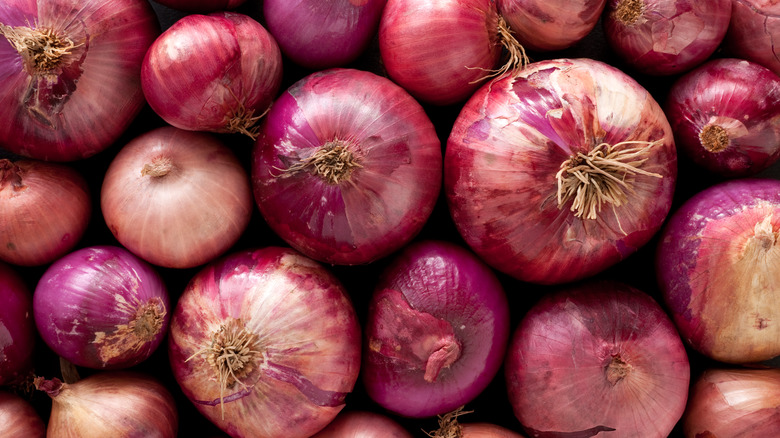
In 2020, the COVID-19 pandemic wasn't the only outbreak that health authorities had to deal with — there was also the one involving salmonella. In June of that year, the CDC noticed a surge in salmonella infections linked to red onions and warned the public to avoid eating onions of any type supplied by Thomson International Inc. The spread of the bacteria had already begun, however, and by October 2020, the infections had reached every U.S. state except Louisiana and Vermont. A total of 1,127 people fell ill from the salmonella strain and 167 of those were hospitalized. No deaths were reported.
In response to the outbreak, Aldi recalled all red, white, yellow, and sweet onions under the Onion 52 brand, which was supplied by Thomson International Inc. The recall affected Aldi locations in 14 states, as well as items available on Instacart. Other companies that also had to issue similar recalls included Walmart, Kroger, and Food Lion.
The CDC estimates that salmonella causes 1.35 million infections in the U.S. alone each year, leading to 26,500 hospitalizations and 420 deaths. To reduce your chances of catching the bacteria, ideally choose fresh onions that aren't bruised or damaged. Make it a habit to use a separate cutting board for raw chicken to avoid cross-contamination.
56,578 pounds of sandwiches recalled for plastic contamination
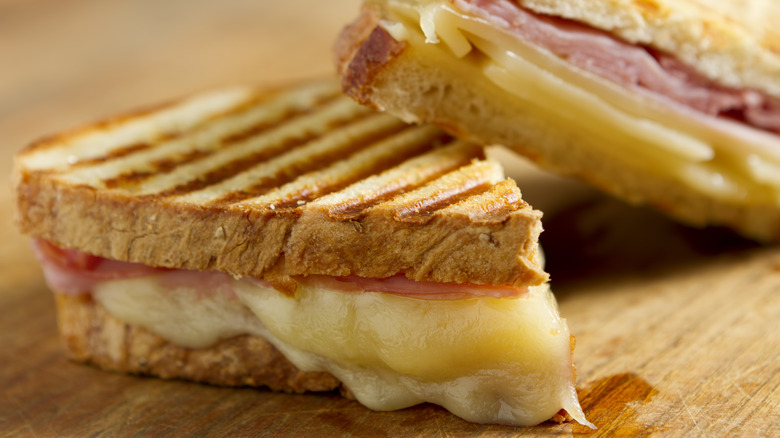
In April 2019, one foreign material became a sandwich filling: Hard semi-transparent plastic. After receiving customer complaints about the unexpected ingredient, manufacturer J&J Snack Foods Corp. recalled 56,578 pounds of its hot stuffed sandwiches from retailers nationwide. To put that into perspective, the serving size of a 6-inch roast beef sandwich at Subway is 224 grams (or roughly 0.49 pounds). If we're to imagine the amount of recalled J&J sandwiches in terms of Subway subs, it would be around 115,465 roast beef sandwiches.
Aldi, which stocks the products, recalled its supplier's Bremer Classic Pepperoni Pizza Hot Stuffed Sandwiches and Bremer Classic Ham & Cheese Hot Stuffed Sandwiches from stores in 29 states. It's unclear how so much plastic got included in the sandwiches or how many people had accidentally ingested the unsavory filling. FSIS later said that no one was harmed from the incident.
More than 132,000 pounds of meat contaminated with E.coli
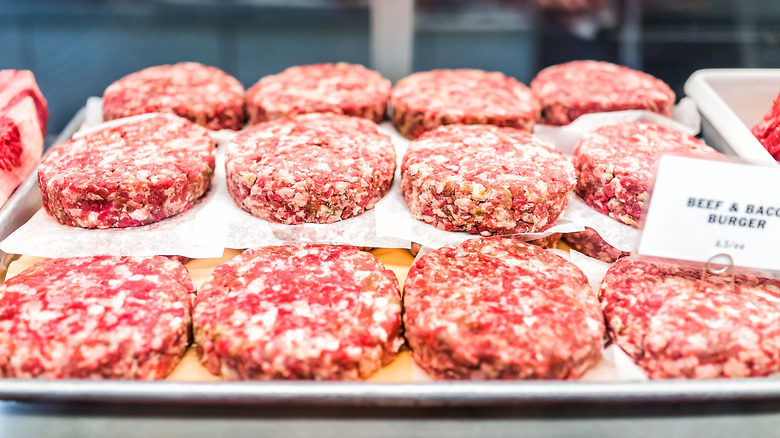
In July 2018, at least 18 people started feeling sick after consuming ground beef from manufacturer Cargill Meat Solutions. Two months later, the USDA announced that one victim had died. The culprit? E.coli.
According to the USDA, meat from the chuck portion of the carcass had been contaminated with a strain of E.coli (O26) that could cause fever, diarrhea, vomiting, and kidney failure. It takes an average of 34 days after exposure for victims to fall ill, which means by the time authorities became aware of the situation, the beef products had already been distributed to locations all across the country.
To contain the outbreak, Cargill recalled 132,000 pounds of its meat products, with Aldi asking its customers in 11 states to dispose of a couple of varieties of 80% lean ground beef patty products. The company also advised Chicagoland-based consumers using the Instacart delivery service to discard the affected items. The massive recall worked and the CDC said that the outbreak was contained.
11.7 million pounds of chicken strips
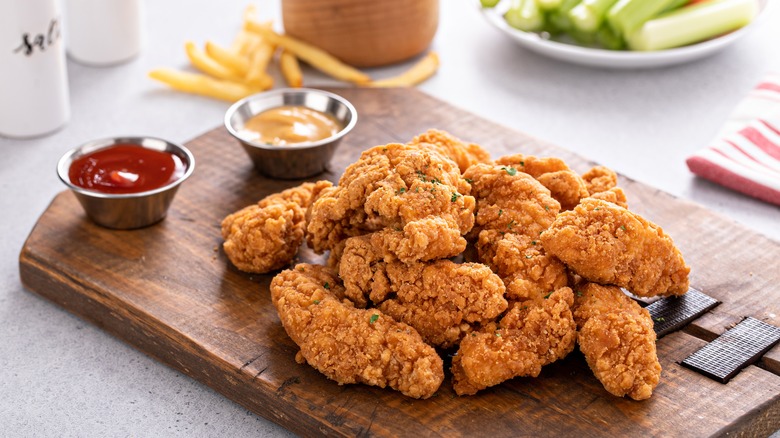
As it turns out, metals ending up in processed foods is more common than we think. In May 2019, Aldi recalled its Kirkwood Buffalo Crispy Chicken Strips and Kirkwood Honey BBQ Crispy Chicken Strips after supplier Tyson Foods revealed that 11,829,517 pounds of its frozen, ready-to-eat chicken products potentially contained metal.
The FSIS received two complaints from customers who had bitten into the pieces of metal. Other consumer complaints followed, with three saying the extraneous material had caused oral injuries. The grievances forced authorities to classify the chicken strips as high health risks. There were so many of the chicken strips that, for its Kirkwood Buffalo Crispy Chicken Strips and Kirkwood Honey BBQ Crispy Chicken Strips brands, Aldi recalled products available in 29 and 33 states, respectively. There were also recalls in Walmart and AWG stores, as well as notices for products exported to Hong Kong, Bermuda, and St. Maarten.
This wasn't the first time that Tyson Foods had to recall contaminated meat in an enormous quantity. The company issued five different recalls throughout 2019 because pieces of metal, rubber, and plastic kept ending up in its products. Then, in November 2022, it recalled 93,697 pounds of beef due to mirror-like materials in the raw meat. None of these other incidents though involved Aldi.
A salad contamination that had two recalls and affected two countries
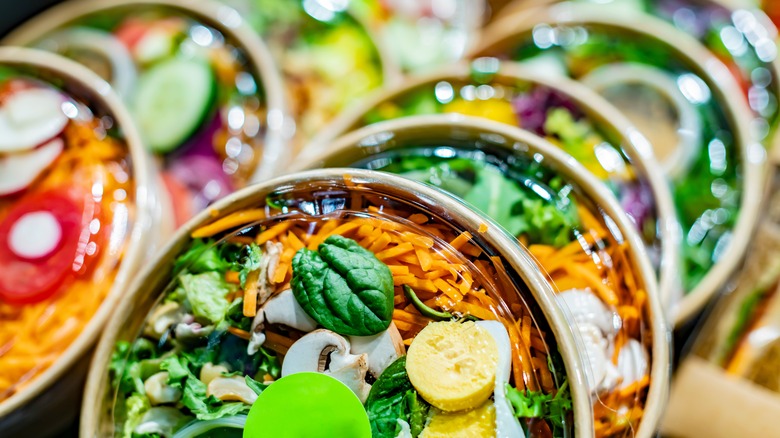
In December 2021, Dole announced a recall of its Dole-branded salads, as well as Aldi's private-label products, namely Little Salad Bar and Simply Nature salad kits. The reason for recall shouldn't be a surprise anymore. It was listeria, which was present in random samples taken from the company's Bessemer City, North Carolina and Yuma, Arizona processing facilities.
As mentioned earlier, listeria is a bacteria that poses a danger to pregnant women, newborns, senior citizens, and the immune-compromised. Eating affected foods can result in fever, chills, nausea, diarrhea, convulsions, vomiting, and even death. For the public's safety, Aldi removed the brand salads from its locations in nine states, while Dole notified other retailers in 17 states to recall products containing the lettuce.
But that wasn't enough to stop the spread of the contamination. In January 2022, there was a second Dole recall, this time for salad kits made at their facilities in Springfield, Ohio and Soledad, California. The recall included Aldi's Little Salad Bar brand, forcing the company to take down the items from stores in 22 states. In addition, Aldi removed the said products available on Instacart's grocery delivery platform. Dole asked other grocery companies not only in the U.S. but also in Canada, to remove affected salad bowls and kits. Despite the bacteria becoming widespread, Aldi said that there were no reports of serious illness related to their products.
Beef products that were actually horse meat

One could argue that this was the biggest scandal in the company's history. It not only involved many Aldi stores, but also the entire European Union. In January 2013, news rocked Europe when lab results confirmed that beef burger products sold in various E.U. member states actually contained horse meat. More chaos ensued as Aldi rushed to take down the products while governments across the continent started investigations. That was just the beginning, however, and soon, more Aldi products like Today's Special Frozen Beef Lasagne and Today's Special Frozen Spaghetti Bolognese were found to contain up to 100% horse meat.
How did horse meat end up in beef products? It's a bit complicated; there were a lot of pointing fingers. Aldi blamed its supplier Findus for the contaminated meats. Findus, in turn, blamed its meat supplier Comigel, which blamed its supplier, who then blamed ... you get the point. In the end, authorities arrested a Dutch wholesaler who allegedly sold 300 tons of horse meat and jailed three U.K. men who inflated their profits by passing off horse meat as beef, which is more expensive. If you'd like to read more about the E.U.-wide issue, we published a horse meat scandal explainer.
Shredded cheeses might have contained metal fragments in 31 states
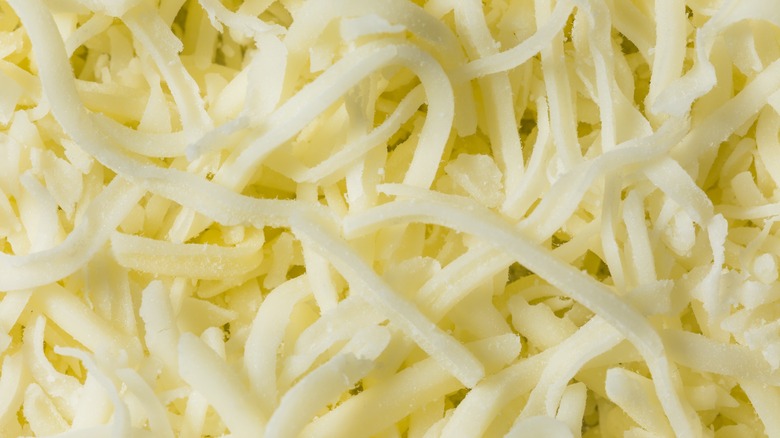
Hold the cheese, please. In October 2025, Aldi stores were in the middle of a massive recall of bagged shredded cheeses that affected 31 states. The Great Lakes Cheese Co., one of Aldi's suppliers for its Happy Farms private dairy label, recalled more than 1.5 million bags of shredded cheese across the U.S. over a concern that metal fragments could be included in the bags of mozzarella. Not such a great addition to pizza night, if you ask us.
Great Lakes Cheese said its mozzarella supplier notified the company of potential foreign objects in the cheese, which began the domino effect of recalls. Aldi recalled the low-moisture shredded mozzarella, along with the Happy Farms Italian Style shredded cheese, which contained some of the mozzarella in question.
Aldi was far from the only retailer to recall its bagged cheeses in late 2025: Walmart's Great Value and Target's Good & Gather store brands were some of dozens of others brands who received shredded cheeses from Great Lakes Cheese that ended up as part of the recall. Even higher-end brands like Borden and Lucerne Dairy Farms were included — making you wonder how different the mozzarella really is.
Bags of flour recalled in 11 states after people got sick from potential E. coli contamination
In case you need the encouragement not to lick the spoon when you're baking, a 2019 recall for Aldi's flour serves as a reminder that people can (and do) get sick when they're not patient with cookie batter.
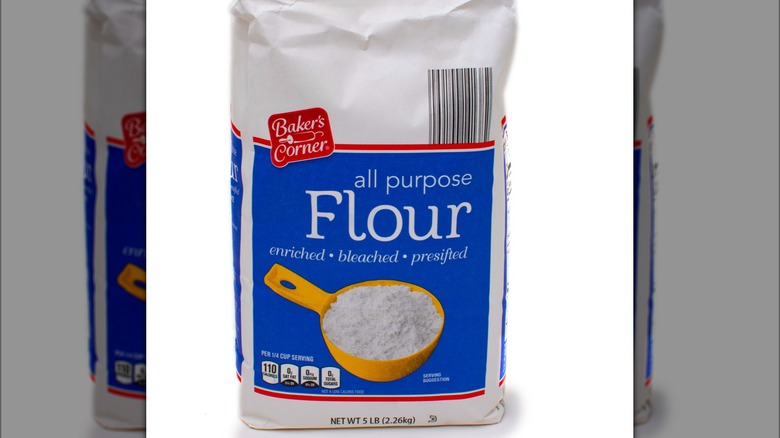
Aldi recalled bags of its Baker's Corner 5-pound bags of all-purpose flour when customers reported getting sick from potential E. coli contamination. According to the CDC, 21 people across nine states fell ill after consuming the flour, and three people were hospitalized. Thankfully, no deaths were reported as a result of the incident. In interviews with the CDC, some customers admitted they taste-tested the raw batter before baking it — a classic no-no according to the agency, since it can elevate the risk of food poisoning caused by germs from E. coli and salmonella.
Even though there was some responsibility on the customers' part, Aldi recalled the flour from stores across 11 states in an effort to remove it from its shelves. Aldi wasn't the only store carrying the problematic baking ingredient, as other brands like Pillsbury and King Arthur were included in the same recall.
Brie and Camembert cheeses were potentially tainted with listeria in 6 states
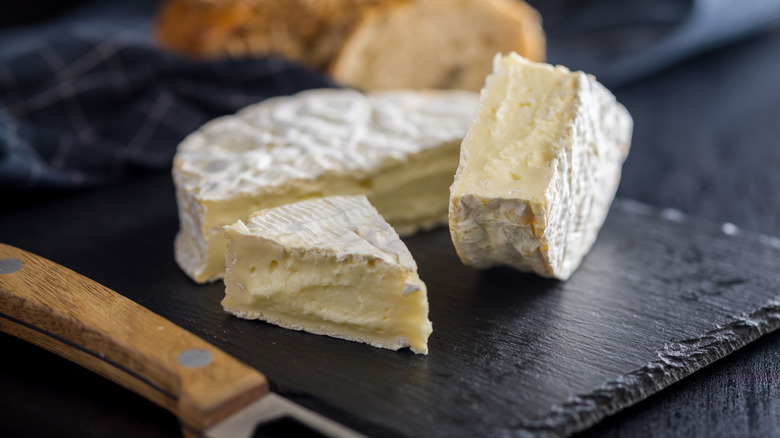
According to the USDA, pregnant women should avoid eating soft cheeses while they are expecting, because of the elevated risk of foodborne illnesses — especially listeria. This recall of brie and Camembert cheeses from Aldi stores illustrates exactly why. (Listeria can make anyone ill, but pregnant women and unborn babies still in utero are among the particularly high-risk groups).
In November 2024, recalls of the cheeses were issued and promptly expanded across six states for potentially being tainted with listeria. Aldi's supplier for the products, Savencia Cheese, announced the recall after testing at a manufacturing plant showed that some equipment might have been contaminated with listeria. The recall affected Aldi's Emporium Selection Brie, as well as La Bonne Vie's Brie and Camembert cheeses. Aldi and its suppliers enacted the recall out of an abundance of caution, since thankfully no one reported illnesses associated with the products before they were removed from stores.
Though the recall wasn't nationwide, it's not the only brie-related incident recently, at least on a global scale. The store also needed to recall its Emporium Selection Brie and French L'Ovale Cheese in August 2025 across Australia for a separate listeria-tainted cheese concern.
More than 100,000 cases of apple juice containing arsenic above regulated guidelines
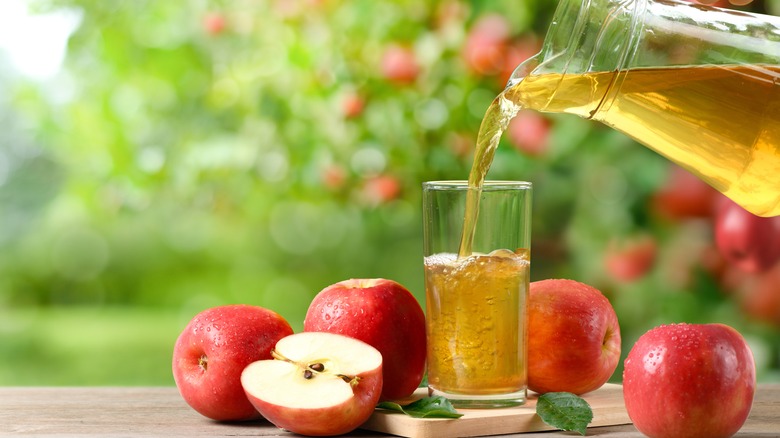
Arsenic is reserved for Cold War movies and Agatha Christie novels, right? Think again. Though the chemical is most notorious for being used as a covert poison, the compound exists naturally in the soil and can enter foods during growth or processing stages. The FDA monitors arsenic levels in foods, supplements, and cosmetics as a result, but every now and then testing shows elevated levels in certain food products.
In August 2024, Refresco Beverages recalled 141,298 cases of apple juice that contained levels of inorganic arsenic that were higher than the FDA guidelines. Refresco bottled apple juice for multiple brands and stores, including Nature's Nectar 100% Apple Juice, which was sold by Aldi. Aldi's recall included 16 states, though the larger recall also covered apple juice sold by Walmart under its Great Value brand. Walmart's distribution included a larger footprint of 25 states, along with Puerto Rico and the District of Columbia. Apple juice was also recalled from BJ's, Dollar General, Weis, Market Basket, and more.
In a statement to ABC News, a Refresco Beverages spokesperson said the arsenic level was "slightly above" the FDA's set guideline of 10 parts per billion, and that the company issued the recall voluntarily. No one reported illnesses associated with the juice, which is very good news considering children are particularly vulnerable to arsenic — and also the most likely population to be sipping on apple juice in the first place.
A frozen waffle recall that affected thousands of stores in the U.S. and Canada
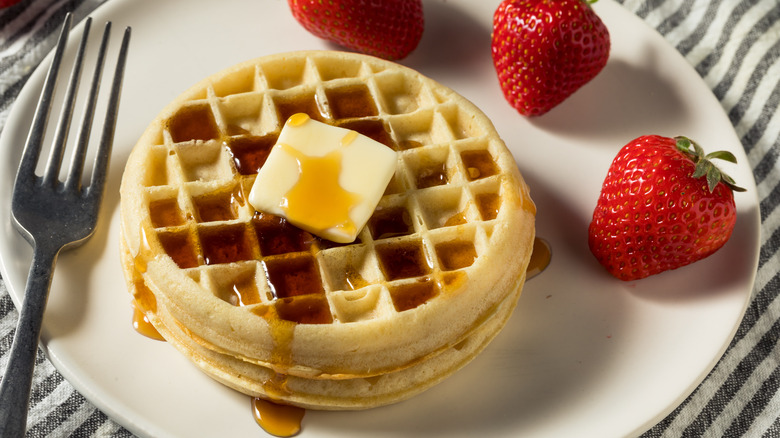
Frozen waffles are a breakfast staple across the U.S. — particularly if you've got children (of any age, really). But customers across most of North America were tossing their toaster-ready waffles and pancakes after a massive recall affected many retailers in the U.S. and Canada.
TreeHouse Foods recalled all of the frozen waffles and pancakes processed at a particular manufacturing facility in Ontario, Canada in October 2024 when routine factory testing showed that some equipment was contaminated with listeria. TreeHouse Foods produces foods for a number of North American brands and private store labels, and the recall included popular brands sold at Aldi, Walmart, and Target, just to name a few. The recall included hundreds of different products, including Whole Foods' 365 brand, Kodiak Cakes, and Krusteaz. According to TreeHouse Foods, there were no reported illnesses associated with the frozen breakfast items.
Aldi's waffles and pancakes included in the recall were sold under the Breakfast Best brand name, and included six flavors of frozen waffles and one buttermilk pancake option.
Nearly 25,000 pounds of Casa Mamita taquitos
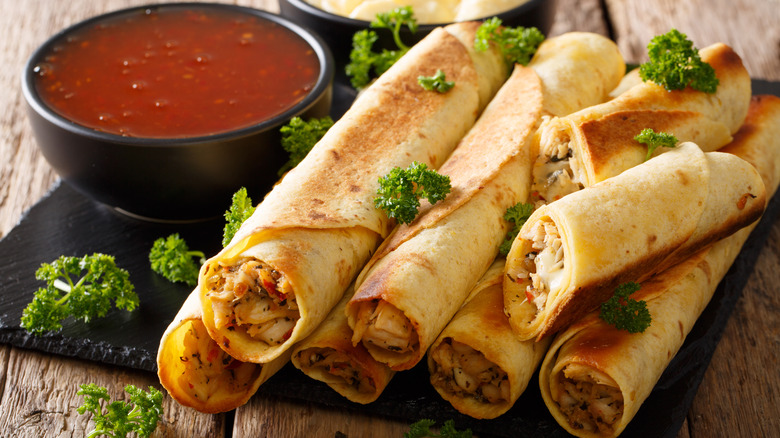
Though some recalls for Aldi products are part of larger issues from suppliers, and Aldi is just one of many stores impacted, there are other cases where only Aldi products are the issue. That's the case with a recall in January 2025, when 24,870 pounds of taquitos were recalled from Aldi stores.
Aldi's supplier for the Casa Mamita frozen chicken and cheese taquitos, Bestway Sandwiches, said it issued the recall because the taquitos could have been contaminated with metal fragments. The company received a customer complaint about finding a piece of metal in the frozen taquitos they bought. Another person reported a dental injury after eating them, according to the USDA's Food Safety and Inspection Service.
Because of the long shelf lives of frozen foods, Aldi stores were concerned for a while that the taquitos could still be sitting in customers' freezers — metal fragments and all. The 20-ounce Casa Mamita taquitos had best-by dates of July 3, 2025 and September 25, 2025, which means that by now you should have disposed of the taquitos either way. If you're a frequent Aldi shopper but your frozen foods linger for a while, though, it's best to double check you're about to chow down on newer boxes of these Tex-Mex treats.
A nationwide recall of a dessert dip months after it was reintroduced
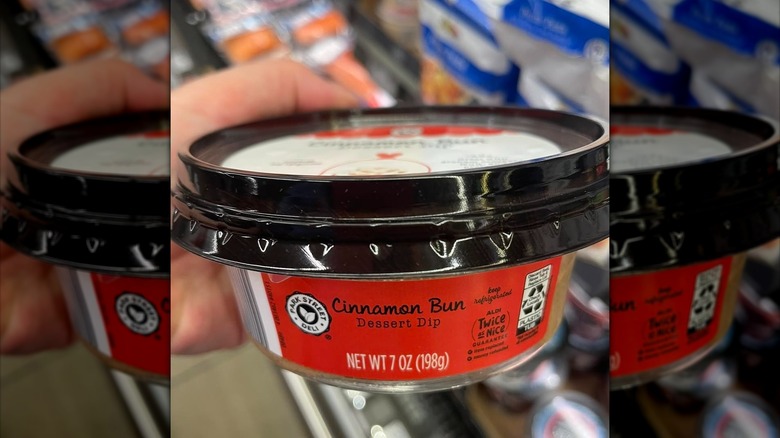
Aldi has a wide selection of dips — many of which we've ranked from worst to best. But while there's a healthy array of savory options for your crackers or veggies, there aren't as many dessert dips to enjoy when your sweet tooth comes knocking. All that said, shoppers went wild for Aldi's cinnamon bun dip, packaged under the Park Street Deli brand. Unfortunately, it was also at the center of a nationwide recall in August 2025, just months after coming back from a hiatus.
According to several Reddit users, this "dangerously good" dip was so amazing, it deserved its own thread devoted to brainstorms about what to eat with it. But while it was on store shelves in mid-2024, it had disappeared by March 2025, with the retailer confirming on X that it didn't have specific plans to bring it back. Apparently, the powers that be realized fans were clamoring for a comeback, though, because excited customers posted about the dip's return in June 2025.
Alas, the return was short-lived, as Aldi recalled more than 19,000 containers of the cinnamon bun dip nationwide just two months later. According to Aldi, the dip containers were potentially contaminated with pieces of plastic — a most unwelcome addition during snack time. Unfortunately, the recall might also have marked the end of the cinnamon bun era, as a quick online search of Aldi products in January 2026 doesn't show any results.