
What Happened To RoboBurger After Shark Tank?
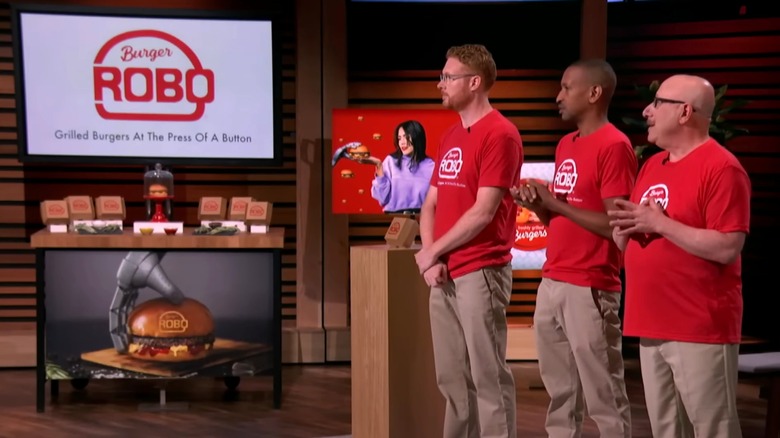
RoboBurger's founders — Audley Wilson, Dan Braido, and Andy Siegel — walked into "Shark Tank's" 15th season with an audacious ask: $1.5 million for just 5% equity, effectively valuating the company at an impressive $30 million. While the Sharks balked at first, there was no denying the business' potential. RoboBurger was pitched as a revolution in quick service food, a robotic vending machine that assembled newly-cooked Angus beef burgers at any time of day in just under four minutes. The machine measured an economical 12 square feet and was plug-and-play, like a portable version of the burger-flipping robot at Sam's Club. Better yet, RoboBurger had seen moderate success through 18 months of pilot runs.
It was also one of the more chaotic pitches of Season 15. Wilson, Braido, and Siegel were flipping burgers over their shoulders, dancing the robot, and admitted to operating at a $700,000 loss in the past year. Enthusiasm for the product faded fast until a last-minute save from one of the Sharks helped RoboBurger score one of the biggest deals of the season, as well as one of the biggest food deals in Shark Tank history, period.
What makes RoboBurger's success on "Shark Tank" particularly impressive is that none of its three founders had a significant background in the food industry. Wilson came up with the idea while running a restaurant he founded during college, but his career later transitioned into data science. Braido was a robotics expert he'd met as a student in Carnegie Mellon, and Siegel was a television marketer he met after graduating. The three teamed up in 2019 to make RoboBurger a reality, and have been working on growing the business since.
What happened to RoboBurger on Shark Tank?
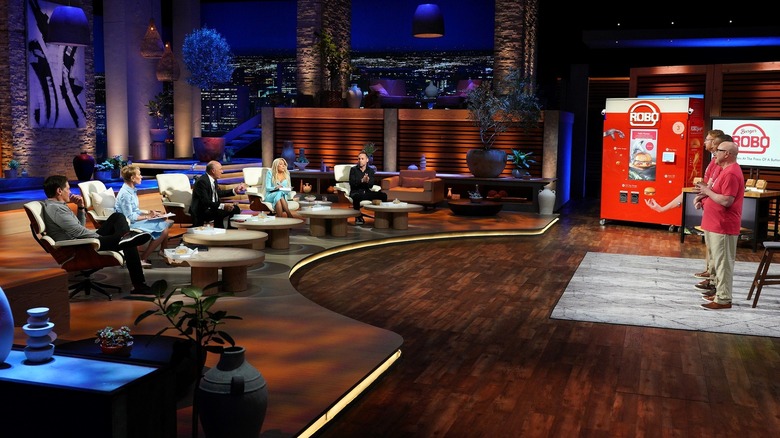
After four years of testing and development, RoboBurger's founders finally made it onto "Shark Tank." While the quality of their burgers had some of the Sharks convinced of the product's potential, there were some serious concerns about the business itself. Barbara Corcoran raised a pink flag about the burgers' customizability early on, after Dan Braido admitted the machine could only serve pre-cooked, well-done burgers due to health and safety standards.
Mark Cuban was the first to pull out, correctly citing concerns about developments in food robotics outpacing their vending machine model — McDonald's, for instance, already had a robotic drink machine in 2023. Guest Shark Michael Rubin was the next to go because the economics simply didn't work out for him. Barbara Corcoran backed out because prior experiences with a vending machine business taught her that they were too much of a hassle to work with, while Lori Greiner found the business model too confusing to make a deal.
It looked as though Kevin O'Leary would be next, especially since the RoboBurger team's inability to give him straight answers about their financial outlook had him visibly frustrated, but Rubin suddenly changed his mind. He offered them a $1.5 million loan at market interest rates for 10% equity, which O'Leary called "a very Mr. Wonderful structure". O'Leary offered to split the loan with Rubin, and after a quick negotiation, RoboBurger secured the full $1.5 million loan for 9% equity split between the two Sharks. This came as a bit of a surprise for fans of Mr. Wonderful, since O'Leary shared in an exclusive interview with Mashed that successful food pitches had to be family-centric and healthy — neither of which RoboBurger really stood out as.
RoboBurger after Shark Tank
RoboBurger has stayed relatively quiet after its "Shark Tank" episode aired on April 19, 2024. After a handful of social media posts in the days that followed, the brand has only posted twice since. There is currently no publicly available information on whether or not the "Shark Tank" deal pushed through. The fan site Shark Tank Recap writes that it did, but did not disclose its sources. It should be noted that, according to a 2023 report by Forbes, Kevin O'Leary was among the Sharks who were least likely to close a deal after the show at just a 45% closure rate, so the odds aren't exactly in RoboBurger's favor.
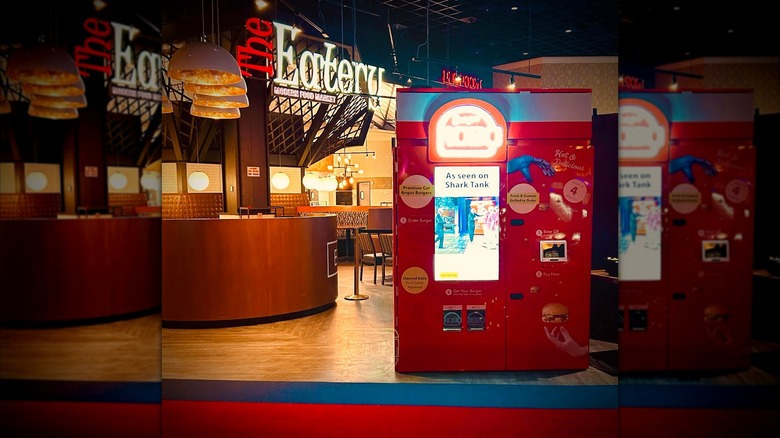
There is also little information on any new locations that have opened up since RoboBurger's episode aired. The brand doesn't provide these details on its website. Audley Wilson, however, did post in mid-2024 about RoboBurger launching a machine at two Hollywood Casino locations in St. Louis and Indiana.
What we do know for sure is that RoboBurger has expanded its menu from its initial offerings. Aside from its original Angus beef burger patties, customers can now order the RoboPlant, a meat-free patty made from black beans, brown rice, onions, corn, and tomatoes. There's also the RoboEgg, a breakfast sandwich that can be made with either a pork sausage patty or a vegetarian version. Its sauce and condiment options have also expanded from the original ketchup, mustard, and cheese to include mayo, relish, and hot sauce.
Is RoboBurger still in business?
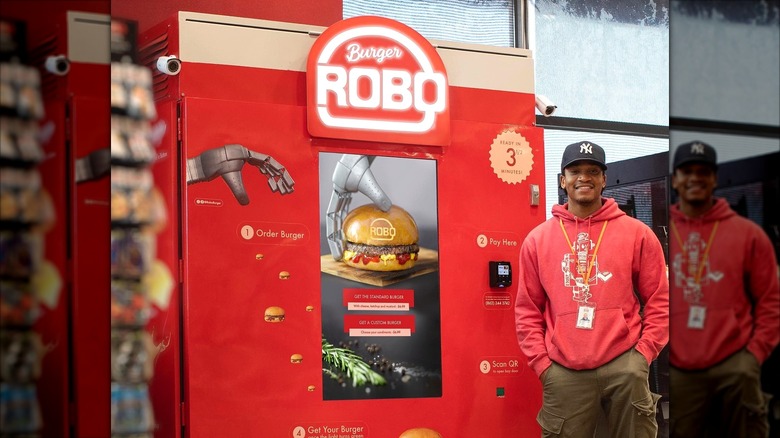
As of this writing, RoboBurger is still operating. It's difficult to determine if sales have improved since its appearance on "Shark Tank"; the company hasn't shared any of that data. All we know is that RoboBurger sold 12,000 burgers over 18 months before its episode was filmed. Most reviews of the burgers themselves also tend to be dated prior to 2024 and are heavily mixed, ranging from "worse than McDonald's" to as good as what you'd get at a home barbecue. The two most recent reviews on Yelp are from late 2022; one of them is for a location that was reported closed in January 2026.
Aside from selling burgers from its own machines, the company sells and leases out RoboBurger systems. It also offers a white labeling service that allows companies to use their own products and branding on the machine, with the RoboBurger team assisting in calibrating the system for their clients' specific sandwiches and condiments. There is no publicly available information on how successful this or any other part of RoboBurger's business model is, however. The company also has yet to disclose any of its financial information beyond what was presented in its "Shark Tank" episode.
The RoboBurger website states that the company will soon be launching a public crowdfunding campaign, but no announcements have been made on its exact date. This heavily implies that whatever amount the company got from Michael Rubin and Kevin O'Leary — if any — needs to be augmented for its current growth stage, regardless of whatever other funding it's already secured.
What's next for RoboBurger?
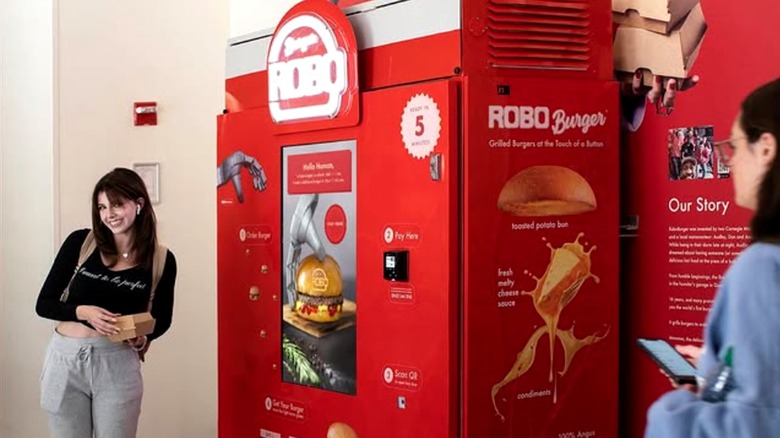
RoboBurger's most recent public update was the announcement of a merger with New York-based robotic vending machine company Sweet Robo, with Sweet Robo founder and CEO Piny Vind assuming the role of President at RoboBurger, back in July 2025. According to the press release, the company plans on expanding its presence in airports, universities, arenas, and other high-traffic, hospitality-oriented areas where the convenience of vending machines are most appreciated.
The merger with Sweet Robo potentially expands RoboBurger's reach and brings the former's four years of experience with automated vending machines to the mix. There have been, however, a few red flags raised about Sweet Robo's business practices on Reddit, so the jury's out on whether or not the outlook for this partnership is entirely positive.
When it comes to projections for success, however, product quality can't be discounted, and RoboBurger remains a big question mark on this end. Since reviews after the "Shark Tank" episode are practically nonexistent, it's difficult to determine if any improvements to the food were made outside of the menu expansion. As was the case in "Shark Tank," there appears to be more enthusiasm regarding the potential of RoboBurger than the burgers themselves, which suggests it's a product still in search of the right market. Given that Sweet Robo has a presence in 20 different countries, it's possible that the partnership will help RoboBurger find exactly that. Japan, in particular, might be a promising destination considering you can already get Michelin-star ramen at a vending machine there.