

Where These 7 Supermarket Chains Source Their Rotisserie Chickens
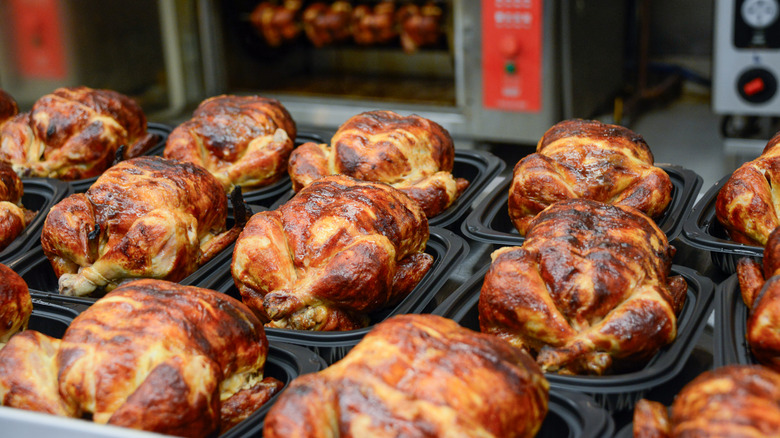
There's no food experience quite like a grocery store rotisserie chicken. Sure, plenty of supermarkets prepare other kinds of hot, ready-to-eat foods, but compared to a single rotisserie chicken, there's really no alternative that can last for as many meals at such a competitive price point. Plus, rotisserie chickens from the store taste better than homemade, which is hardly ever the case for something from a grocery store hot case.
Integral to how rotisserie chickens became popular is their availability on supermarket shelves, dating back to the 1990s. Even if the incomparable joy of a store-bought rotisserie chicken has been a staple of American life for decades now, it's not always easy to find out which companies are supplying the birds. Many of the biggest names in the grocery store chain world, like Albertsons and Safeway, provide no insight into where they source their rotisserie chickens. It's safe to assume that leaders in chicken production, like Tyson and Perdue, for example, play a part. Nevertheless, that's merely an educated guess, and not a verifiable fact.
From national mainstays like Costco to regional favorites like H-E-B, however, several well-known grocery store chains have, in fact, shared some details about their rotisserie chickens' origins. So, based on that info, here's where seven noteworthy supermarket chains source their rotisserie chickens.
1. Costco owns its own chicken farms and contracts nearby farmers
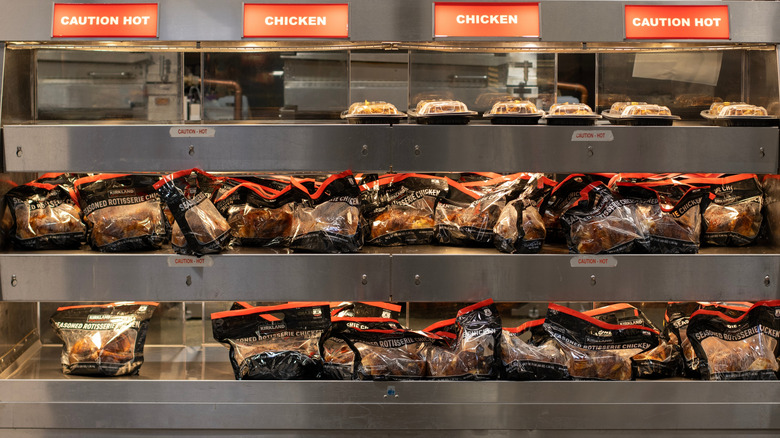
Rotisserie chickens may be available at practically every large grocery store, but the one chain synonymous with a rotisserie bird more than any other is Costco. That, of course, is because of its famous $5 price point. The chicken certainly isn't healthy, primarily due to the high sodium and cholesterol content in its seasoning. Regardless of that one notable caveat, there just aren't many places left that sell so much food for so few dollars.
For what it's worth, the Costco rotisserie chicken is a loss leader, meaning Costco loses money on each rotisserie chicken purchased. The hope is that customers will be lured in by the chicken and buy items with positive profit margins that keep the deal alive. That said, Costco does what it can to minimize production costs and lose as little money as possible on each chicken sold.
The key to where Costco sources its rotisserie chickens is a company called Lincoln Premium Poultry that the chain founded in Nebraska with the express purpose of supplying Costco chicken products. In total, Lincoln Premium Poultry is responsible for about 40% of the chicken sold at Costco. Some of the rest of its inventory, meanwhile, comes from contracted farmers also in Nebraska. Even if Costco may still have to work with competing chicken suppliers for that remaining 60%, controlling its own supply chain has become a significant contributor to how the warehouse keeps the price of its rotisserie chicken so low.
2. Whole Foods purchases from Global Animal Partnership-certified farms
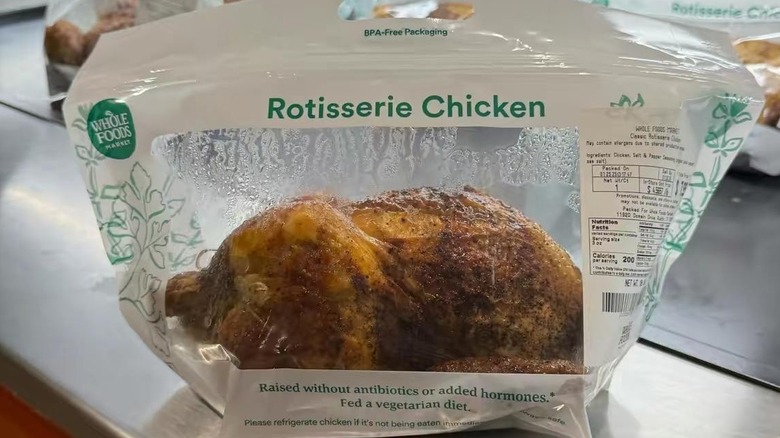
There's a good reason grocery store rotisserie chicken is often cheaper than raw poultry — cooked chicken has a longer shelf life than raw meat, and can even be repurposed into a dish like a chicken salad if it doesn't sell during its initial window of availability. Such is the case at Whole Foods Market, where most raw chickens cost $10 minimum, and a whole rotisserie chicken totals $8.99.
The Whole Foods rotisserie chicken may be a little pricier than its Costco equivalent, but customers can, at least, rest assured that Whole Foods guarantees its chickens were raised under certain ethical standards. All meat at Whole Foods, including its rotisserie chicken, is sourced from farms that earned a Step Five Global Animal Partnership (GAP) label. This is GAP's second-highest tier of animal welfare certification, indicative of more space for animals than what's standard, a shorter transport time to the slaughtering facility, shelter from extreme weather, and more.
How Whole Foods' rotisserie chicken tastes is, of course, a different matter entirely. But customers to whom the ethics of meat are important may want to prioritize Whole Foods over competing supermarkets that require no such ethical standards.
3. Sprouts allegedly sources its rotisserie chickens from Perdue Farms
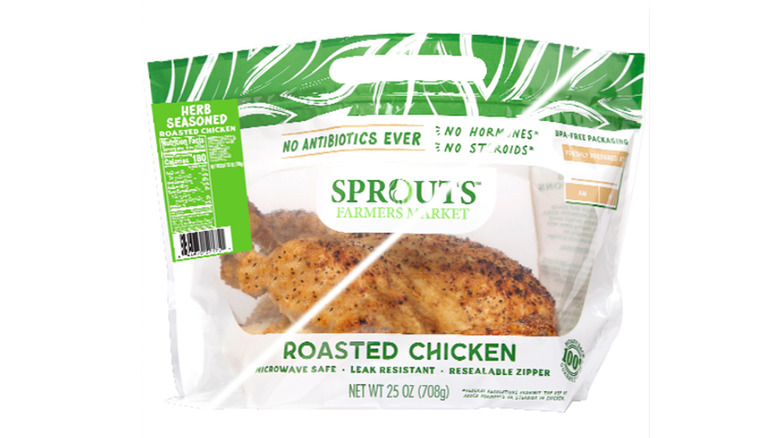
Sprouts Farmers Market, for what it's worth, has not shared its rotisserie chicken supplier with the general public. In an August 2022 Reddit thread, however, both a user who recounted speaking with a Sprouts employee and a self-professed Sprouts deli worker claimed that Sprouts stores nationwide source their rotisserie chickens from Perdue, a leading chicken supplier. In order to check the veracity of this claim, I reached out to Sprouts' media contact, but five days later, I had heard nothing back.
Occasioning the discussion of Sprouts' chicken supplier is the fact that Sprouts rotisserie chickens contain some extra seasoning. A so-called Unseasoned Roasted Chicken, notably, still has 320 milligrams of sodium per 4-ounce serving. The source, however, is purportedly not Sprouts but Perdue, injecting its chickens with brine before they're shipped to stores. Nevertheless, that doesn't inherently mean Sprouts is selling poor-quality chicken — Perdue operates under its own set of animal welfare and quality guidelines, and Sprouts advertises its chicken's lack of hormones, steroids, and antibiotics.
Meanwhile, on the Mashed ranking of grocery store rotisserie chickens from worst to best, Sprouts earned the number-two spot. So, even if Sprouts may be working with a big-business chicken supplier, the result is a rotisserie chicken that can go toe-to-toe with some of the best that any supermarket has to offer.
4. Wegmans works with America's oldest chicken company
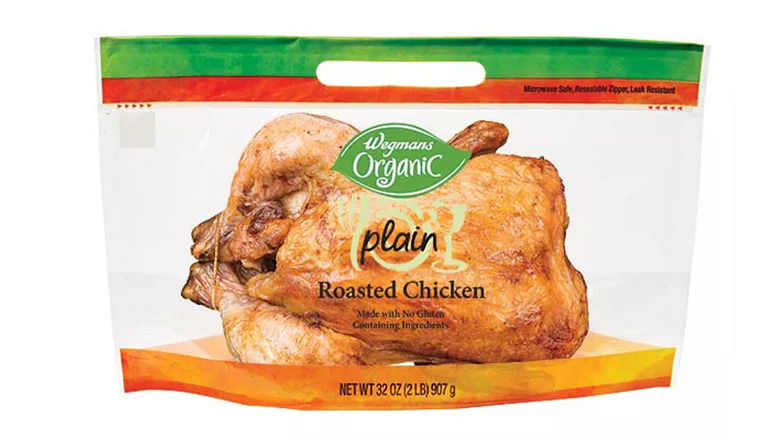
Wegmans is a regional grocery store chain concentrated primarily in New York and Pennsylvania, with additional locations in some surrounding East Coast and Southern states. Thanks to its chic atmosphere (for a grocery store), quality products, and enthusiastic employees, Wegmans has amassed something of a cult following. Contributing to the generally good vibes is the fact that Wegmans' rotisserie chicken supplier is not one of the big names in American chicken production, but a comparatively fancier business claiming to be America's oldest branded chicken company, Bell & Evans.
One pillar of Wegmans' success is its commitment to stocking local products when possible. Fittingly, the family-run chicken business is based in Fredericksburg, Pennsylvania, right in the midst of Wegmans' area of operation. Beyond its longevity, what sets Bell & Evans apart is an elevated level of care for its chickens, as well as some extra steps in processing, like air chilling, intended to improve the quality of meat. Simply put, the Wegmans brand is built on high quality, so it shouldn't come as a surprise that its rotisserie chicken supplier holds itself to similar standards.
5. Fairway Market also sells Bell & Evans rotisserie chickens
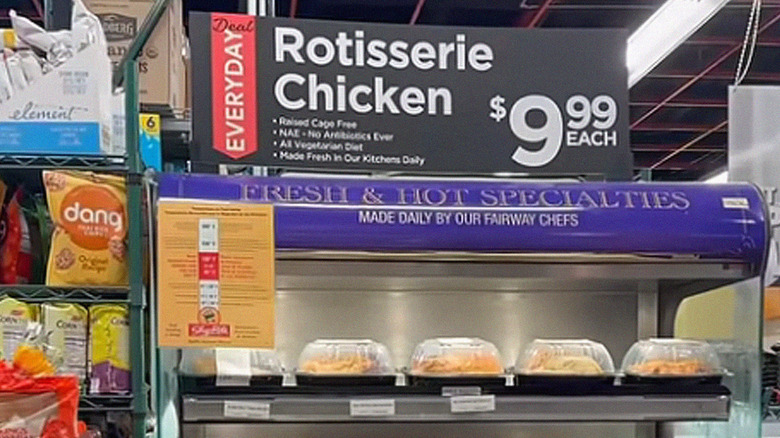
Fairway Market belongs on a list of grocery stores you'll wish you knew about sooner, for its high-quality products and especially its signature olive oil tasting bar. While there are only four Fairway Markets that remain in operation — all in New York City — the chain earned some notoriety for selling what one connoisseur claimed is the best rotisserie chicken at any grocery store.
Johnny Novo is a popular New York-based food reviewer on TikTok, sharing videos to an audience of over 81,000. After eating over 100 grocery store rotisserie chickens, Novo determined that Fairway Market's is the best of the bunch. Specifically, Novo raved about the chain's seasoned Latin rotisserie chicken. Separately, Fairway Market sells a plain rotisserie chicken and advertises that it comes from the same Bell & Evans farm that Wegmans uses. The origin of that Latin rotisserie chicken, however, is unstated.
Nevertheless, between its TikTok award-winning Latin seasoning and a partnership with the luxe Bell & Evans farm, it's safe to say Fairway Market is more outwardly committed to the art of the rotisserie chicken than most competing supermarkets.
6. H-E-B sources most of its chicken from family-owned farms in Texas
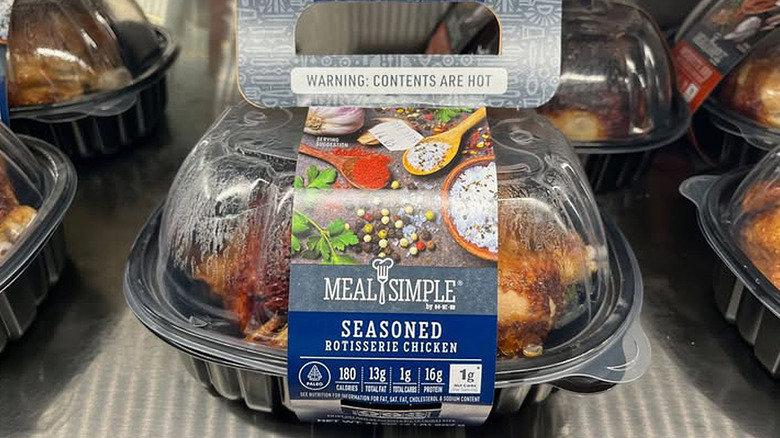
H-E-B's footprint is relegated entirely to the Lone Star State, but within Texas' borders are hundreds of locations in more than 160 unique cities. More than just a regular old Texan grocery store chain, H-E-B attracts a loyal customer base on the strength of its famously high-quality food products, including a few rotisserie chicken options.
A chain-wide animal welfare policy is one of several factors that help H-E-B maintain a high standard of food quality. Among the guidelines for the welfare of chicken sold at H-E-B stores is a commitment to sourcing between 70 and 80% of chickens from independent family farms based locally in Texas. H-E-B's luxury Central Market brand, for example, produces a Tuscan Herb rotisserie chicken that advertises its Gonzales, Texas, origin. Some rotisserie chickens may come from the 20-30% of what must be a supply from larger farms. Nevertheless, those chickens, too, must meet certain welfare standards, ensuring a baseline level of quality, local Texas farm or not.
7. Erewhon uses Mary's Chicken
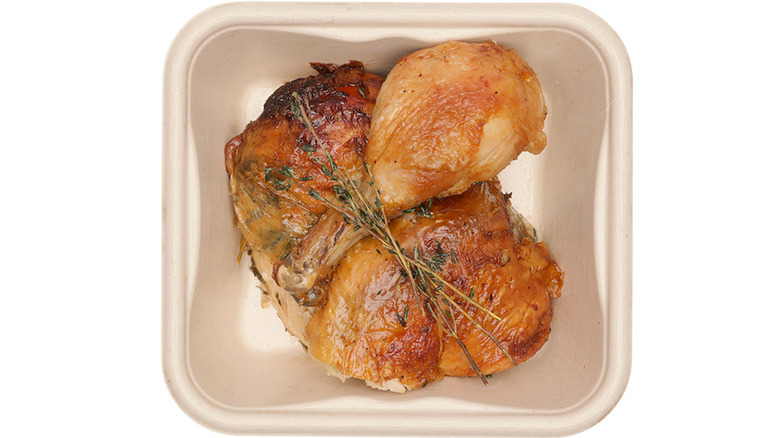
In total, there are 10 Erewhon supermarkets, with a few more on the way, all relegated to the greater Los Angeles area. Among Angelenos, Erewhon is notorious for its exorbitant prices. Some refuse to shop at a store selling a $48 jar of artichoke hearts, for example. Others find the quality of the products worth such a premium cost. Justified or not, it's safe to say Erewhon should make a concerted effort to work with the best suppliers possible to deliver on the inherent promise of its famously high prices.
Rotisserie chickens at Erewhon are organic and free-range, sourced from a brand called Mary's Chickens. The company's origins date back to 1954, and it's remained family-owned for the entirety of its operation. Among the qualities that separate Mary's Chicken from the pack are Certified Humane and Global Animal Partnership labels, in addition to the same air-chilling process that Bell & Evans uses.
Because it wouldn't be a proper Erewhon discussion without touching on price, rotisserie chickens are $9.75 per pound, typically totaling around $25. That makes it one of, if not the single most expensive, of all supermarket rotisserie chickens. At the very least, Mary's Chicken is outwardly committed to quality — whether or not that justifies such an upcharge is ultimately up to each shopper.