

10 Things You're Doing Wrong With Biscuits And Gravy
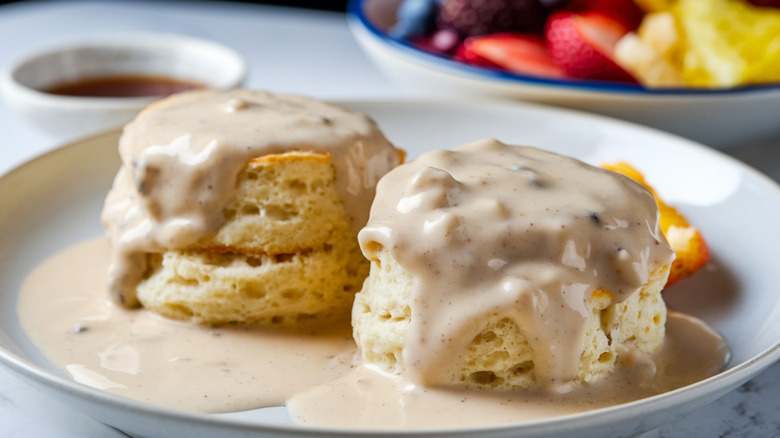
Biscuits and gravy is one of those classic Southern dishes that embody the definition of comfort food. It consists of fluffy, freshly baked biscuits smothered in a flavorful sausage gravy, and is most typically enjoyed at breakfast. The hearty dish can often be found served at old-school diners, but plenty of upscale Southern-style restaurants also offer unique takes on the historically simple dish.
Though there are many restaurants with the best biscuits and gravy around the U.S., to satisfy a certain craving, you might need to whip up a batch yourself. But it can be daunting to tackle a recipe for homemade biscuits and gravy, as it is a hands-on process that requires copious whisking, careful handling of the dough, and proper ingredient selection. To help assuage your fears, we did some of the hard work for you in finding out what could potentially go wrong in your baking venture, and chatted with a few biscuits and gravy experts about what the most common missteps are, so that you can avoid making them yourself.
Our panel of pros includes Tiffani Neal, founder of Barlow's Foods; Cynthia Christensen, recipe developer and owner of But First We Brunch; Brian Theis, cookbook author and recipe developer at The Infinite Feast; and Cheryl McColgan, cookbook author, recipe developer, and founder of Heal Nourish Grow. Each gave us some things to look out for and also tips for success, so you can perfect your own version of homestyle biscuits and gravy at home.
1. Overworking dough
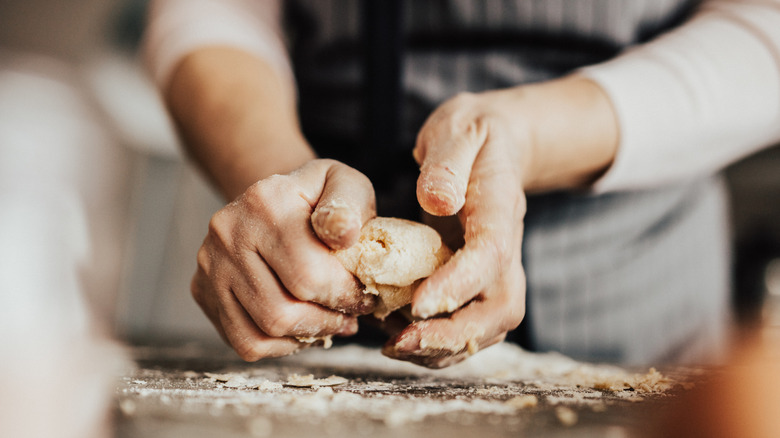
Our experts all agree that overworking the biscuit dough is the biggest faux pas that home chefs can make when preparing biscuits and gravy. "This is the number one biscuit killer," says Tiffani Neal of pancake and syrup brand Barlow's Foods. "Too much mixing equals tough, dense biscuits instead of light, flaky layers." Not only does handling your biscuit dough too much affect the interior of the biscuit, leading to a crumbly or dense texture, but it can also keep your biscuits from rising tall.
So, how do you know when to stop working your biscuit dough? Experts say the dough should be just barely mixed. "You want the dough just mixed enough to hold together, but not so much that you develop too much gluten," explains Cynthia Christensen of But First We Brunch, who also says that the key to making the perfect biscuit is "cold fat, gentle hands, and knowing when to stop."
If you are concerned about thoroughly mixing the ingredients in your dough, experts say it isn't as big of an issue as you might think. "Don't worry if you still have bits of butter in the dough, it will increase flakiness," assures Brian Theis, who wrote "The Infinite Feast: How To Host The Ones You Love."
2. Kneading your biscuit dough
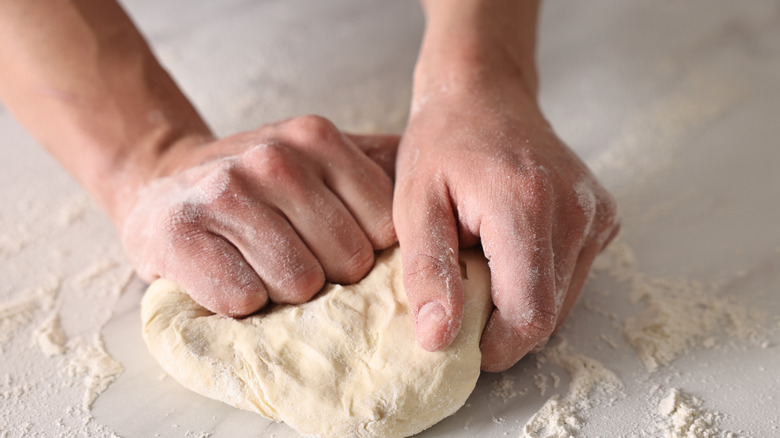
Planning to make homemade biscuits may have you picturing kneading your dough roughly with flour as though it were pizza dough. However, experts say that kneading biscuit dough is not the recommended method. Instead, they offered us a couple other techniques to try.
"I never knead my dough, instead using a cut and stack technique to cut biscuit dough into quarters and stack on top of each other to help the dough to come together and also build flaky layers," says Christensen. "Then I use a sharp-edged biscuit cutter or cookie cutter, a sharp knife will do, to cut straight down and straight back up. This exposes all of the layers and allows them to reach their flaky potential."
Another technique employed in great homemade biscuit recipes instead of kneading is folding your dough. "Make sure to fold, fold, fold your flattened dough to create layers. Otherwise [it] will be one boring non-laminated biscuit," warns Theis.
3. Twisting your cutter in the cut-and-stack method
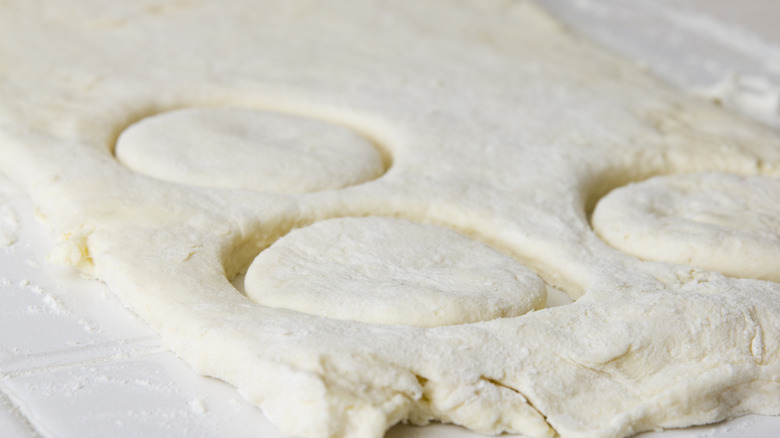
If you have decided to utilize the cut-and-stack method to make your biscuits, our experts say that's great, but there is one big rule to follow: Pay close attention to how you use the biscuit cutter. Theis says, "Don't twist your cutter! That seals the edges of dough rounds, [and] also kills the rise." This means that by twisting your biscuit cutter, you will sacrifice the tall, flaky biscuits that are both delicious and attractive.
Christensen agrees that the cut-and-stack method is the way to go, and that it's important to move the cutter in a straight up-and-down motion rather than twisting it. This is what "creates those beautiful flaky layers that make a biscuit feel bakery-worthy, even when it's homemade."
Some home chefs might be tempted to twist the cutter in order to form a perfect shape. But our experts warn that this is not the correct objective. "Your goal is not perfection, it is flakiness, rise, and flavor. The more rustic [biscuits] look, the better they'll be," Theis says.
4. Not keeping ingredients cold
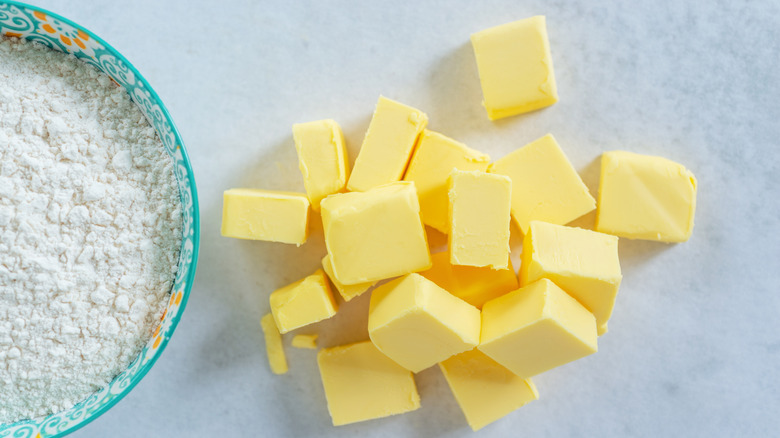
One of the biggest mistakes everyone makes when baking biscuits is using room-temperature ingredients, especially butter. According to Neal, keeping the ingredients cold is part of "what gives you those tender, pull-apart layers instead of crumbly or cakey biscuits."
To keep butter cold throughout the prep process, our experts like to use a pastry blender, which is a tool that blends the butter into the dough (key for preventing dry pie dough and other pastries). "I think the most important technique for this dish that might be new to home chefs is to use a pastry blender to keep the butter nice and cold," said Heal Nourish Grow's Cheryl McColgan.
Some experts, however, say that while you should start with cold ingredients, you don't need to stress about maintaining the temperature. As Christensen put it, "I worry less about trying to keep things cold as I go. Let's all relax. I start with cold ingredients, but then I like to make my biscuits and then place them on a sheet pan and pop them into the freezer while my oven preheats. This allows me to take my time to make good biscuits, knowing that the freezer will take care of firming up the butter and chilling the dough."
5. Cooking your biscuits incorrectly
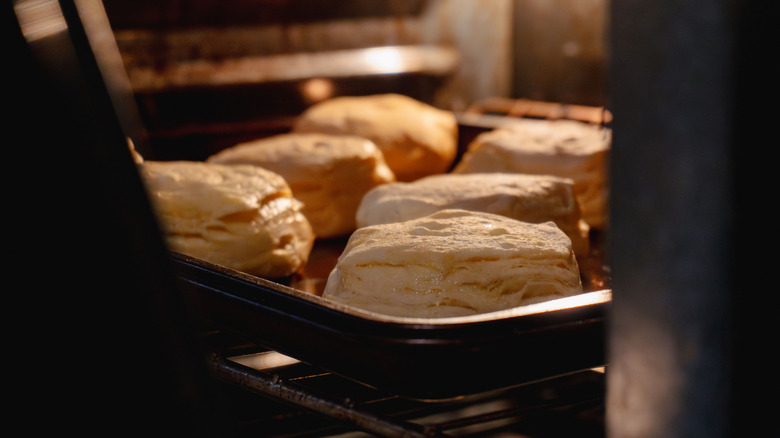
After going through the process of making your own biscuit dough and cutting it into your preferred biscuit shape, it's time to bake. Nothing can ruin a good meal of biscuits and gravy more than an overcooked or undercooked biscuit, or one that is flat like a hockey puck. Though specific oven temperatures may vary by recipe, McColgan says that it's important to "bake them in a hot oven to increase steam and for more rise."
Even before you've popped them into the oven, the temperature of your biscuits can play a role in the success of your dish. Christensen tells us that cooling your biscuits right before baking them is a key step that can ensure the dough will benefit from the aforementioned steaming action. "Having your biscuits cold before they go into the oven ensures that when the chilled dough hits the heat of the oven, the water in the butter will be released as steam and pop open all of the layers, and that's why we came to the party."
6. Picking out subpar sausage

Not all sausage is created equal when it comes to sausage gravy. In fact, experts agree that the sausage is one of the most important components of the dish. "Biscuits and gravy is one of those dishes where quality really matters because there's nowhere for weak ingredients to hide," says Christensen. "You don't need a long ingredient list. It just needs the right ingredients treated well."
The moral of the story: Do not skimp on the quality of the sausage. If you're not sure where to start, Neal says that you can't go wrong with a good sausage that has some spice, and McColgan adds that it's smart to source your sausage from a specialty purveyor. "My key ingredient is a really good sausage. Find a local butcher that does this well or make your own by seasoning ground pork with your favorite spices," she says.
If you want to get more specific, Theis insists that pork is the way to go, with his personal favorite being Odom's Tennessee Pride. "This is not the time for chicken, turkey, or, Heaven help us, plant-based sausage. Repeat after me: pork, pork, pork," he says.
7. Rushing the sausage-cooking process
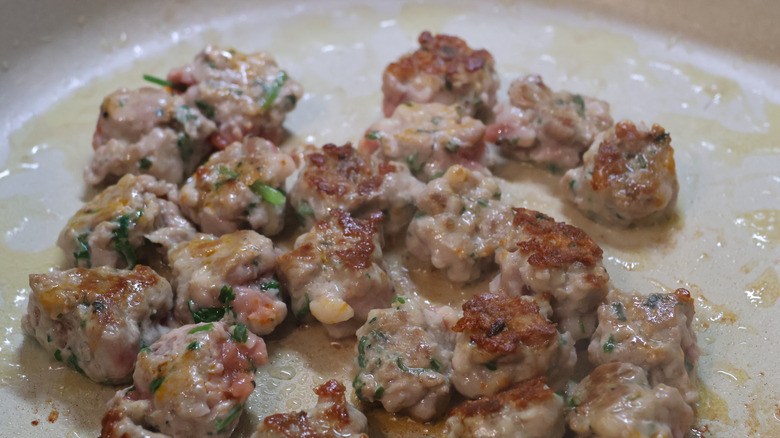
Once you have your high-quality sausage, it's time to start the gravy-making process. Experts say that cooking the sausage with care is the first step to creating a tasty and also texturally appealing gravy. "Be sure to first thoroughly cook and caramelize your sausage (not burn) to render most fat and best flavor," instructs Theis. "Undercooked sausage in a cream gravy is a Southern culinary 'don't'!"
Christensen echoes the importance of the browning stage, adding that a common gravy-making mistake is rushing through that initial sausage-cooking process. "If you don't properly brown the sausage and cook the flour in the fat before adding the milk, the gravy can taste flat, greasy, or pasty instead of rich and savory," she says. And once you are done with browning the sausage, don't drain all of that rendered fat from your pan. "That's not just grease, that's flavor. You want to use that to build your gravy."
8. Making your gravy too thick or too thin
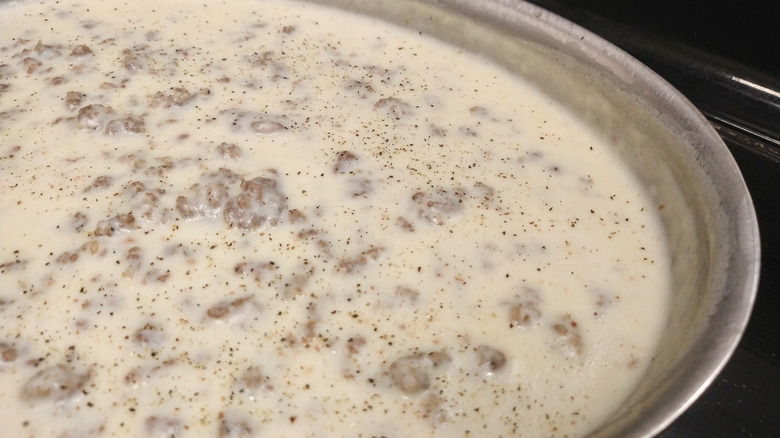
Good gravy starts with a roux. Learn how to make a roux, and you're on your way to getting the perfect texture for your gravy. You don't want that gravy to be too thick or too thin. "Gravy should coat a spoon — not sit like paste or run like milk," Neal says in a sentiment shared by McColgan. The latter elaborates, "It should be enough to cling to the back of a spoon, but still fluid enough to spread easily and soak in the biscuits without making them soggy." Of course, if your gravy is too thin, you run the risk of it running all over your plate.
Theis has given us his trick for gravy-making, which is to properly measure the ingredients before whisking them together. "Add butter to your rendered sausage fat (after removing sausage) so you have the best possible fat to flour to milk ratio," he says. "2 tablespoons fat (from sausage, plus butter), 2 tablespoons flour, and 1 cup milk is a good jumping off point. Adjust as it suits you." It's good practice to take your time here, regularly testing — and whatever you do, don't stop whisking or your gravy will become lumpy.
9. Seasoning gravy before it thickens
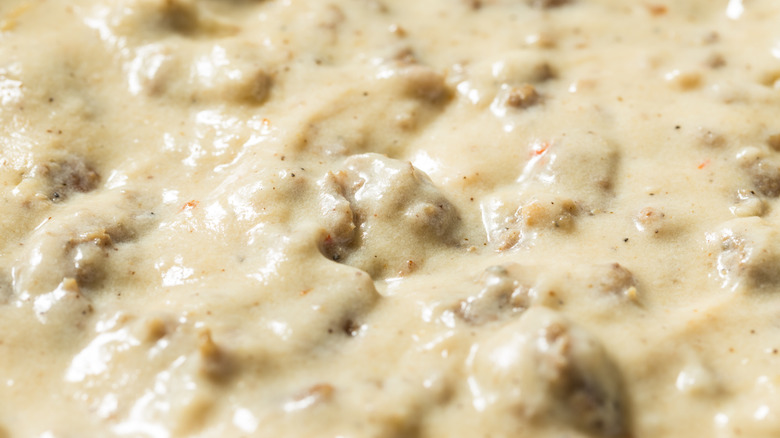
After you have done all of the hard work to get your gravy the perfect consistency for your biscuits, the biggest bummer would be to have a lackluster flavor. While the choice of seasoning is ultimately up to you, our experts say that the timing of when to season your gravy is of utmost importance.
"The key is to wait to season until after your gravy has thickened," says Christensen. "It's too risky to season early, and then as the gravy reduces, you'll find that it's too salty. Wait until it is thickened, taste, and season at that time." Over-seasoning is actually one of the common mistakes people make with homemade sausage gravy, and it's more likely to happen if you taste as you cook, so experts say to wait until the roux is complete before adding spices. This could help to keep your traditional biscuits and gravy flavor profile intact.
Once it comes time to season, the professional consensus is that black pepper is a must. Theis calls it a non-negotiable spice for biscuits and gravy, and says, "I like to add a little extra heat as well. My go-to is Tabasco Green Pepper sauce. It has a milder flavor and doesn't turn the gravy pink."
10. Adding too much gravy to the biscuits
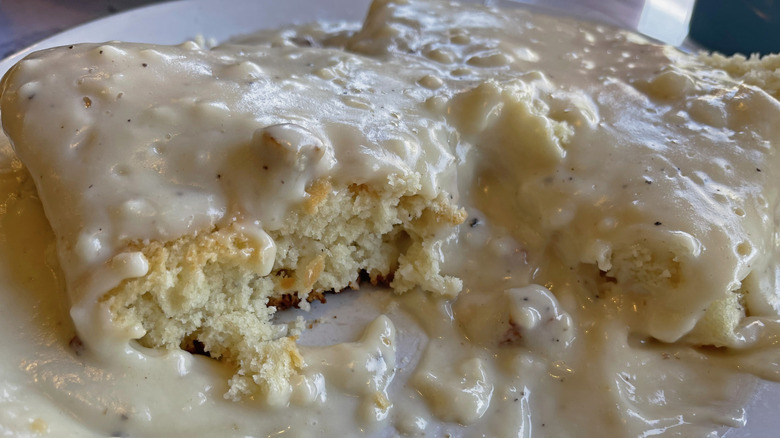
Although the biscuit-to-gravy ratio is ultimately a matter of personal preference, experts do agree that there is such a thing as having too much gravy on top of the biscuits. Neal's general rule is to make sure that there is "enough gravy to soak in but not so much that the biscuit loses its structure."
Christensen believes firmly that the biscuit should be covered, but not buried by gravy. "I like just enough gravy to flavor every bite, but not so much that the biscuit disappears completely," she says, adding that overdoing it on the gravy can cause you to lose the contrast between fluffy biscuit and creamy gravy — which is "the whole point."
A safe bet is to start with smaller portions — about a ¼ to ½ cup of gravy per split biscuit; you can always add more. And while there is certainly no shame in loving your biscuit swimming in gravy, there's another aspect to consider, especially if you're plating for others: how appetizing that plate will look. As McColgan reminds us, "Plenty of biscuit showing also makes for better photos."