

Why Knowing Your Whiskey's Barrel Entry Strength Is Important
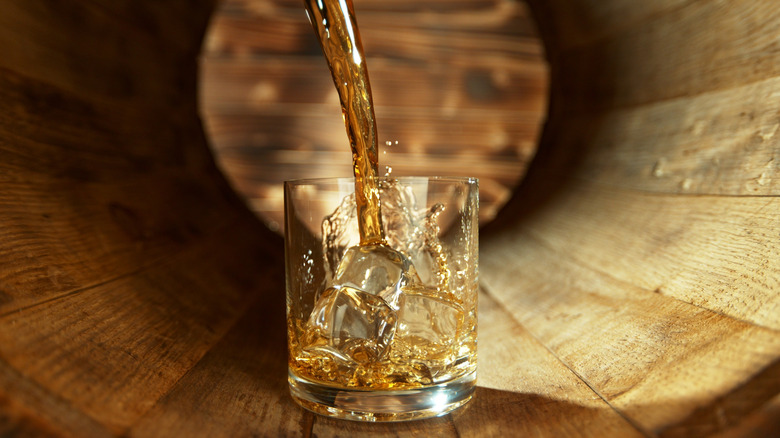
In the distilling world, there can be an almost overwhelming number of factors that influence a whiskey's final taste, aroma, and overall experience. Among the most important (but least understood) of these is the whiskey's barrel entry strength. To break down why this matters, we asked master mixologist Justin Lavenue, co-owner of The Roosevelt Room and owner-operator of both The Eleanor and RoadHaus Mobile Cocktails.
As the name suggests, barrel entry strength (sometimes called barrel entry proof) is the percentage of pure alcohol in the whiskey mixture that's placed in the barrel to age. "It sounds like one of those technical details designed to impress someone on a distillery tour, but it can meaningfully affect the finished whiskey," Lavenue told Mashed. He further explained, "Changing the alcohol-to-water ratio changes how the spirit extracts and dissolves different compounds from the barrel, which can influence sweetness, tannin, oak character, spice, aroma and texture."
Generally, this will fall within a relatively narrow range. By law, the maximum barrel entry strength for whiskeys in the U.S. is 62.5% alcohol, or 125 proof. "The key words are 'no more than,'" according to Lavenue. "A distiller can choose a lower entry proof, and some intentionally do." However, the minimum proof required for a bottled spirit in the U.S. is 80 (or 40% ABV), ensuring barrel entry strength will always be above this number.
Barrel entry strength is an important factor but not the decision-maker
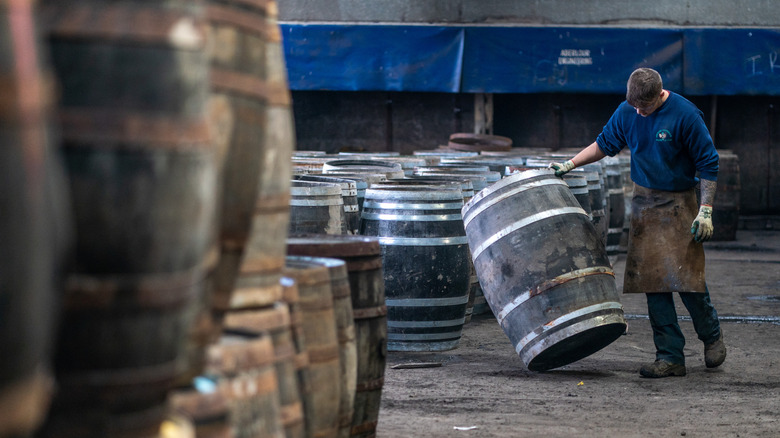
As with any business, economics also play a role in barrel entry strength. "Lower entry proof creates more total liquid for the same alcohol, requiring more barrels and warehouse space," Justin Lavenue told Mashed. This can be a double-edged sword for distillers: On one hand, they're stretching a fixed amount of alcohol further, producing more barrels for eventual sale, but on the other, they're incurring higher upfront costs in materials and facilities.
As important as knowing a whiskey's barrel entry strength can be, Lavenue warns that it shouldn't be a determining factor in choosing a spirit. "That would be like buying a car based entirely on tire pressure: It matters, but it does not tell you whether you'll enjoy driving it," he explained. "Think of it as one clue in a larger mystery." In part, this is because the barrel entry strength isn't usually the strength you'll find in the bottle on the liquor store shelf. Whiskey makers often blend and dilute the product that comes out of the barrels to create a more consistent flavor or drinkable experience. The exceptions are those bottles labeled as "barrel strength" or "cask strength," which are presented to drinkers in a similar state as when they emerged from the barrel.
There are many factors you can look for when identifying a quality whiskey. To be sure, barrel entry strength doesn't top the list compared to things like age and brand reputation. Still, knowing this detail can be a valuable explanation for the differences in two whiskeys that otherwise seem similar in ingredients and final proof.