

Every Brisket Lover Should Own This Essential Tool
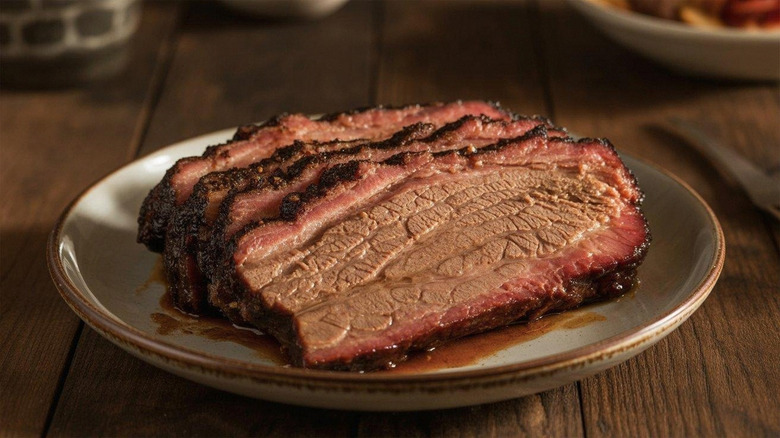
You have to really love brisket to take on the job of cooking it. It isn't like popping some burgers or a steak on the grill, which is a fairly quick task. No, cooking brisket is a lengthy process that involves hours upon hours of cooking and then more hours of resting.
The typical cook time for a brisket lands anywhere between eight and 18 hours. The large range is why Traeger grills says, "Each brisket cooks differently so it is important to cook to temperature not time." The grill company notes that a brisket is finished at 204 degrees internally. If you are wrapping your brisket, which is done to combat the "stall" period where smoked meat loses moisture, you'll need to measure the internal temperature earlier. For example, our recipe for Classic Smoked Brisket requires you to get the meat to 165 degrees before wrapping it in paper and then getting the brisket to 205 degrees (the exact degree will vary depending on the recipe).
Owning a meat thermometer, then, is essential if you want to try smoking your own brisket. The last thing you want is to undercook meat and get people sick or have a dry or overcooked brisket after 18 hours of work.
Meat thermometer options and how to use them
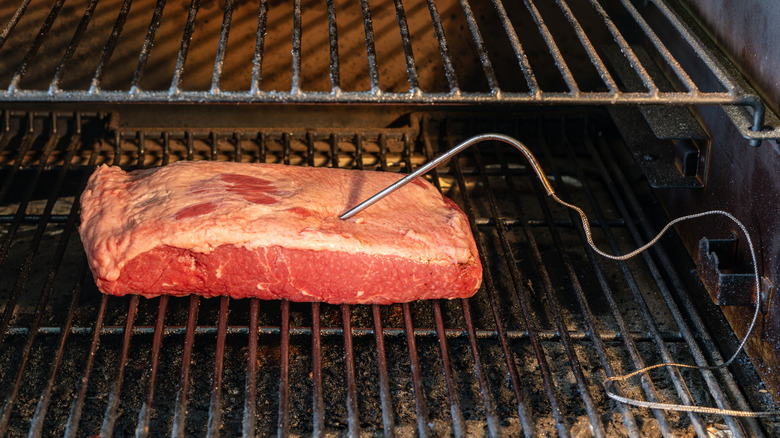
When it comes to meat thermometers, you have two options. You can easily pick up a traditional meat thermometer (instant read is best) that you stick in when you need to check the temperature, or you can invest in a probe or leave-in thermometer. The latter is great for brisket because you don't constantly have to check the meat. Instead, the thermometer remains inside the brisket the whole time, connected by a wire to an external temperature gauge you glance at.
Once you've picked out a meat thermometer, you need to know how to use it correctly. You're going to want to stick your thermometer into the fattiest, thickest part of your brisket — but not from the top. The side is the best place to place your thermometer. When using a wired leave-in thermometer, run the wires out a natural hole or opening in the grill, and avoid having the wires rest on the grates entirely or as much as possible.
After your brisket reaches the final internal temperature, you'll have to rest it before serving. Our recipe puts resting at one hour. Rest time is a great opportunity to whip up some sides to serve your brisket with. Try coleslaw or pickled vegetables for a bright, acidic contrast to the heavy meat. Or stick with classic BBQ sides like potato salad, baked beans, or mac and cheese. You can also go for the tradition of serving plain slices of white bread to soak up extra sauce.