

Texas Roadhouse Cactus Blossom Vs Outback Steakhouse Bloomin' Onion: Which Is Better?
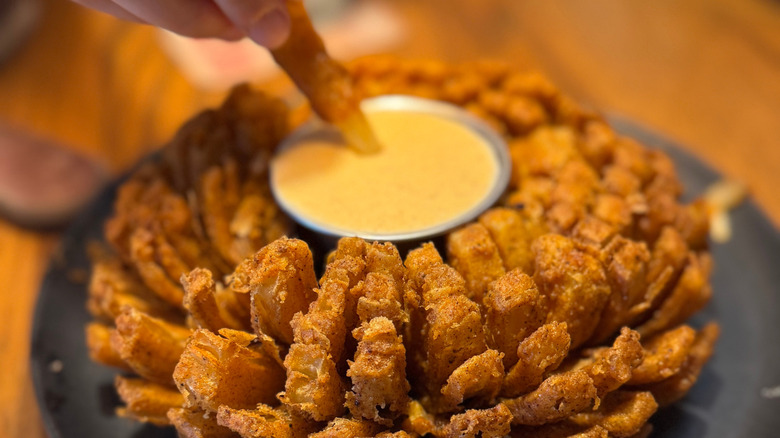
It's not every day that you eat an entire onion before your meal, so when you do, it should be delicious. Battered, seasoned, and deep-fried is usually a reliable way to make that happen, and few restaurants are better known for a dish like this than Outback Steakhouse. Back in the 1980s, Outback popularized its own take on the sliced, deep-fried onion, and the Bloomin' Onion soon became the appetizer the chain is best known for. Its popularity didn't stay contained to Outback, though.
The dish inspired a wave of copycat versions at other big-name restaurants (we've ranked all of the Bloomin' Onion spinoff variations), including Texas Roadhouse's take on it by the name Cactus Blossom. Both dishes start from the same basic idea: a whole sweet onion, sliced into petals, coated in a seasoned batter, and deep-fried until golden and crisp. From there, though, the similarities waver, from the batter itself to the dipping sauce to the price tag. To find out which chain does it better, we ordered both, ate our way through each one, and compared them side by side on presentation, flavor, texture, and value.
Outback Steakhouse's Bloomin' Onion
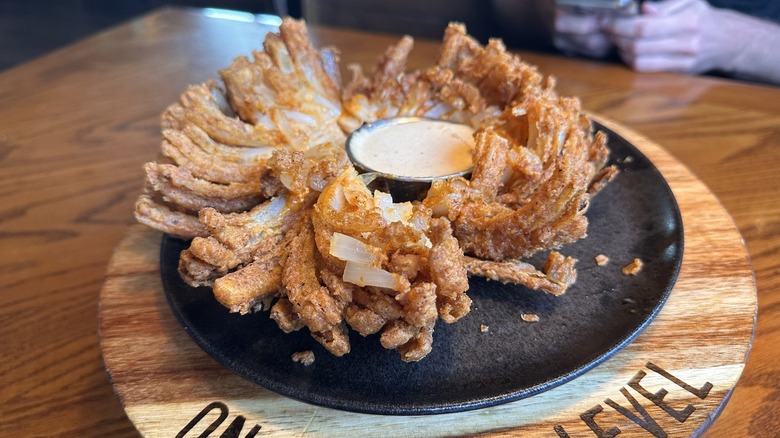
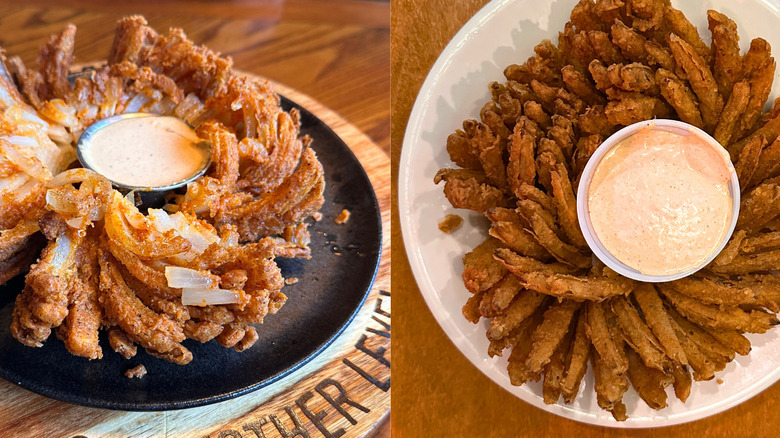
Outback's Bloomin' Onion is not your everyday appetizer — it's decidedly one you get excited for. And I have to admit that I felt kind of deflated when it arrived, deflated actually being a key word to describe its presentation here. Our appetizer was less than picture-perfect, and sort of squashed. It was salt in the wound when we saw a nearby table receive a perfectly golden onion that closely resembled the photo on the menu. Nonetheless, it smelled wonderful, and we dug right in.
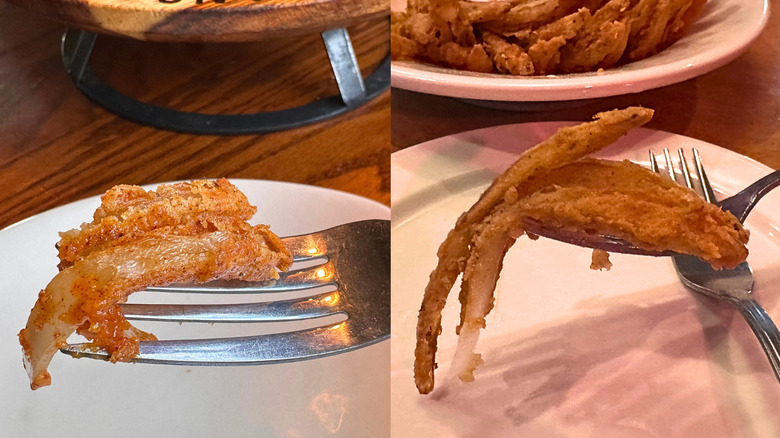
The first bite burst with a smoky paprika flavor right away, backed by a peppery, slightly mustardy seasoning that built to a decent spiciness. The batter was plenty zesty and the onion itself was fully cooked and sweet (never raw or sharp), but the fried bits were inconsistent all around.
Texture-wise, the good bits had coating that was crisp in a light and airy way, and the onion underneath stayed tender. But it was hard to ignore that some bites were mostly just greasy, overly fried batter than onion, while others were onion coated at the base in undercooked batter. We're talking, wet, pasty, noticeably raw batter.
The dipping sauce was a highlight, thick and creamy enough to mellow out the spice, with a horseradish-y after-kick. But the portion of sauce ran out about halfway through the onion. Ultimately, a noticeable amount of grease was left behind on the plate, and the whole thing left a strong burnt onion flavor lingering afterward (understandably so).
Texas Roadhouse's Cactus Blossom
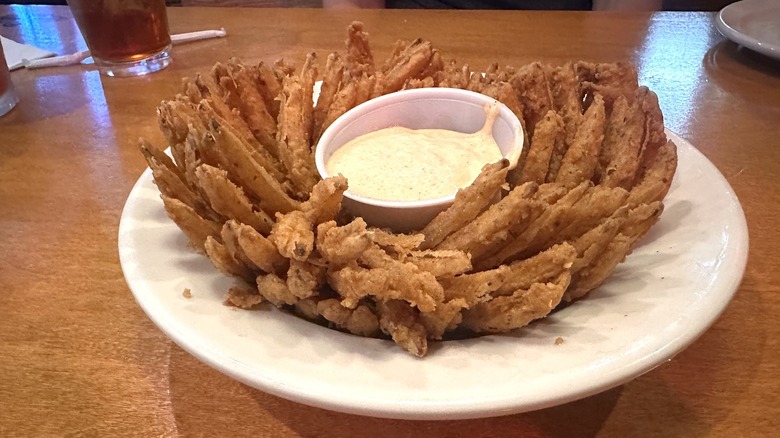
Where the Bloomin' Onion tastes zesty and smoky, Texas Roadhouse's Cactus Blossom has more of a classic salty fried-food flavor. Each crispy bite has a much milder hint of paprika and pepper, with a pleasant sweet-salty finish that lingers, rather than an onslaught of spice. It's a decidedly less layered flavor than Outback's had, but not in a bad way.
This onion had none of the heavy, overly greasy quality that weighed down the Bloomin' Onion. The batter itself is craggier in texture, and the onion slices seemed a touch thicker than Outback's thinner, stringier cuts, but the fry came out noticeably even across each and every petal. Copycat recipes for the Cactus Blossom use a beer batter, which could be what makes it craggier and crispier (thanks to the carbonation). It almost had a cornmeal-like flavor to it, but our server noted that cornmeal was not an ingredient here.
The dipping sauce is much more mayo-forward with notes of sour cream, giving it a lighter, sweeter, creamier profile than Outback's version — and, importantly, there was plenty of it. While eating around Texas Roadhouse's Cactus Blossom, there was never an all-onion bite the way the Bloomin' Onion sometimes had. It does leave a mild fried-food-and-onion aftertaste, but nowhere near as strong or lingering. It's also a bit smaller than Outback's portion.
Final verdict: Is Outback's version bloomin' with deliciously seasoned goodness, or does Texas Roadhouse's Cactus Blossom surpass expectations?
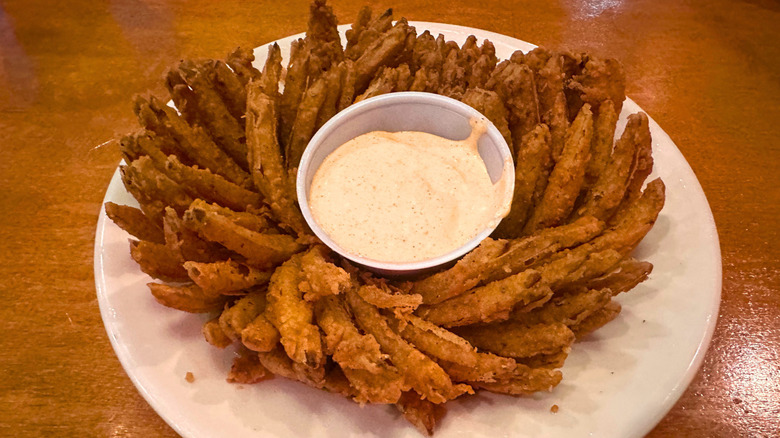
Chain restaurants are great, but the caveat will always be consistency, or lack thereof, by location. While we expected Outback's version of the onion to win due to sheer popularity, Texas Roadhouse's Cactus Blossom was a clear and easy winner — despite the fact that we once considered it to be one of the most overrated items on the Texas Roadhouse menu. Our Bloomin' Onion was fried very inconsistently all-around, with bites of pure batter, and others of pure grease, though the good bites were wonderfully, complexly spiced (that unique seasoning is what makes the Bloomin' Onion so delicious when it's cooked well). Coating those 200 petals evenly can't be easy though; when you try to make a Bloomin' Onion at home, uneven coating and clumpy petals is a common pitfall.
The Cactus Blossom, on the other hand, left us hardly anything to complain about. This was, indeed, a picture-perfect appetizer. Each petal was evenly coated, perfectly crisp, and lightly seasoned in a way that let the delightfully sweet, tender onion flavor, well, blossom. While both Outback and Texas Roadhouse's sauces were delicious in their own ways, we liked the mild, sweet flavor of Texas Roadhouse's a bit more, and we sincerely appreciated that there was enough of it. Running out of dip less than halfway through the Bloomin' Onion was a real letdown. Considering that the Cactus Blossom costs several dollars less, it's a win on flavor, consistency, and value all at once.
Comparing cost, nutrition, and value
The Texas Roadhouse and Outback Steakhouse onion apps have varied pricing: Outback's Bloomin' Onion is $11.99 before tax, while Texas Roadhouse's Cactus Blossom comes in at $7.99, both at North Carolina locations. However, we'd say that the size of each appetizer is about proportionate to the price, with Outback's version being notably larger. The nutrition facts don't feel as proportionate.
A whole Bloomin' Onion packs in 1,920 calories, 152 grams of fat, 4,870 milligrams of sodium, 131 grams of carbohydrates, and 105 milligrams of cholesterol, according to Outback's own nutrition information. Despite its smaller appearance, a whole Cactus Blossom comes in at 2,250 calories and 135 grams of fat, but with far more carbohydrates at 236 grams, but less cholesterol at 15 milligrams, per Texas Roadhouse's website. Both are decidedly indulgent, but the extra calories and carbs on the Cactus Blossom are notable.
Neither chain publishes an exact weight for its onion, but both describe it the same way on the menu: a whole onion meant for the table, not necessarily for one diner. Outback's version is typically considered meant to feed about four people. Split four ways, that puts Outback at roughly $3 a person against Texas Roadhouse's $2, and Texas Roadhouse wins on calories-per-dollar, with about 282 calories for every dollar spent versus Outback's 160.
Methodology
Before writing this article, I had never tried either of these dishes, and tried to make it a point to not ready any information about either beforehand. The results were, indeed, surprising! Both onions were ordered from Chapel Hill, North Carolina locations of each chain and eaten dine-in rather than as takeout, so both arrived as fresh as possible. Neither order included any customizations, though Texas Roadhouse offered a spicy option, which was tempting, amongst some other secret menu customizations to the Cactus Blossom.
There was one potentially meaningful difference in ordering method: the Bloomin' Onion was ordered on a Saturday night, while Texas Roadhouse's Cactus Blossom was ordered on a Wednesday evening. Whether or not restaurant volume (or a busier kitchen) had an effect on how consistent a fried appetizer turns out could be worth considering. Nutrition facts for both dishes were pulled directly from each company's official websites. Each onion was then judged on presentation, overall flavor, consistency from bite to bite, portion size, quality of the dipping sauce, and crispiness of the batter.