

11 Mistakes Everyone Makes With Hash Browns
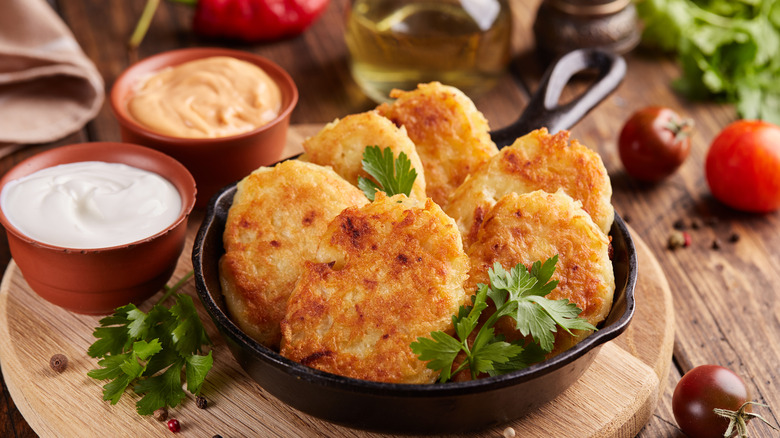
When they're good, they're great, but so often hash browns can be disappointing, especially when you make them yourself at home. You might be used to the ones with perfectly crisp exteriors and soft middles you get at your favorite diner or brunch spot, but then end up frustrated when you can't get the same effect at home. Well, usually, it's down to making some common hash brown errors.
As a food writer, cooking is kind of my thing. I'm a huge fan of hash browns and regularly make my own at home. However, I'm just one person and I wanted to get more opinions about what can make or break this breakfast classic. I spoke with Cynthia Christensen of But First We Brunch; Scott Rodriguez, head of culinary for Perkins Restaurant & Bakery; and David Davidov of The Cooking Foodie. They helped open my eyes to more things that can go wrong with hash browns and how to avoid them.
So, if you're looking to serve up a big side of potatoes and want to get it right, you're in the best place. We've got expert insight into the mistakes everyone makes with hash browns and what to do instead. You're about to unlock a new era of potatoey goodness. You're welcome.
Choosing the wrong potato varieties
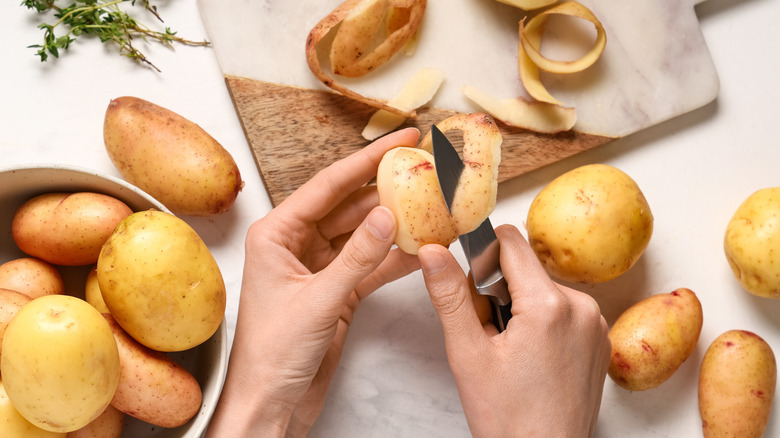
You might think that whatever potatoes you have at home will do for hash browns, assuming they're all basically the same. And while you will get something approaching hash browns with any potato you might pick, some will give you much better results than others. It's important to give your hash browns the best possible foundation by choosing the right kind of potato.
If you're not familiar with the difference between waxy and starchy potatoes, now's the time to bone up. "Russets would be my first choice," says David Davidov. "They're high in starch and relatively low in moisture, which is exactly what you want when you're trying to get a really crisp exterior." Scott Rodriguez also notes that Russets are large in size, so shredding them is quicker and easier.
A russet potato is a classic example of a starchy potato, which is the perfect variety for hash browns. Common waxy varieties include Fingerling and red potatoes, which aren't recommended for hash browns since less starch and more moisture means they won't crisp up the same. "Yukon Golds can work too and have a lovely buttery flavor," Davidov continues. "But if maximum crispiness is the goal, I'd reach for Russets." Yukon Golds are all-rounder potatoes, partway between starchy and waxy. So, they're nicely flavorful but a little harder to get truly crispy. Whether or not that trade-off is worth it is up to you.
Ignoring the difference between diner-style hash browns and hash brown patties
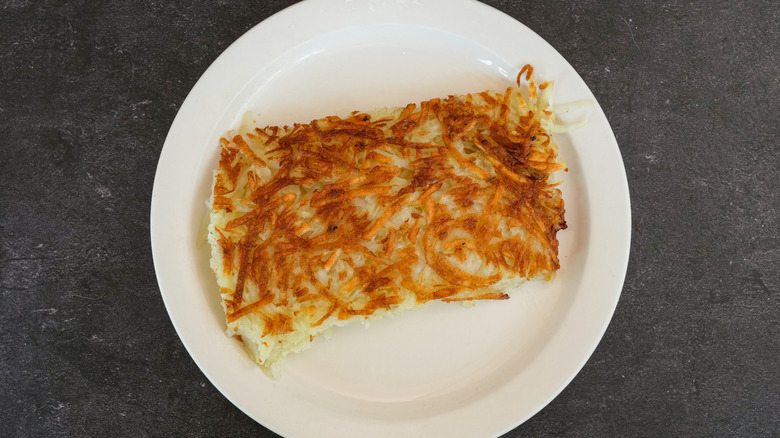
Hash browns are among the diner foods that don't taste the same at home. But, it's worth noting the difference between diner-style hash browns and hash brown patties. If you treat them as interchangeable, you might not end up with the style of potatoes you're looking for. Neither is the right or wrong answer, they're just different.
"Diner-style hash browns are typically made with loose shredded potatoes, cooked directly on a griddle or in a skillet and they have lots of crispy edges with a soft potato base, David Davidov explains. "Hash browns in the form of patties are also made with shredded potatoes, but are formed into shapes and cooked as a single unit." Diner hash browns tend to form into clumps as they cook, but they're not necessarily even and may fall apart when flipped because they don't have a binder. Some people love this irregularity, but others prefer something more uniform.
Davidov prefers diner-style when cooking from scratch at home. "You get more of that contrast between crispy edges and tender potato, and there's no need to worry about forming perfect patties," he says. However, "patties are great when you want something neat, portable and easy to serve, especially for breakfast sandwiches," he adds. So, think about what you want and choose accordingly.
Grating the potato incorrectly
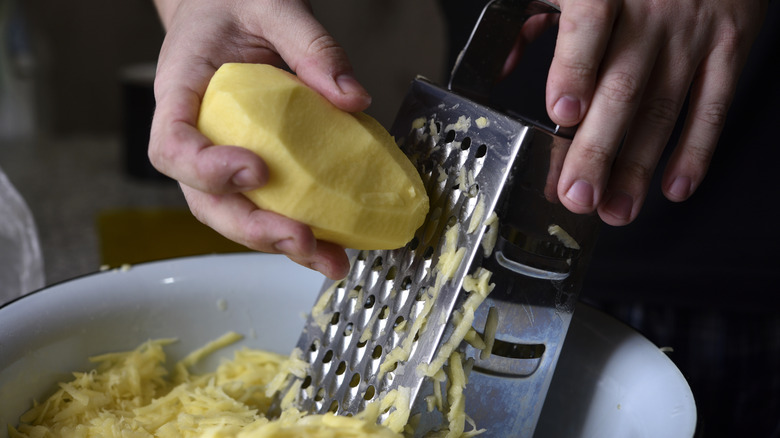
Hash browns are made using grated or shredded potato. This sounds pretty straightforward, but you can do this wrong. If the potatoes are grated incorrectly, you might end up with hash browns that don't cook properly or fall apart completely.
"I grate peeled russet potatoes using the large holes of a box grater or the grating disc of my food processor," Cynthia Christensen. The size is the important part here. "Another mistake is grating the potatoes too finely," says David Davidov. "I prefer a coarse grate because you still get those distinct strands and a nice contrast between the crispy outside and tender center."
Using the wrong size is a common mistake people make with box graters but luckily it's an easy one to avoid. If you use the small side of the grater, the shreds are too densely packed and the larger amount of surface area can release more moisture, so it's harder to get everything nice and crisp. It would also take a long time to do by hand. If the thought of shredding by hand gets you down, Christensen's suggestion to use the shredding disc on your food processor is a time-saving one. As long as you have a disc with the right size holes, this works nicely.
Not squeezing the moisture out of the potato shreds
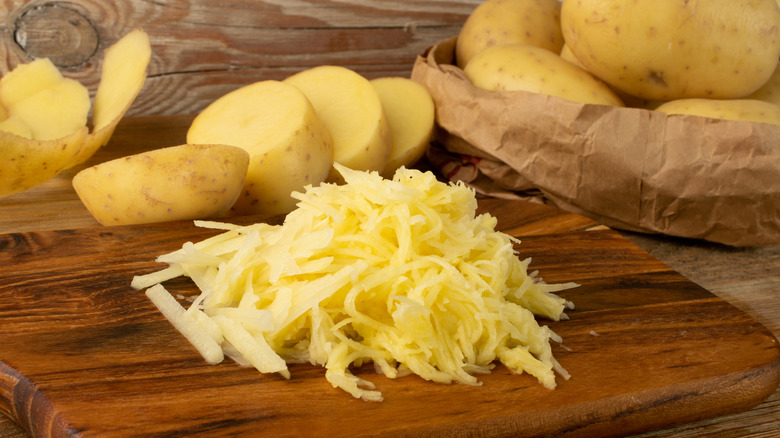
You've finished grating your potatoes, your arms are tired, and you're ready to eat hash browns. It would be natural to want to move onto cooking, but you need to remove some of the moisture in your potatoes. This isn't a step you can skip without running into issues, no matter how tempting it is.
"Getting the water out of the potatoes is probably the single most important part of making good hash browns," says Cynthia Christensen. The way you do this is simple. "Put the grated potato in a clean kitchen towel and squeeze it really well," advises David Davidov. "You'll probably be surprised by how much liquid comes out," he adds. When I first started making hash browns from scratch, this was the thing that made the biggest difference. The couple of times I skipped this step, my hash browns came out soggy, and I needed to add way more binder to hold them together. "The drier the surface of the potatoes, the easier it is to get them golden and crispy instead of soft and steamy," says Davidov.
Christensen also advises soaking the shredded potatoes in cold water for 10 minutes before draining and rinsing them, prior to squeezing them out. This removes extra starch and may help prevent potatoes from going gummy, getting a better crunch. However, this is something I haven't found makes a difference to my hash browns, so it's worth trying both ways and making up your own mind.
Seasoning hash browns incorrectly
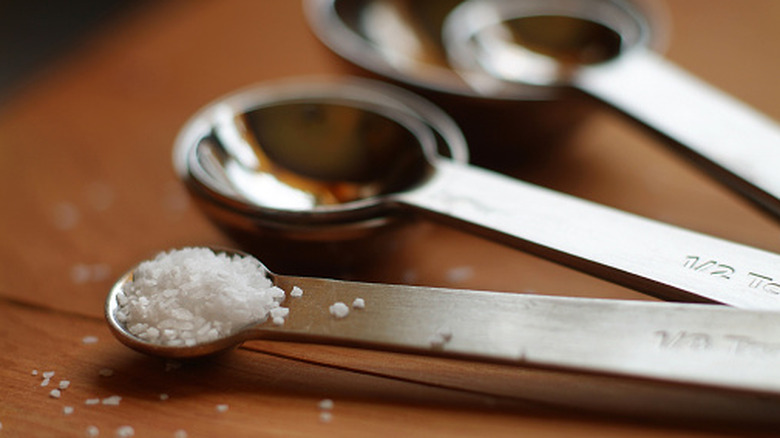
Once you've shredded and dried your potatoes, it's time to season them. But, this is somewhere you can easily make mistakes. Too much, too little, or the wrong kind of seasoning can all ruin the finished dish.
One of the places it's easy to go wrong is over- or under-salting — it's something I did many times before I came up with a rough formula. Too much salt and they end up inedible, too little and they're bland and underwhelming. Using around ¼ teaspoon of fine salt per large potato generally gives good results, but if you're worried about overdoing it, start with less and taste the mixture before cooking — raw potatoes might not taste amazing, but a small amount is safe to eat.
The type of seasoning also matters, but it is down to preference. "I'm a fan of keeping them pretty simple," says David Davidov. "Good potatoes, salt, and freshly ground black pepper can be enough." Cynthia Christensen also appreciates them straightforward. "If I want to change things up, garlic powder, onion powder, smoked or sweet paprika, and finely chopped chives or scallions all work well," she adds.
Personally, I like to make them a little herby to take them to the next level. Rosemary, thyme, and sage all pair particularly well with potatoes, so you can't go wrong with any of those three, or a combination. Choosing different seasonings is a simple way to upgrade your homemade hash browns.
Trying to form patties without a binder
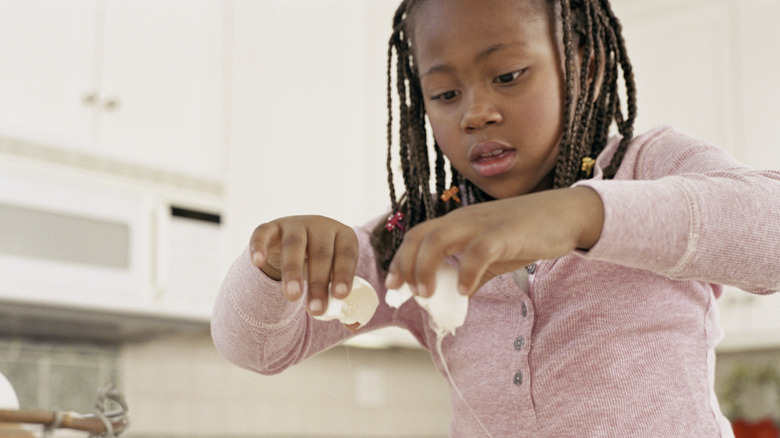
If you decide to make hash brown patties, you're going to need a binder. This is where a lot of people go wrong and end up trying to form their potatoes into uniform lumps without anything to hold them together. There are a couple of main options when it comes to binders, so feel free to choose depending on what you have or what best suits your dietary needs.
"For my hash brown patties, I season the dried potatoes and add a small amount of egg and flour to help them hold together," Cynthia Christensen tells us. "I shape them about ¼-inch thick and chill or freeze them briefly before cooking so they hold their shape," she adds. A combination of egg and flour is a classic choice for a binder in a hash brown recipe, the two forming a kind of dough that holds the potatoes together.
However, you don't necessarily have to use eggs. I opt to make my hash brown patties vegan by skipping them all together. This also makes them suitable for egg allergy sufferers and can save you some money, especially at times when grocery prices are rising. I tend to just use flour, which often holds the potatoes together perfectly well. However, if you need a little more moisture to help, a small drizzle of oil gets the job done.
Making unevenly sized patties
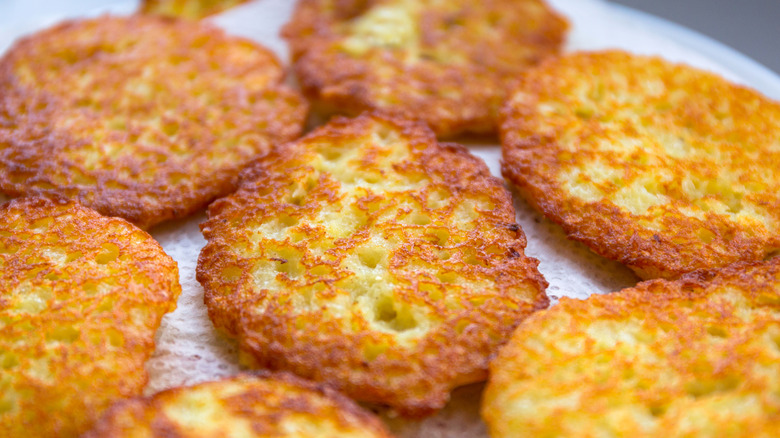
Individual hash browns take more work to make than diner-style hash browns, with the whole extra steps of binding the mixture and forming the patties. But, if you're going to do it, you might as well do it right. Don't make the mistake of forming unevenly sized patties or you might end up in a pickle. Yes, even patties look neater and more uniform, but that's not why doing this is important. The thing about making hash browns of different sizes is that they cook at different rates. Some might be perfectly done in the same time that it takes others to burn, while larger ones could be left raw in the middle.
While you don't necessarily have to be precise to the gram, making hash browns of roughly the same size will make the cooking process go more smoothly. "If you're making patties, my slightly unconventional tip is to steal a tool from another cuisine: a Spam musubi mold," suggests Cynthia Christensen. "I use one to make evenly shaped hash brown patties, and because every patty has the same thickness and surface area, they cook consistently," she says. This also makes them look as neat as good fast food hash brown patties — but way better.
You don't necessarily have to buy a dedicated tool, though. You could use a measuring cup to get a roughly equal amount of the mixture each time, then form them by hand. A ¼ or ½ cup should be about right, depending on whether you like them smaller or larger.
Choosing a nonstick pan to cook hash browns
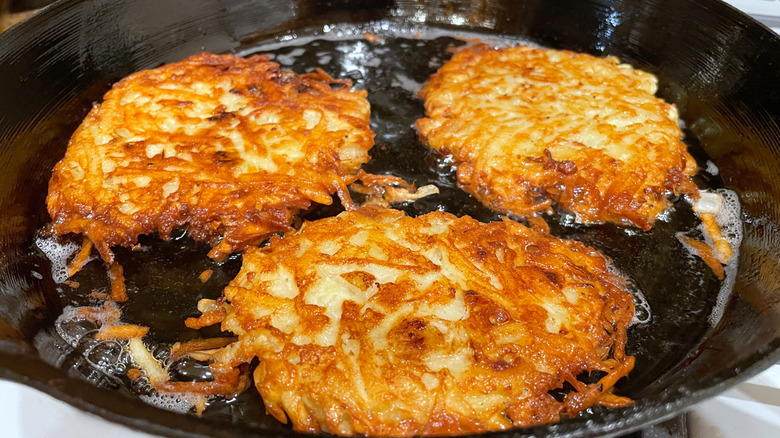
One of the key tips for getting perfectly crispy hash browns is to use the right pan. If you've been picking up the nonstick pan you use for everything, you're probably not going to get the best results. A heavier pan will actually help you get a more crispy surface.
"I don't recommend nonstick because it isn't ideal for the higher, sustained heat that helps hash browns develop their best crust," says Cynthia Christensen. Instead, her favorite pan for hash browns is a heavy cast-iron skillet. "It holds heat really well and gives the deeply golden, crisp crust I'm looking for," she says.
But, if you don't have a cast iron skillet, don't worry. "A properly preheated stainless steel skillet also does a great job," Christensen tells us. Basically, use anything other than nonstick, where possible. Carbon steel, copper, or ceramic-coated cast iron (like Le Creuset) are all better options. The trouble with nonstick is that it's designed to prevent sticking, and that very same mechanism makes building up a deep, crisp crust a challenge.
Using the wrong fat or too much fat when cooking hash browns
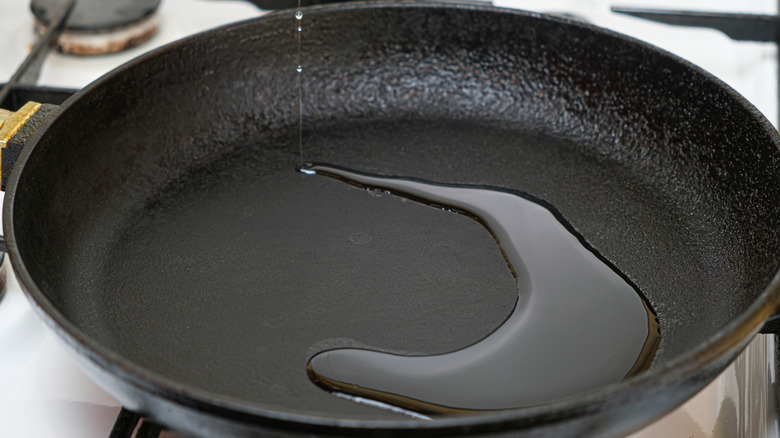
It's important to cook your hash browns in the right kind and amount of fat. Using too much, too little, or the wrong kind can all lead to subpar results. You don't want to fall down at the last hurdle and leave your hash browns greasy, undercooked, or soggy, so it's important to think about this if you want perfectly crispy hash browns.
"I like a combination of neutral oil and butter," says David Davidov. "Use the oil mainly for frying, then add a little butter because I really like the flavor it gives the potatoes," he says. Cynthia Christensen also uses this combination, for flavor and crispiness. It's worth noting, however, that using too much butter could leave your hash browns less crisp due to its moisture content. And, if you want to keep them dairy-free, using oil alone works just fine. It's best to avoid flavorful oils that could overwhelm the potatoes, such as extra virgin olive oil or toasted sesame oil, unless that's a deliberate choice.
Using the right amount of oil is vital, too. "You don't need to deep-fry them, but don't be too conservative with the fat either," Davidov notes. If you use too little oil, it will take longer for the potatoes to cook and they may steam rather than fry, so they're soggy instead of crispy. "You want a thin, even coating across the bottom of the pan so the potatoes make good contact with it," says Davidov. "For every pound of shredded potatoes, use 3 tablespoons of oil," Scott Rodriguez suggests.
Overcrowding the pan
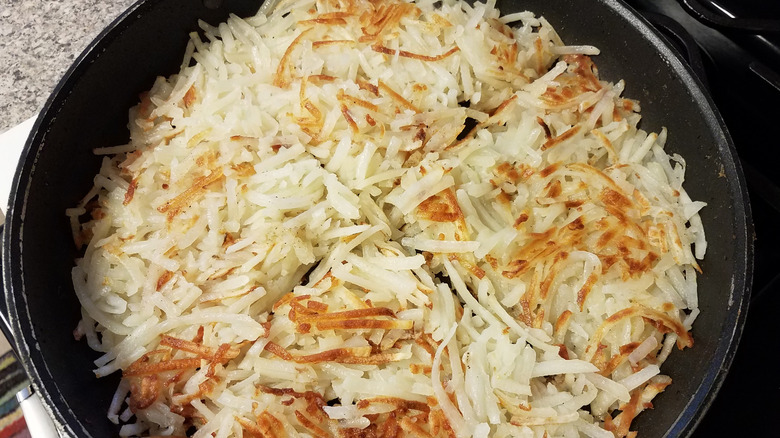
Whether you're making diner-style hash browns or patties, it's important not to overcrowd the pan. Although you will have done your best to get the excess liquid out of your potatoes, they will still release some moisture as steam as they cook. And, when you have too many steaming potato shreds in one pan, you won't get the crispy results that you're looking for.
When making diner-style hash browns, making your pile of potatoes too thick is a mistake. "If you pile them too high, the outside might brown while the potatoes underneath basically steam," David Davidov explains. "Spread them in a fairly thin, even layer and give them some time," he suggests. Cynthia Christensen agrees that making the potato layer too thick is a mistake, as is making patties that are too thick. "Whether I'm making patties or diner-style hash browns, I want them fairly thin so that more of the potato is in direct contact with the hot pan," she remarks.
And, when making patties, you need to give each one enough space when pan frying them. You can absolutely cook several at once, but don't cram them all up together. Leaving around ¼ inch to ½ inch between each one gives them some room to breathe and means any steam released won't affect its neighbors. It takes longer, but it's well worth cooking them in a couple of batches or using two pans if they don't fit comfortably in one.
Not leaving hash browns long enough before flipping
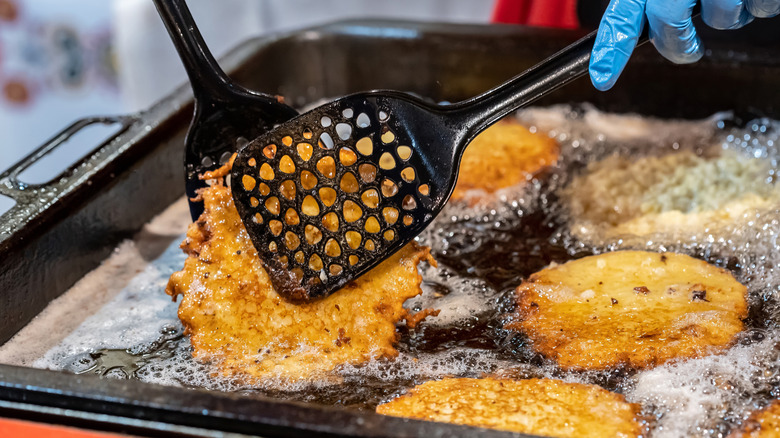
By the time you've got to this stage of the process, you're probably tired and hungry and just waiting to get some hash browns in your belly. But, when you don't leave them long enough before flipping them, you won't get them properly crispy, and isn't that what hash browns are all about?
"Don't rush the flip," says David Davidov. "I think this is where a lot of people go wrong," he remarks. This is the point when you want things to hurry up, but exercising patience really is key here. "Once the potatoes hit the pan, let that first side really develop a crust," says Davidov, suggesting you lift a small corner of the potatoes with a spatula to check on them. "If it's deeply golden and releases easily, that's usually your sign that it's ready," he says. Whereas, "if it's pale and sticking, give it another minute or two," he adds.
The same goes for patties. You want that first side to get as crisp as possible before you flip. Regularly flipping them back and forth will only take longer and might end up with less crunch. "If you keep lifting, stirring, and moving them around, they never get a chance to brown properly," says Cynthia Christensen. "Just walk away for a few minutes — I know it's hard, but just do it."