

Raising Cane's Vs Chick-Fil-A: Who Has The Better Chicken Tenders?
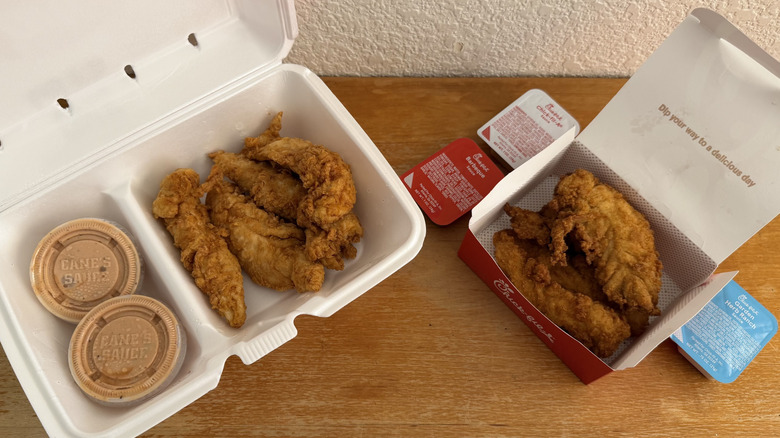
Arguably more than any other fast food chain, Raising Cane's is synonymous with chicken tenders. Whereas close competitors like Zaxbys or Bojangles also serve, for example, wings and breakfast sandwiches respectively, virtually everything on the Raising Cane's menu is tender-focused. Even sandwiches and the secret menu items at Raising Cane's still incorporate its signature chicken fingers to some degree. Meanwhile, Chick-fil-A may well qualify as the single most beloved chicken chain — at the very least, it's the top chicken-selling restaurant in America.
In the past, I compared Popeyes chicken tenders to Raising Cane's, and later compared KFC chicken tenders to Raising Cane's. Both times Cane's came out on top. With that said, I had never tried tenders from Chick-fil-A before this experience, so it was a genuine mystery to me how the country's best-selling chicken spot would perform against arguably the foremost tender specialist. Based on my thoughts and observations after trying both chains for myself, ahead are comparisons between Cane's and Chick-fil-A tenders in a number of categories, before my pick for the best chicken tender chain overall.
How does the size of the chicken tenders compare?
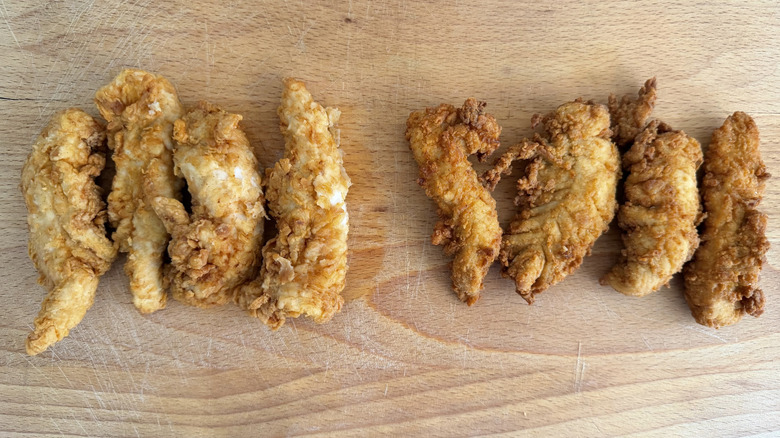
In the past I've measured tenders with a ruler, but in this case I stuck to the eye test, because it was clear the tenders from one chain were larger than the others. Plus, tenders are just about as irregularly shaped as possible, so ruler measurements are inherently flawed, given frequent changes in height and width.
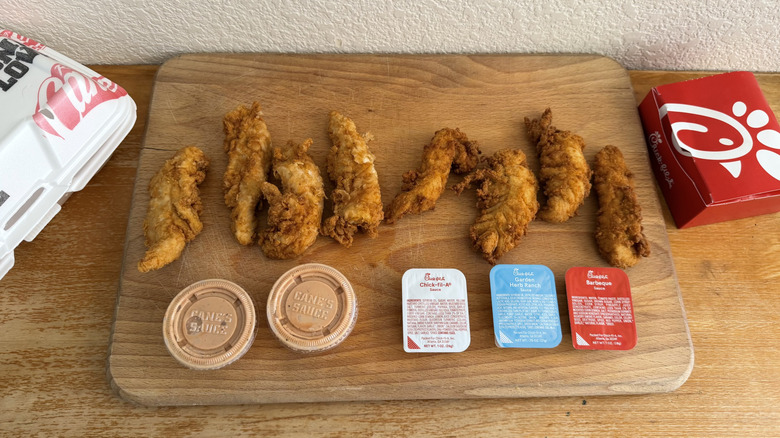
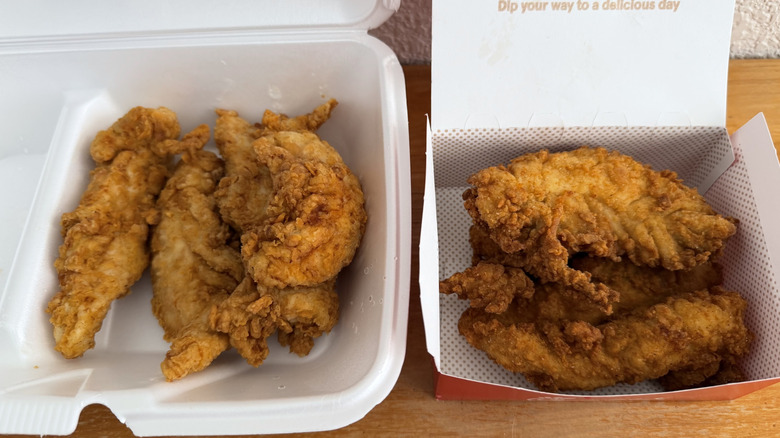
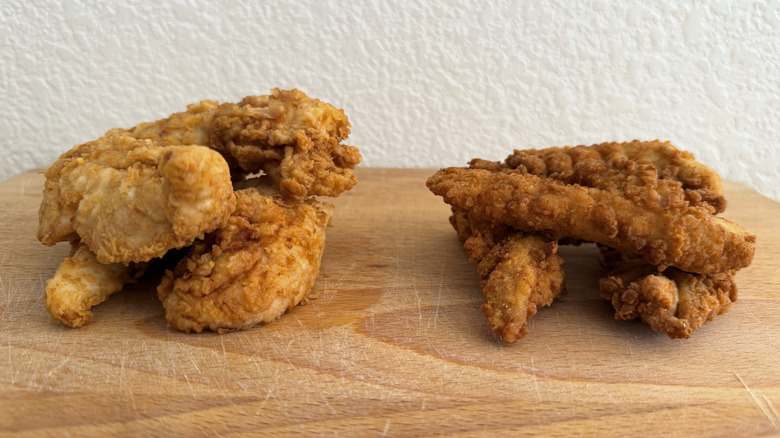
With all of that said, my four Raising Cane's chicken fingers were larger than my four Chick-fil-A tenders. First off, the single smallest tender of my batch of eight was from Chick-fil-A. Plus, looking at cross-sections of tenders from the two chains, Raising Cane's visibly provided a larger mass of chicken. My Cane's bag even felt heavier. To double-check my work, I used the lasso tool in Photoshop to select my four Cane's tenders and drag them over their Chick-fil-A counterparts in the same image — while they spanned roughly the same area, more space and less overlap between Chick-fil-A tenders made it clear that what I received from Raising Cane's was safely a larger quantity of food.
How does the quality of each chain's chicken compare?
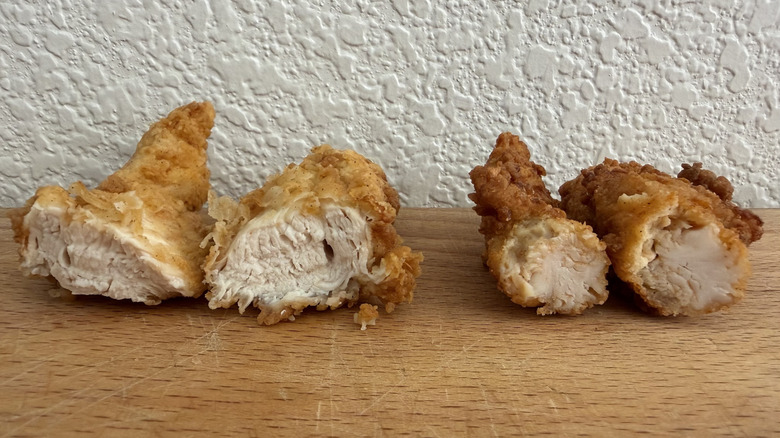
In an exclusive interview with Mashed, Raising Cane's co-founder Todd Graves revealed that a big part of what makes Raising Cane's tenders so good compared to the competition is the quality of the chicken. Cane's exclusively uses rich tenderloin meat and even purports to hold its suppliers to a high standard. I found that the apparent care Cane's puts into the quality of its chicken showed — when I tried some isolated bites of chicken, they were amply meaty and lacking in the dryness that can plague lower-quality white-meat chicken.
What immediately stood out to me about my Chick-fil-A chicken, meanwhile, was not its heft or consistency but its flavor. I was convinced that Chick-fil-A uses a pickle brine to flavors its tenders, courtesy of a salty, lightly spiced flavor driven by a prominent tang. While Chick-fil-A's supposed use of pickle brining seems to be a long-standing myth, the chain does apparently prepare its chicken tenders with vinegar powder, resulting in a pickle-y flavor. It was satisfying, for what it's worth, but wasn't quite special enough to make up for a chicken that I soon realized was slightly drier and tougher than its counterpart from Raising Cane's. Backing up that finding was the fact I got a couple bites of excessively tough chicken, which was something that didn't happen once with my Cane's chicken fingers.
Which chain uses better breading?
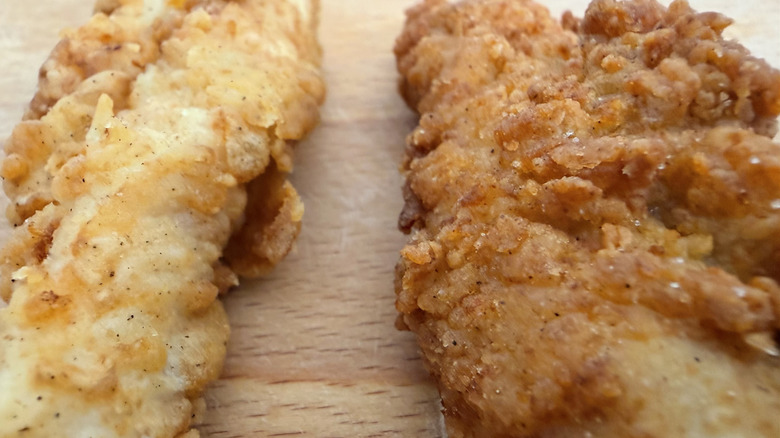
There were ultimately things I liked about the breading on both chicken chain's tenders. While I wouldn't normally factor in the time I often have to leave food sitting out to properly analyze it, in this case, I felt that played an significant role in my decision for the chain with superior breading.
First of all, the Raising Cane's breading was lightly crispy, creating visible crags, without branching off into masses of pure breading as tends to happen on crispier fried chicken. Chick-fil-A's breading was, in fact, crispier, with pockets of extra crunch where the breading was particularly thick. Both were enjoyable, but what made me ultimately prefer the Raising Cane's breading was the fact it held up better over time. Lacking excessive crispiness, it was a little wetter, for lack of a better term, and that kept it fresher for longer. The Chick-fil-A breading, rather, lost some panache as time went on. Since both chains do considerable drive-thru and take-out business — meaning plenty of customers will inherently leave their food sitting a bit before eating — I think it's fair to factor in the extent to which Raising Cane's did a better job holding up, resulting in a superior breading.
How are the tenders seasoned?
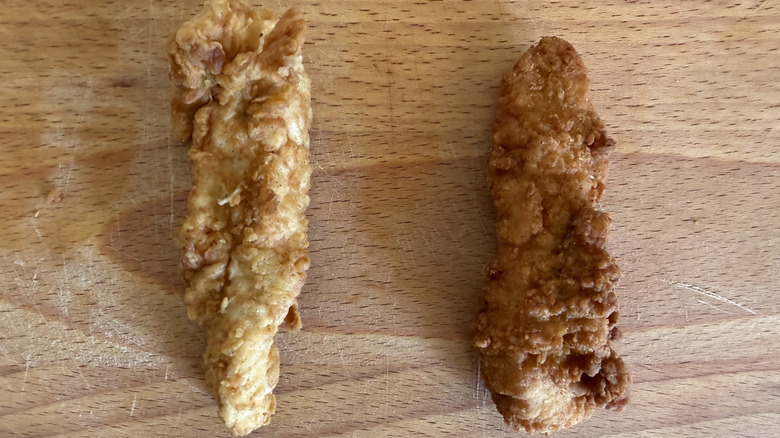
Among Raising Cane's doubters, a lack of seasoning on its chicken seems to be the most common complaint about the chain. For what it's worth, I would argue that those doubters are failing to see the forest for the trees, confusing a minimalist seasoning that foregrounds quality with under-seasoned. When I isolated bites of breading, I tasted both ample salt and a rich buttermilk flavor. The chicken, meanwhile, was tender and juicy, but not perceptibly seasoned — and that was totally fine given its high quality. I wouldn't regularly eat Cane's chicken tenders plain, but even dipped in a sauce as common as ketchup, they shine.
My Chick-fil-A chicken's flavor was dominated by a vinegar-y tang, accentuated by a blend of spices I would guess includes garlic and paprika. Its breading was likewise defined by a similar or perhaps identical spice blend, sans vinegar. Lacking from its flavor were the salt and buttermilk I enjoyed in my Cane's tenders, buried beneath bolder spices. While I think Cane's chicken tastes great, it needs to be dipped. Chick-fil-A's tenders, rather, are surprisingly tasty on their own, even if they're better in dipping sauce. So, as much as I will always defend the seasoning on Cane's chicken, Chick-fil-A wins the seasoning head-to-head.
How do the dipping sauces compare?
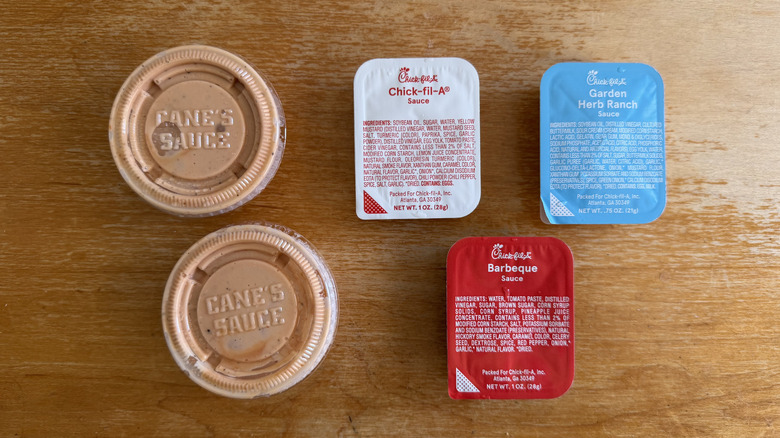
More than any other component of its menu, sauce is the single item that Raising Cane's does outright better than competing chains. The secret behind Raising Cane's iconic Cane's Sauce is famously kept a secret, hence a lack of truly comparable copycats. The adjectives I noted down to describe Cane's Sauce this time around were tangy, smoky, creamy, and black pepper-forward. Each of those flavors built up a harmonious whole, seriously greater than the sum of its parts.
From Chick-fil-A, I opted for dipping cups of Chick-fil-A Sauce, ranch, and barbecue sauce. On its own I thought the barbecue sauce was decent, contrasting a pronounced sweetness with vinegar tang. The chicken, however, seemed to neutralize that tang, and I found it off-puttingly sweet. The ranch was solid, really just tasting competent rather than iterating in any meaningful way on what a baseline ranch should taste like. Unsurprisingly, Chick-fil-A Sauce was the star of the show, merging the sweet tang of a honey mustard with some barbecue-esque smokiness. As much as I typically enjoy Chick-fil-A sauce, it tasted two-dimensional when juxtaposed with Cane's Sauce. So, despite an undoubtedly deeper roster of sauces, nothing could live up to Raising Cane's masterwork, winning the sauce category for Cane's.
How do they compare nutritionally?
A single chicken finger from Raising Cane's totals 130 calories, 6 grams of fat, 1 gram of which is saturated fat, 35 milligrams of cholesterol, 230 milligrams of sodium, 5 grams of carbs, and 12 grams of protein. Factoring in a 43-gram Cane's Sauce, without which no order is complete, adds 190 calories, 18 grams of fat, 3 grams of which is saturated fat, 10 milligrams of cholesterol, 570 milligrams of sodium, 6 grams of carbs, and 4 grams of sugar.
From Chick-fil-A, one tender — based on dividing nutritional data for a serving of two in half — equals 100 calories, 5 grams of fat, 1 gram of which is saturated fat, 25 milligrams of cholesterol, 290 milligrams of sodium, 6 grams of carbs, 1 gram of sugar, and 10 grams of protein. Dipping sauces differ nutritionally, of course, but going with the chain's signature offering, a 28-gram dipping cup of Chick-fil-A sauce adds 140 calories, 13 grams of fat, 2 grams of which is saturated fat, 10 milligrams of cholesterol, 170 milligrams of sodium, 6 grams of carbs, and 6 grams of sugar.
Altogether, nutritional data for one tender and one dipping sauce from each chain falls more-or-less in the same ballpark. By a slim margin, it's far to say the nutritionally superior chain is Chick-fil-A. Even if a bare Cane's tender is slightly lower in sodium, its saltier-by-volume dipping sauce almost nullifies that advantage, giving Chick-fil-A the win by a safe margin.
How do the value and customizability compare?
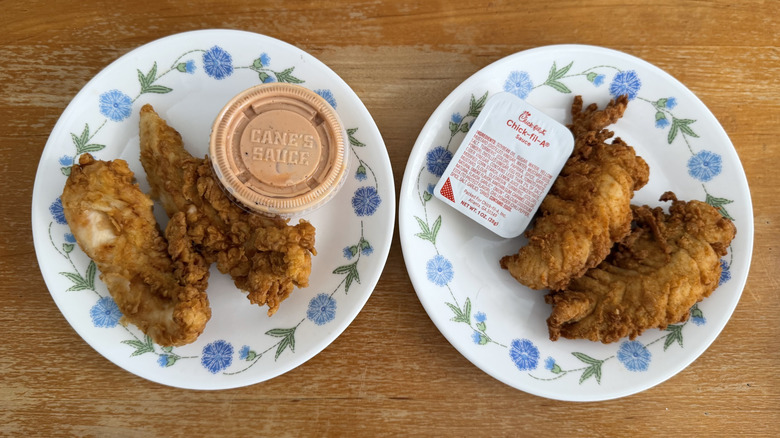
My local Raising Cane's and Chick-fil-A restaurants are located in the suburbs of Las Vegas, far enough away from the Vegas Strip that their prices shouldn't be much different from the national average. At my Raising Cane's, a three-tender combo is $10.69, a four-tender combo is $12.39, and a six-tender combo is $17.89. Individual chicken fingers are $1.99 à la carte, and a single Cane's Sauce is $0.45. At my Chick-fil-A, two Chick-n-Strips are $3.95, three are $5.75, four go for $7.25, and 10 total $18.09. The first two sizes come with two sauces, a four-count comes with three, and a 10-count comes with five. Three, four, and ten count orders can also be ordered as combos with choices of a side and a drink for $10.09, $11.49, and $21.49.
Chick-fil-A, then, is the cheaper chain per chicken tender — a four finger combo at Raising Cane's may come with fries, sauce, Texas toast, cole slaw, and a drink, but that $5 difference compared to four tenders with two sauces at Chick-fil-A is considerable. Four à la carte tenders, meanwhile, are also pricier, whereas the Chick-fil-A combo is slightly cheaper than its competition. Due to a larger selection of sides and sauces, it's fair to say tender orders at Chick-fil-A are more customizable too, even lacking the ability to order just one tender. Overall, then, Chick-fil-A is superior in both value and customizability.
Raising Cane's has better chicken tenders
The quality I liked the most about my Chick-fil-A's tenders was how good they tasted plain. Thanks to a pickle-y brine and a strong seasoning blend, the baseline flavor of each Chick-fil-A tender was surprisingly solid. However, that flavor diminished a bit when paired with a dipping sauce, so that strength wasn't ultimately a major factor, given the extent to which dipping sauces are a pretty integral component of any proper tender meal.
In my head-to-head, Raising Cane's tenders won the chicken, breading, and dipping sauce categories, each of which is key to a good overall flavor. The fact Raising Cane's tenders were bigger wasn't all that important to me, but adds some value nevertheless. And even if Cane's tenders are perhaps inferior nutritionally and less of a monetary deal, the differences are minor enough that I would argue it's worth the extra cost at Cane's for a superior product. Raising Cane's genuinely specializes in chicken tenders, so it's not really a huge surprise that its chicken fingers were better overall than what amounts to one of many chicken dishes at Chick-fil-A.
Methodology
Less than a mile separates Raising Cane's from my nearest Chick-fil-A in the suburbs of Las Vegas. So, I picked up my Chick-fil-A tenders from my closest restaurant's drive-thru, before heading to the drive-thru of the nearby Raising Cane's in the same trip. From the former I ordered a four-piece tenders with one Chick-fil-A sauce, one ranch, and one barbecue sauce. From Cane's I got four à la carte chicken fingers and two Cane's Sauces. Neither chain had any indication my orders were for the sake of a review and not just a routine meal.
At home, I started tasting both kinds of tenders by dissecting one of each, so I could analyze their breading, chicken, and seasoning in isolation. Once I had my initial thoughts in those categories down, I tried some plain tender bites to get a better sense of how those components contributed to a greater whole. When I felt I understood what made the tenders themselves tick, I started dipping them, ultimately trying each kind of tender in every dipping sauce, including sauce from the opposing restaurant. All of my impressions are based entirely on this experience, and not any past thoughts I may have had on the featured items or chains.