

Cheap Vs Expensive Turkey Deli Meat: Is It Worth The Splurge?
Calling something or someone a turkey has long been considered a putdown. Yet, there's nothing more noble than the humble American turkey. Just ask Benjamin Franklin. After the U.S. government adopted the bald eagle as its symbol, Franklin criticized the choice in a letter, saying that the turkey is "a much more respectable Bird, and withal a true original Native of America ... He is besides, though a little vain and silly, a Bird of Courage."
But where would Franklin stand on the cost of turkey deli meat? Perhaps the famously frugal Founding Father would choose to save a penny rather than spring for some expensive, high-end designer turkey slices. It's impossible to say, because for everything Franklin did over the course of his storied life, he never stood inside a mega supermarket faced with decision paralysis over a dozen different brands of lunch meat. So figuring out whether it's worth it to spend more on your turkey slices is a task that falls to our generation.
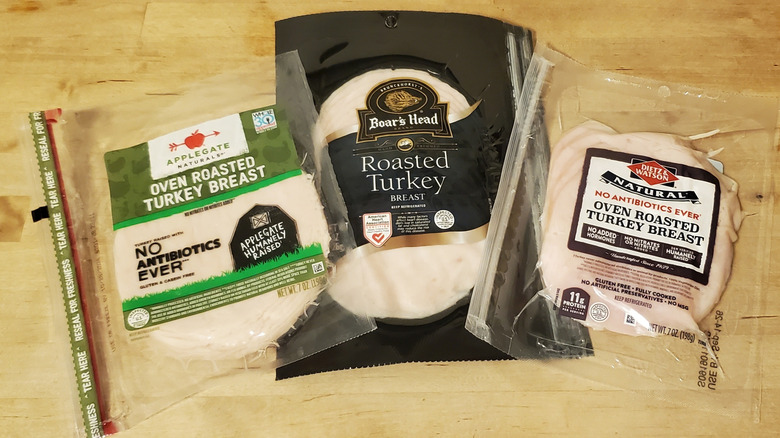
And it's a task we're prepared to tackle head-on. We've sampled turkey from eight different national or regional deli meat suppliers — four from the cheap seats and four from the luxury boxes — and compared them in a rigorous gauntlet of meat consumption. Our goal: to determine once and for all whether it's worth the splurge to spend your Benjamins on high-end turkey meat.
Boar's Head
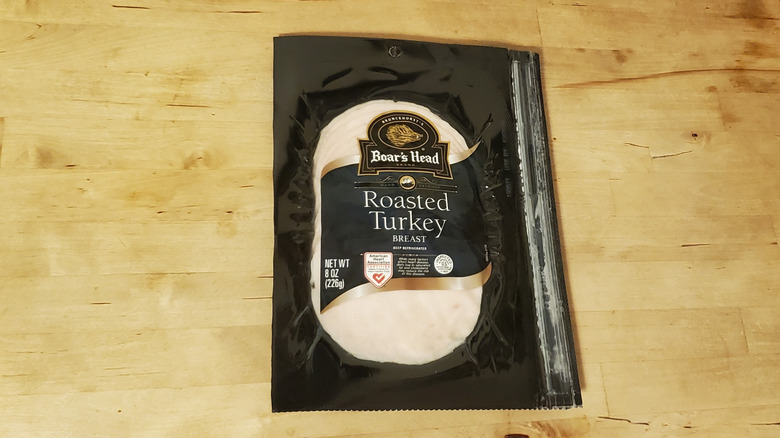
I started by sampling Boar's Head — a deli meat you won't find at Walmart — which was also one of the most expensive brands, priced at $17.98 per pound (though prices may vary by locality). The slice I chose at random from the pack was sliced thin, but at 17 grams, not excessively so. Similarly, while the brand's turkey slice was moist to the point of leaving a faint wet residue on my plate, it wasn't so wet as to be sloppy. Across the board, in fact, Boar's Head felt like a perfect baseline turkey slice: good turkey flavor without being too strong, good moistness without being too wet, good thickness without being either too thick or too thin, and a nice texture that was neither gristly nor grainy.
Like all high-end turkey brands, Boar's Head had a much simpler ingredient list than the cheaper meats. In fact, with just five ingredients, it tied with Dietz & Watson for one of the lowest ingredient counts of all the brands I tried. Turkey breast and water were the main ingredients, with salt, sodium phosphate, and sugar rounding it out. The sugar gave the slice just the slightest hint of sweetness; not enough to notice in a vacuum, perhaps, but just enough to make it stand out from the other turkey brands. Overall, I thought it was a good, if not spectacular, slice of turkey meat.
Applegate
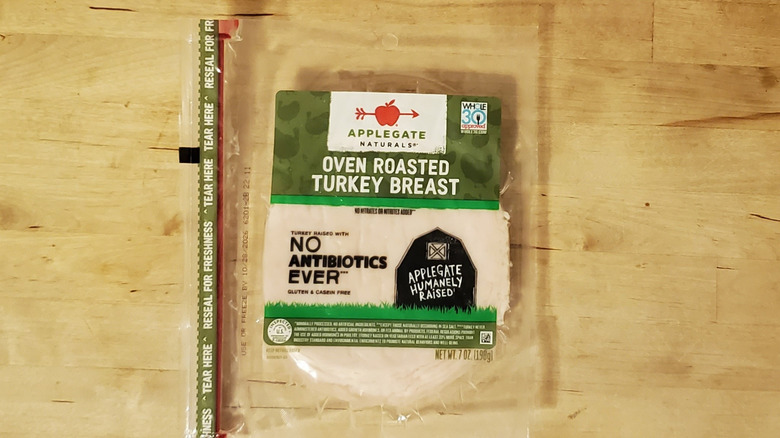
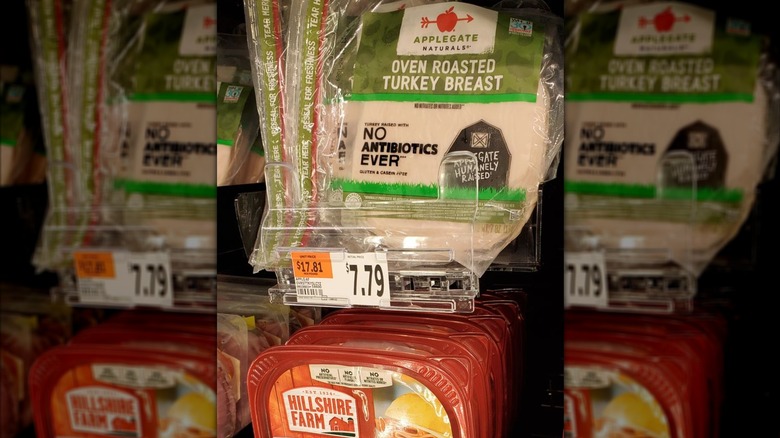
Applegate has made a name for itself as a healthy alternative to cheap meats, like Applegate's high-quality frozen breakfast sandwich. The packaging for its sliced oven-roasted turkey breast proudly proclaims "no antibiotics ever" and "humanely raised." That's part of the justification for the $17.81 per pound being charged at my local grocery store for the brand's turkey slices. And it should be noted that Applegate, as well as some of the other high-end deli meat brands, also offers up organic versions that cost even more money. But can you taste the natural difference?
Yes. A look at the modest ingredient list helps tell the tale. In addition to turkey breast, water, turkey broth, and two kinds of salt, Applegate turkey slices have just two additional ingredients: potato starch and rosemary extract. The potato starch is used to maintain texture and lock in moisture, while rosemary extract is a natural food preservative. This use of all-natural ingredients gives the Applegate turkey a notably different taste than the others I sampled — it tasted simpler, with a strong natural turkey flavor.
The texture was also excellent, with nothing gristly or sinewy in the slice I sampled, and the moisture level was on point: not too wet, not too dry. It was also the thickest of the six slices, weighing in at 26 grams, notably the biggest and heaviest single slice. It felt like a deli meat that would be the star of a sandwich rather than just a bit player.
Dietz & Watson
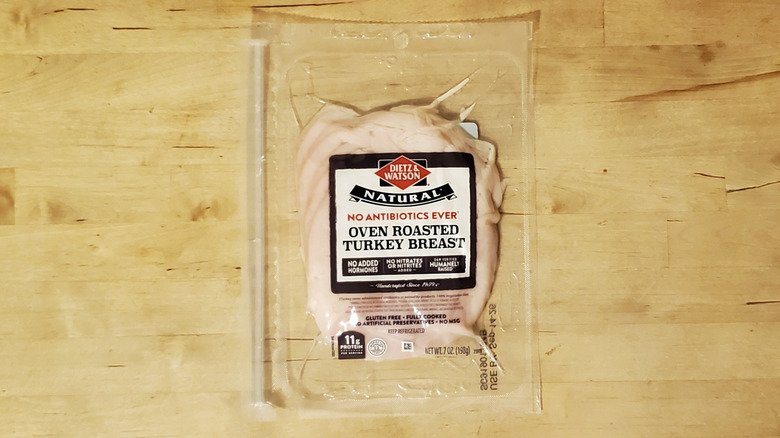
Though prices may vary by region, when I bought the turkey for this grand experiment, the cost of the high-end brands was remarkably consistent. At $17.12 per pound, Dietz & Watson was marginally cheaper than Applegate, Boar's Head, or Plainville Farms, but the difference between the four was barely more than a dollar.
While the quality level was similarly high for all four expensive turkey brands, Dietz & Watson arguably pipped the others to the post. Though taste is, famously, a matter of taste, I slightly preferred the flavor of the Dietz & Watson turkey to the others. Other than Plainville Farms, the other three more expensive brands each had one unique signature ingredient among the sparse ingredient lists that seemed to influence the flavor: for Boar's Head, it was sugar; for Applegate, it was rosemary extract; and for Dietz & Watson, it was dry vinegar. The result was just the merest hint of a sharpness to the flavor, which I personally gravitated towards.
The Dietz & Watson turkey slice was also on the thicker side, coming in just a teensy bit lighter than the Applegate offering at a meaty 23 grams. On the other hand, the Dietz & Watson turkey was easily the wettest of the eight brands. It's important not to be too dry, of course, but Dietz & Watson seemed to overegg the balance by putting a little too much water in the recipe for my druthers — perhaps due to the use of carrageenan for water retention. Despite this, though, the meat itself had a pleasant texture, with no evident gristle.
Plainville Farms
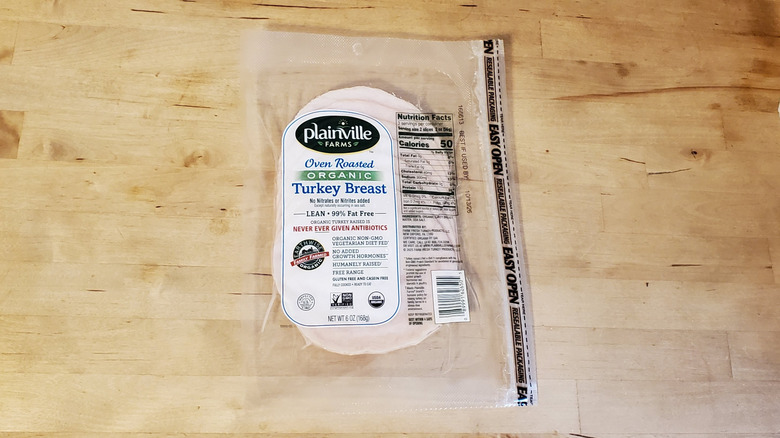
The Plainville Farms website proudly proclaims that it has a focus on natural turkey rooted in a farming tradition that spans nearly two centuries. That focus shows in its range of turkey deli meat options, which include both "Natural" and "Organic" varieties, but thankfully nothing unnatural or inorganic. The difference between the two is actually quite small. The natural option includes one extra ingredient (potato starch) and has slightly more sodium, but otherwise the nutritional information is essentially the same. And either of them qualifies as the most natural of all the brands I tried.
That's because the organic variety I purchased only has three ingredients: turkey, water, and salt. At 24 grams, the slice I tried was also among the heftiest (though the packaging suggested it should have been even larger, at roughly 28 grams per slice). The result was a slice that showcased how turkey was meant to be. It was pretty much pure turkey flavor, with just a soupçon of salt at the back end. It was also quite moist; there was enough water that a small amount was noticeably pooled inside the pouch. Of course, you do pay for these differences: at $18.64 per pound, it was the most expensive turkey I sampled, though also the only organic.
I live in an area with wild turkeys, and when I see a rafter of turkeys crossing the road, this is what I imagine they taste like. If only all turkey deli slices tasted this good.
Hillshire Farm
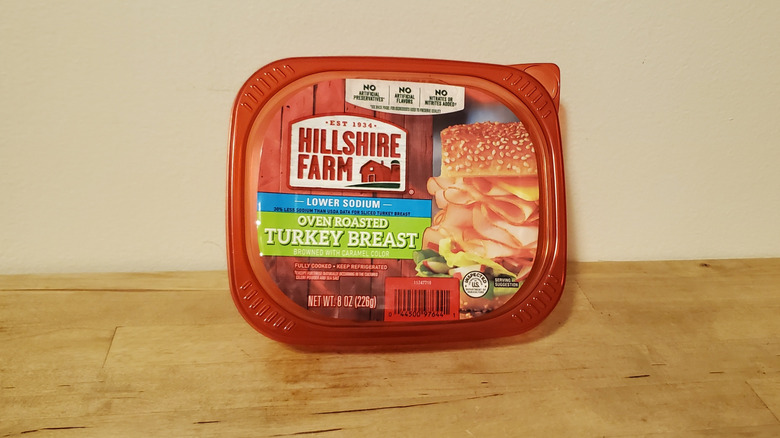
At $10.98 per pound, Hillshire Farm was the most upwardly mobile of the four cheap brands of turkey deli meat I sampled. It was much cheaper than the luxury turkey brands, but it still had aspirations. And of the four cheap options I tried, Hillshire Farm had the best taste, with a fairly robust turkey flavor that shone through.
There were some signs of putting on airs, though. While I wouldn't classify the Hillshire Farm turkey as dry, it certainly wasn't as moist as any of the more expensive brands. The consistency, though, is what really let Hillshire Farm down, as the slice I ate had some chewy, gristly bits in it that made for an unpleasant bite or two. The Hillshire Farm slice of turkey was also thinner than any of the premium brands, weighing in at 16 grams — like the price, again in that middle zone between the razor thinness of the cheaper brands and the plump thickness of the expensive brands.
Hillshire Farm also had more ingredients than its higher-end competitors, with 11 compared to between three and seven for the expensive brands we tried. Three of those ingredients involved salt; even the "lower sodium" variety I purchased still had more sodium (340 milligrams per 56-gram serving) than the regular Applegate turkey (290 milligrams per 55 grams). On the plus side, Hillshire Farm did have the most secure packaging for storage after opening, so it's got that going for it, which is nice.
Oscar Mayer
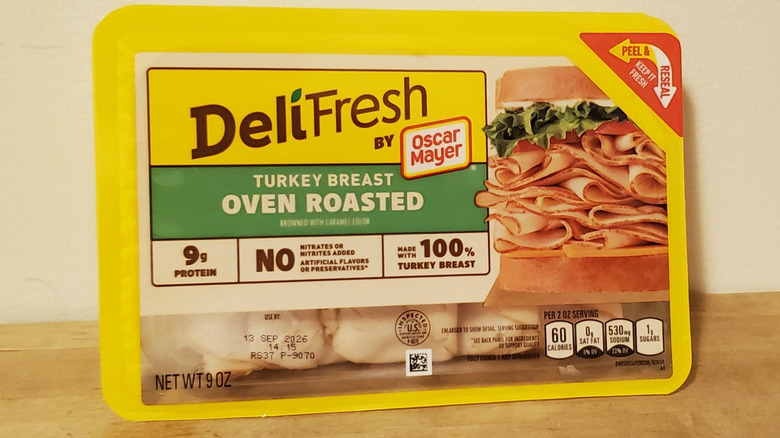
My turkey has a first name; it's O-S-C-A-R. My turkey has a second name; it's D-R-I-E-R. That's the first impression I received when eating a slice of Oscar Mayer's widely affordable turkey deli meat. Living right on the edge of actually being too dry to eat, Oscar Mayer was easily the driest of the eight brands I tried.
Which is a bit odd, since, like many of the moister brands, water is listed second among the ingredients on the package. For Oscar Mayer, water comes right above 10 other ingredients, including modified cornstarch, which is supposed to help the turkey retain water — and perhaps not coincidentally add bulk to processed meat, so you get less bang for your buck. Some of the other additions didn't exactly instill confidence either. Adding "natural flavor" to something that should inherently be both natural and flavorful is a bit of a red flag. And the sodium level is high: at 530 milligrams per 56-gram serving, you're getting close to twice as much as the 290 milligrams per serving from Applegate.
Having said that, the taste was okay, and the texture was fine too. At just 10 grams per slice, Oscar Mayer had one of the thinnest and lightest of all the slices, so you'll need to load up to fill out your sandwich. Luckily, at just $9.76 per pound, that won't cost you too much.
Buddig
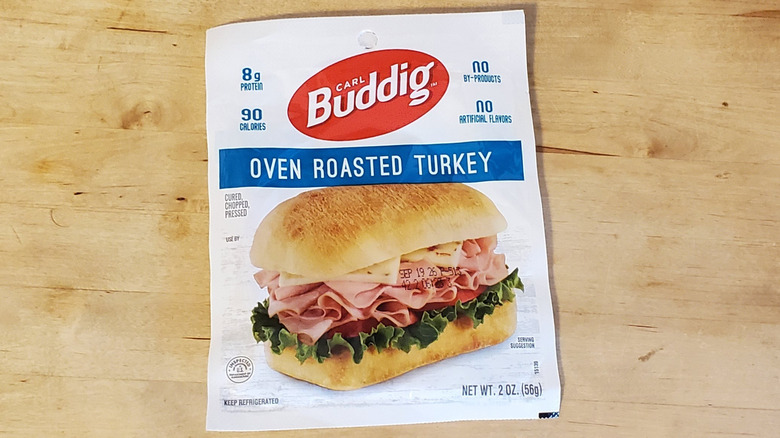
Just how cheap Buddig's turkey meat is depends on how you buy it. For the sake of convenience, I opted to buy just the single-serving, non-resealable pouch. This is also easily the most expensive way to buy Buddig. To really get a sense of just how much cheaper the brand is compared to its competitors, you'll want to consider the 22-ounce Mega Pack, which at my store was on sale for the absurdly low price of $3.99 per pound, or less than 25% the cost of the expensive brands I sampled.
Conventional wisdom says you get what you pay for. I suspect conventional wisdom came up with that adage after eating Buddig turkey. The meat was grainier and chewier than the other five brands. It was also saltier — 590 milligrams per serving — and boasted a strange pink tone that bore no resemblance to the natural turkey meat coloring of the Applegate or Dietz & Watson turkey. It also had nearly twice as many calories (90) compared to Dietz & Watson (50) for the same serving size, while packing an impressive 16 ingredients. Among those ingredients is mechanically separated turkey, which is a "paste-like and batter-like meat product," per the USDA. Yum!
Buddig slices were also the smallest at just 9 grams per slice. They were so thin that when I held one up to the light, I could see right through it. While this might make for a great way to watch a solar eclipse, I personally prefer a little meat on my meat, so I wish the individual slices were thicker. The best thing I could probably say about the Buddig turkey is that it had more moisture than the Oscar Mayer sample and thus didn't taste nearly as dry.
Lunch Mate
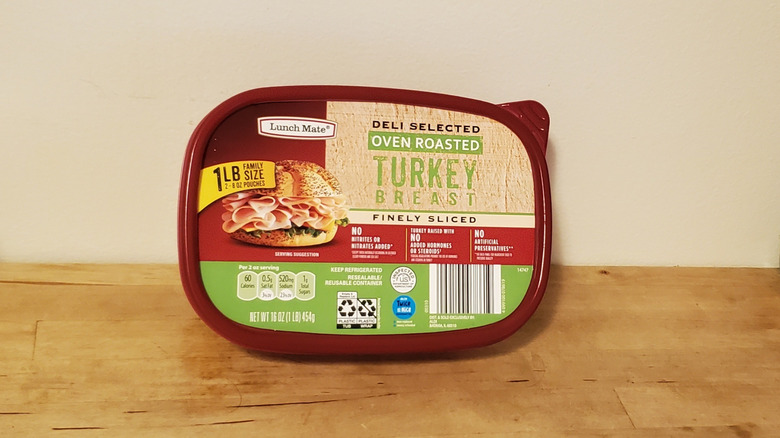
Aldi is one of the go-to grocery chains with high-quality deals that win shoppers over. Naturally, Aldi has its own in-house brand of lunch meats called Lunch Mate. Perhaps natural isn't the best word to describe the brand's discount turkey offering, given it has one of the more interesting ingredient profiles among the lunch meats I tested.
With 11 different ingredients, Lunch Mate doesn't quite measure up to the whopping 16 ingredients of Buddig, but what it lacks in quantity it makes up for with filler. Lunch Mate has not one but two ingredients (carrageenan and modified food starch) that lock in moisture to add bulk to the meat. Additionally, Lunch Mate turkey includes cultured celery powder, which is a natural nitrate. This allows Lunch Mate to put "No nitrates or nitrites added" on the package while still adding nitrates; if you look closely at the label, there's a little asterisk noting the celery powder. Tricky!
Also tricky is the odd fact that the Lunch Mate "Premium" option was actually cheaper than the regular version. I stuck with the base offering, which was still quite cheap at $5.89 per pound. As for the eating experience itself, it was basically, "what if Oscar Mayer wasn't dry?" The slice, at 10 grams, was very thin indeed, and at 520 milligrams of sodium per serving, it packed a salty kick. But it also was quite moist, making for a better overall eating experience than Oscar Mayer. Apparently, having two moisture-locking additives worked.
Conclusion
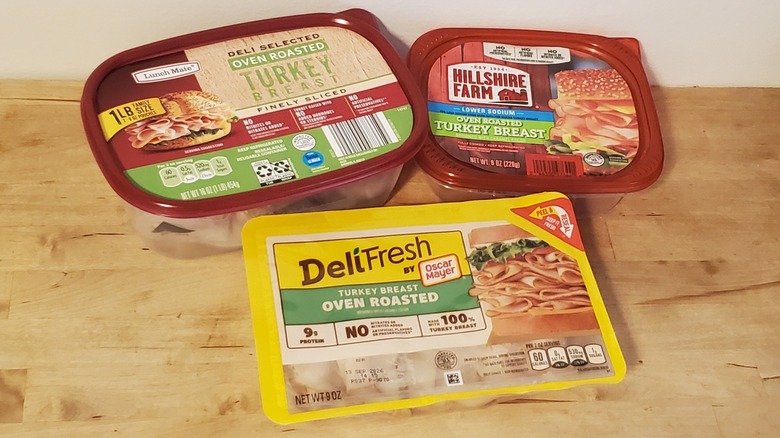
So, is it worth it to spend more money on deli turkey slices? In a word: yes. It absolutely is, assuming, of course, that you can afford to spend between two and four times as much on this portion of your groceries. Across the board, the more expensive turkey brands tasted better, and the slices of meat were thicker and moister. They also were uniformly healthier, with lower sodium, fewer calories, and far fewer weird ingredients. The star of the show with each of the more expensive brands was the turkey itself, with real turkey meat and turkey flavor pushed to the forefront.
The cheaper brands essentially had one thing going for them: They were cheaper. If cost is an issue, or you're buying in bulk because you have to feed 40 kids on a school field trip or something, then an industrial-size block of Buddig turkey product might make sense. But if you want to treat yourself to a nice sandwich, splurging on higher-quality turkey will never be one of the deli-meat mistakes you're making.
Methodology
To determine the quality and value of the deli meat brands I tested, each turkey slice was evaluated on several criteria: taste, texture, dryness, and thickness. All six sample packages of sliced turkey were purchased at the same time and sampled in order; one random representative slice was picked from each brand, with a brief respite between slices to reset the palate. Additionally, to ensure a level playing field, the plain roasted turkey variety was chosen for each brand — nothing smoked, or with added honey, or maple flavors, just straightforward turkey.
Taste was judged by how much natural turkey flavor came through. Since many brands use various fillers in addition to the actual meat, brands with stronger turkey flavor were rated higher. Texture focused on whether there was any gristle or tougher muscle fibers. For dryness, in addition to mouthfeel, I also briefly placed each slice on a clean plate to see how much moisture residue it left behind. And for thickness, each slice was weighed on a food scale for exact weight.
Finally, nutritional information and price were also factored into the final evaluation. To balance for varying package sizes, the price used for comparison was the price per pound. The prices cited are the actual prices I paid in the Greater Boston Area; prices may be higher or lower in other parts of the country.