

How To Order Whiskey Like An Expert
The world of whiskey is a massive one, and if you're trying to discover your next favorite sip, heading out to bars or distilleries is a great way to sample something new without investing in an entire bottle. It's a great way to learn, too, from those who are front and center in the industry and have their finger on the pulse of everything that's new, old, and in-between. But it can also be intimidating, which brings us to our question: How do you order without sounding like a complete newbie?
We reached out to some industry experts to get their advice on how to order whiskey like a pro, and they gave us some great insights. Even beginners can quickly learn to identify a quality whiskey, and it's all about being willing to learn. One of the aspects that all of our experts agreed on was that ordering like a pro starts with being willing to start a conversation and dialogue with those behind the bar.
Take it from Chris Walster from The Cask Connoisseur, who told us, "I think the first thing I would say is that ordering whiskey like an expert does not mean pretending you know everything. In fact, the best whiskey drinkers are usually the most curious. ... The best whiskey order is not always the rarest bottle on the shelf. It is the one that helps you understand your own palate a little better." So, let's talk about how to best satisfy that curiosity!
Know how to describe your preferred flavor profile and whiskey style

There are more than a dozen unique types of whiskey, and that's just scratching the surface when it comes to the vast myriad of choices that are out there. Order a rye whiskey and you'll get something that's lightyears away from a bourbon, and the bottom line is that everyone's tastes are different. Knowing how to describe your preferences in a way that takes out the guesswork and subjectivity is key, according to Chris Walster.
"Rather than just asking for 'something smooth,' which can mean very different things to different people, try giving a few clues about what you already enjoy," he recommends. "For example, you could say: 'I usually like bourbon, but I'd like to try something a little spicier,' or 'I enjoy fruity, sweeter whiskies, but I'm open to trying something with more oak.'" That gives your bartender a more objective place to start in curating recommendations, which is bound to be much-appreciated.
Zak Lindahl — the Beverage Director at The National, Autograph Collection in Downtown Oklahoma City — agrees, and recommended becoming familiar with the trademarks of different styles. For example, you can expect something sweet and caramel-forward with a bourbon; ryes tend to have a spicy, peppery kick; and if you're getting into malted barley-based whiskey, you'll find more grains and earthiness. Being able to communicate what you like — and what you don't like — in a clear way will go far.
Ask for recommendations adjacent to your favorites to discover something new

While it can be tempting to throw caution to the wind and try something completely different, your palate can be a delicate thing. It's easy to offend, too, and that's why Chris Walster says that even if you're looking for a new favorite, the best place to start is with something close to an old favorite.
"A good way to branch out is to order in steps," he says. "Start with something familiar, then move one step away from it. If you usually drink bourbon, try a rye with a sweeter profile. If you like lighter Scotch, try a Highland or Speyside malt before jumping straight into heavy peat. If you already enjoy sherry cask whiskies, ask for something with more spice, dried fruit, or oak influence. You do not have to leap straight into the deep end to discover something new."
Tony Lott is the Director of Food & Beverage at The Barnett and Maison Métier, and he agrees that exploring options within a particular style is a great way to discover new favorites. He recommends taking a certain type of whiskey — such as Irish, rye, or bourbon — as a starting point, then chatting with your bartender to learn about similar options. And that's important: What you might be feeling one night could be completely different from the next, so go with the flow of the evening.
Ask your bartender to curate a flight

Sampling several different types of whiskey alongside each other is a great way to compare. Travis Robinson is the manager at Rickhouse at the Spoetzl Brewery & Distillery, and told us, "At Rickhouse, we encourage guests to schedule a distillery tour and tasting, so they are able to try multiple samples side by side to discover what styles [they] enjoy most."
Even if a distillery tour isn't in the cards for you, the idea of a sample flight is still one that you should keep in mind. Learan Kahanov is the co-owner of Peck Slip Social, a New York City hotspot that specializes in whiskey. He told us that the staff there absolutely loves when customers ask for advice in putting together a flight — and it definitely says something about that customer.
"Someone ordering a whiskey flight is usually adventurous, curious, or both," he says. "They're not just trying to get from Point A to Point B, they want to compare, learn, and have a little fun with it. That kind of guest gives the bartender room to guide the experience, instead of just filling an order." And you can see why that would be really fun for everyone involved. Those behind the bar are there because they're passionate about what they're doing, and getting the chance to share that passion with someone who's truly interested makes for an outstanding evening.
Inquire about local bottles and the stories behind them

Fun fact: Jack Daniel's is the best-selling whiskey brand in the United States, but we all know that this fan favorite isn't the only game in town. According to the American Craft Spirits Association's 2025 report, there were 2,282 craft distillers in the country, and you can rest assured that every one of them is putting out something unique. Whiskey is, after all, given character by the climate it's distilled and aged in, so a Texas whiskey is going to be quite different from one created in Oregon. Local brands can be new-found treasures, which brings us to advice from Mark Bystrom, General Manager at Salon Salon inside Maison Métier: "Be curious, ask questions, and be open to new experiences. Try new things, especially local offerings," he suggests.
That can — and should — mean a conversation with your bartender. Emily Lewis is a bartender at Village Camp Flagstaff's Bistro & Bar, and agrees that being a whiskey expert is all about leaning into curiosity and absorbing knowledge rather than showing off your own. A trip — whether it's across the country or down the street — can be a learning experience, if you let it. "If you want to order whiskey like a pro, don't ask for the most expensive bottle," Lewis told us. "Ask for the bottle that offers the best story, whether that's a local distillery, an unusual cask finish, or a whiskey the bartender can't stop talking about."
Bring up this one important question

If you're wondering how, exactly, to start a conversation with your bartender, we see you. Fortunately, we have a very specific answer to that, thanks to Chris Walster. He suggests: "If you are at a bar, I would always ask what they are excited about on the back bar. A good question is, 'What would you recommend that people often overlook?' That is much more useful than simply asking for the most expensive bottle. Price does not always equal enjoyment, and some of the best pours are the ones that sit quietly behind the obvious names."
Steering the conversation in this direction not only gives bartenders the chance to share some personal favorites, but you might also discover something extra-special. Some places have their own, proprietary whiskeys that are only available there, and that could be an opportunity that you don't want to miss. Peck Slip Social, for example, has created a rye whiskey that's designed to be accessible to those new to the world of rye. It was made in collaboration with Whistle Pigs Distillery, and is a three-cask blend that you'll need to visit to try. Those are the kinds of treasures you're going to want to be on the lookout for.
Feel free to ask for a few drops of water or ice
If you have that friend who heaves a dramatic sigh at your on-the-rocks order and insists that getting a whiskey neat is the only way to experience it in the way it was intended to be enjoyed, you can safely ignore them. Don't take our word for it: Salon Salon General Manager Mark Bystrom says: "There's no wrong way to order or drink whiskey. Want it cold, drink it on ice; want to experience it from room temp to cold as it slowly dilutes and opens up, ask for one cube; want it boozy in-your-face, have it neat, maybe with a couple drops of water. ... You're the one consuming it, you get the most out of it if you do it for just you!"
There's a very good reason you should consider adding water to your whiskey, and there's a whole bunch of science backing up the idea that a bit of water makes it easier to differentiate flavors and notes. Chris Walster also explains that those in-the-know will take their time sipping. "Smell it first, take a small sip, then give it a moment," he advises. "Whiskey changes in the glass, and your palate needs a second to adjust, especially with higher proof drams." He also says that adding a few drops of water is perfectly acceptable, and learning just how it changes the tasting experience is pretty neat. (No pun intended.)
Don't order a cocktail and make a decision about the whiskey
The world of whiskey is wide and varied, and there's something out there for everyone. Zak Lindahl comments that it's incredibly important not to feel as though you have to like something that seems incredibly popular. If it's not for you, that's fine — it's about enjoyment. While he agrees that when it comes to the conversation between neat, with water, or on ice, they're all perfectly fine, he does say that there's one big faux pas you can make.
"There is no universally correct way to drink whiskey. There is, however, a universally incorrect way to judge a whiskey: trying it in a cocktail or mixer first, and deciding whether the whiskey itself is good. Even something as spirit-forward as an Old Fashioned changes the expression and character of the whiskey," he explains.
Lindahl goes on to stress that while there's absolutely nothing wrong with a whiskey cocktail, and they're tried-and-true classics for a reason, they're not the way to go if you're looking at developing an opinion about a whiskey on its own. Save the cocktails for later. He also gave us this tip for when you're sipping whiskey neat: "Hold [the whiskey] on the palate for roughly one second for every year it spent in wood before swallowing. This allows the whiskey's texture, flavor development, and finish to fully present themselves."
Know what proof you prefer
Proof is about much more than just how strong a whiskey is, and you could absolutely go down an entirely complicated rabbit hole trying to learn all that's been published on the impact of proof on flavor. As far back as the 1970s, scientists have known that the proof whiskey is barreled at impacts the flavor of the end product, and can create something that ranges from deliciously caramel-forward to funky, overwhelming woodiness. When you're talking about the proof in the bottle, you'll find there's a vast difference in accessibility and an in-your-face boozy kick as you go from low to high proof, so knowing where your comfort level is can be key to finding your next great go-to order.
That's some advice that comes to us from Patrick Amice, the General Manager of Hospitality at Caledonia Spirits. "Most bartenders will be familiar enough with their back bar that if you're able to tell them a proof that you like, they can find you something in that proof range they can recommend," he says, and adds, "For beginners, I recommend 100 proof or below for rye."
Pay attention to the mash bills of your favorite whiskeys

If you already have a favorite whiskey, check out the mash bill. That'll tell you the percentages of each grain that went into the whiskey. Not only is the mash bill the key to picking out a quality bottle of bourbon, you'll come to learn that it'll tell you a lot about what kind of flavors you can expect.
It follows, then, that when you can give a bartender an idea of the mash bill that goes into making some of your favorites, it can be a huge help in showing what you're looking for. Patrick Amice explains, "Bartenders at higher end or whiskey-centric bars will have a much broader knowledge of mash bills, and would be able to guide you if you tell them about a mash bill you like."
It's a pretty neat aspect of whiskey-making that's definitely worth learning about, as the rye content is why rye whiskey has that distinctive, peppery, spice kick that can be incredibly polarizing. Other grains impart flavors that are just as distinctive, from the malty, toasted notes of barley to the sweetness of wheat. Different combinations create different flavors, so knowing how your favorite is created is a great way to get to learn about your palate.
At a distillery, ask what whiskey best represents the distinct house style
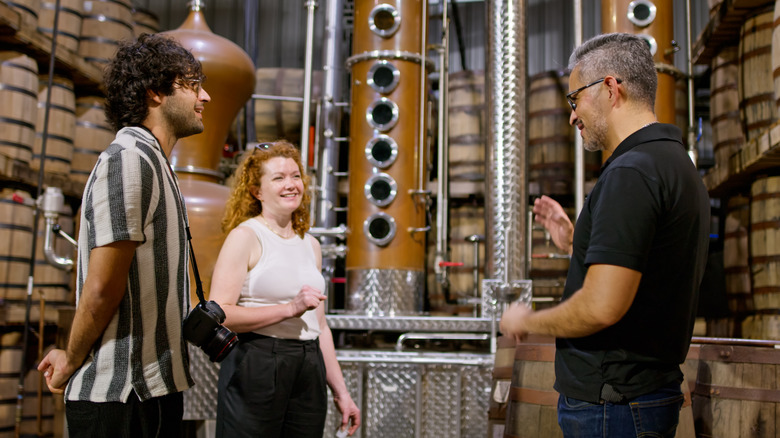
Any whiskey lover probably has a bucket list of distilleries they'd love to visit, and we wanted to know what the experts had to say about getting the most out of a tour. Sure, you'll probably be tempted by on-site-only purchases and samples, and that's fine! However, Chris Walster says that you should ask about something else.
"On a distillery tour, I would ask which expression best shows the distiller's house style," he said. "That is a great question because it helps you understand what makes that distillery different, rather than just tasting the biggest, oldest, or most expensive release."
You'll discover a lot when you start visiting craft distilleries and asking the right questions. For example, Caledonia Spirits prides itself on offering a whiskey made from solely Vermont-grown grains, Up North Distillery is doing the same in Idaho, and Tobacco Barn Distillery in Maryland gets its grains from its own farm. All are putting out products that showcase the terroir of each individual and very different state. Neat, right?
Avoid trendy and disappearing terms that don't really mean anything
Chris Walster thinks that it's worth being a little suspicious about whiskey-related words and buzzy phrases that seem questionable. "Make sure you don't just say 'trendy' words that you think sound good, that's likely to end you with the worst whiskey for sale on the bar," he says. It's better to be upfront about your likes, dislikes, and knowledge, than to throw around terms to try to sound more knowledgable than you are.
Zak Lindahl agrees, and offers some examples. "One of the biggest mistakes people make when ordering whiskey is focusing entirely on age statement, rarity, or price before understanding the style of whiskey they're drinking."
Let's take age statements. Those have long been said to reflect quality, but today you'll find some distilleries that just don't use them anymore. The Craft Irish Whiskey Co., for example, is a wildly award-winning distillery that is very straightforward about the fact that it doesn't care how long a whiskey takes to mature, it's going to be bottled when the distillers say it's finished. Some experts point out that depending on the climate, an old whiskey is going to pick up too much flavor from the barrel. Others simply prefer to work without time restraints. In other words, it's all about the whiskey, not the labels.
Be confident and own what you like

You've probably heard some of the stories about whiskeys that sell for an absolutely eye-watering price. There are a handful of Johnnie Walker whiskeys that are worth a small fortune, and back in 2021, a whiskey NFT from Macallan sold for a shocking $2.3 million. The good news is that you don't have to be a millionaire to order great whiskey like a pro — we promise.
Learan Kahanov confirms that being a whiskey pro isn't about price at all. "People should absolutely order and discover what they like regardless of price," he told us. "Much like wine, great whiskey exists in all styles and price points. If someone loves Macallan 18 and wants to pay for it, more power to them. The goal is not to shame the expensive order or romanticize the obscure one. Drink what you like." Nevertheless, experimenting with new whiskeys is always a great way to discover more.