

This Greek Salad Wrap Recipe Is Fresh, Filling, And Ready In 10 Minutes
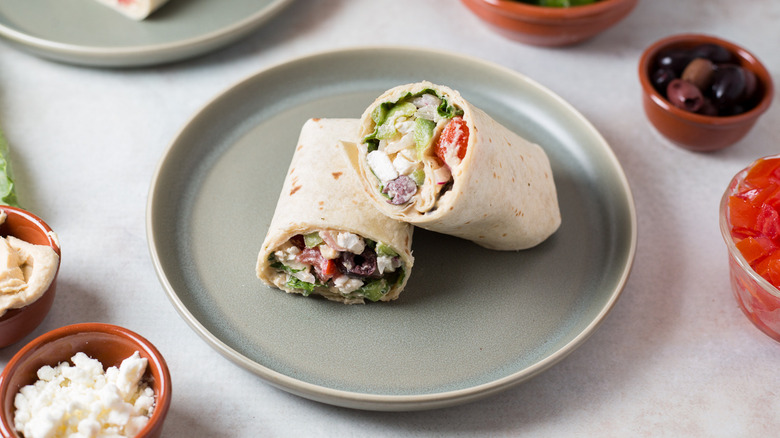
A good salad is a tried-and-true lunchtime staple, but the same old bowl and fork routine can get stale after a while. An easy way to breathe new life into even the stalest of lunchtime routines is by transforming that go-to salad into a handheld wrap, which is exactly what we've done in this Greek salad wrap recipe. Requiring absolutely no cook time and just 10 minutes of prep work to whip up four wraps, this is exactly the type of recipe to keep in your back pocket for easy mid-day meals or after-school snacks.
While not all salads are well-poised to receive the wrap treatment (some are simply too loaded or too dressed, which would result in a soggy tortilla), the classic Greek salad is a prime candidate for such a transformation. It's packed with a plethora of crisp veggies, salty feta cheese, briny olives, and a tangy vinaigrette, and we've captured all those key elements here. To help prevent sogginess, this recipe also calls for spreading a layer of hummus onto the tortilla before adding the filling — not something that you might find in traditional Greek salad, per se, but an earthy touch that serves a purpose while also enhancing the overall Mediterranean flair of the wrap.
Gather the ingredients for Greek salad wraps
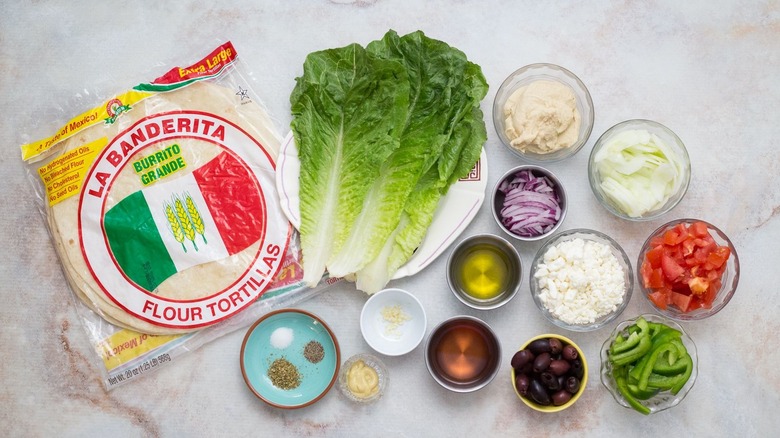
For the Greek salad portion of these wraps, you'll need a cucumber, green bell pepper, and red onion (each thinly sliced), chopped tomato, crumbled feta cheese, and Kalamata olives. Meanwhile, extra virgin olive oil, red wine vinegar, crushed garlic, Dijon mustard, dried oregano, salt, and pepper come together to create the tangy dressing. When it comes to assembling the wraps, you'll need large flour tortillas, your favorite homemade or store-bought hummus, and romaine lettuce leaves for some added crunch.
Step 1: Assemble the salad
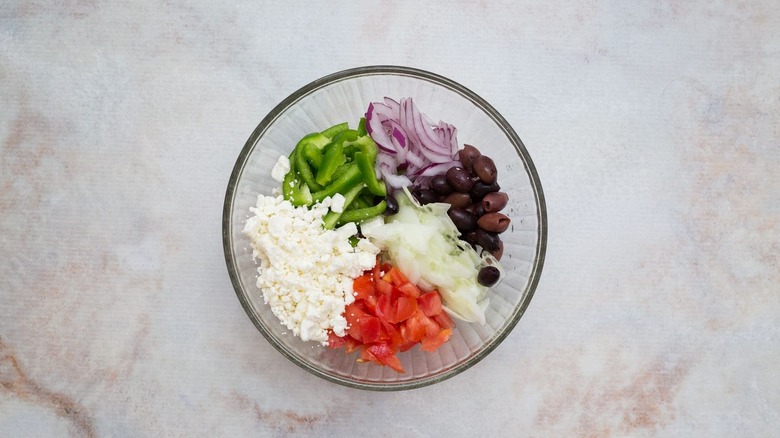
To make the salad, place the cucumber, tomato, green bell pepper, red onion, feta, and Kalamata olives in a bowl.
Step 2: Make the dressing
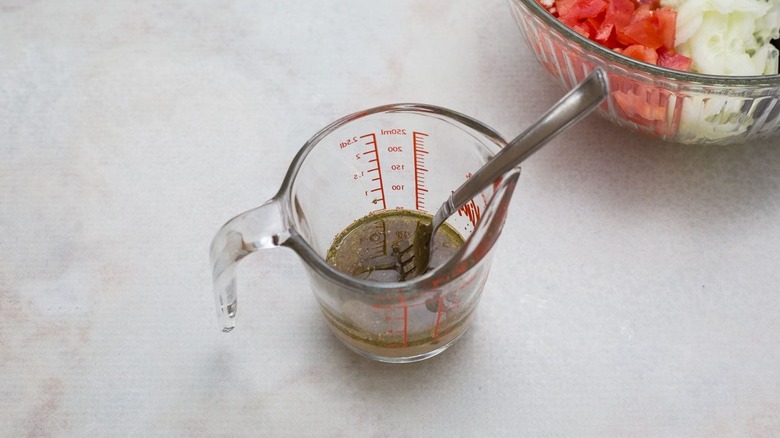
For the dressing, place the extra virgin olive oil, red wine vinegar, crushed garlic, oregano, Dijon mustard, salt, and black pepper in a small bowl or measuring cup and whisk to mix.
Step 3: Dress the salad
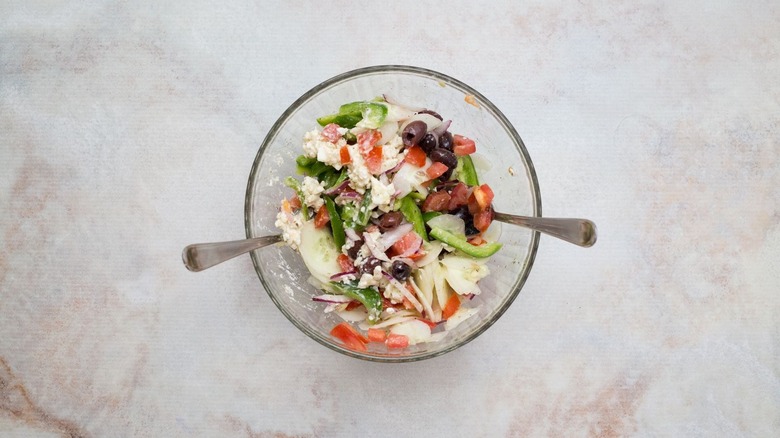
Pour the dressing over the salad ingredients and toss to coat evenly. Taste and add more salt or black pepper if desired.
Step 4: Spread hummus onto each tortilla
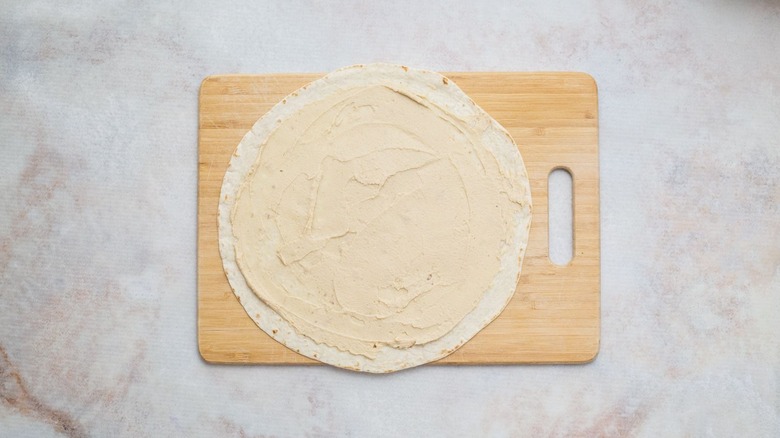
Spread equal amounts of the hummus over each tortilla (¼ cup each), leaving a border around the edges.
Step 5: Layer romaine onto the tortilla
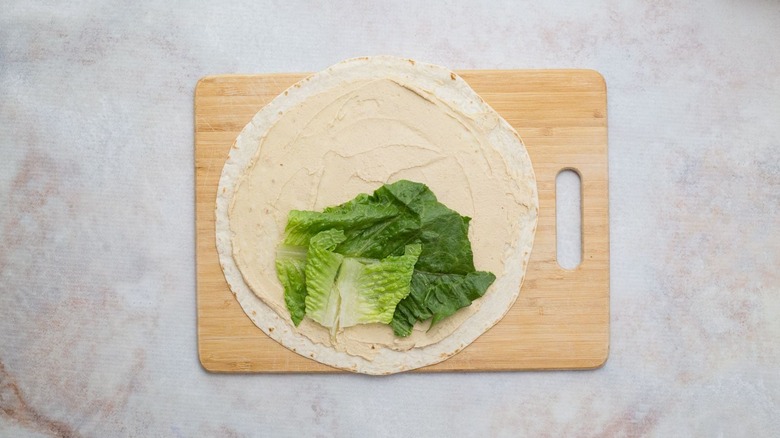
Spread equal amounts of the hummus over each tortilla (¼ cup each), leaving a border around the edges.
Step 6: Portion Greek salad onto the tortillas
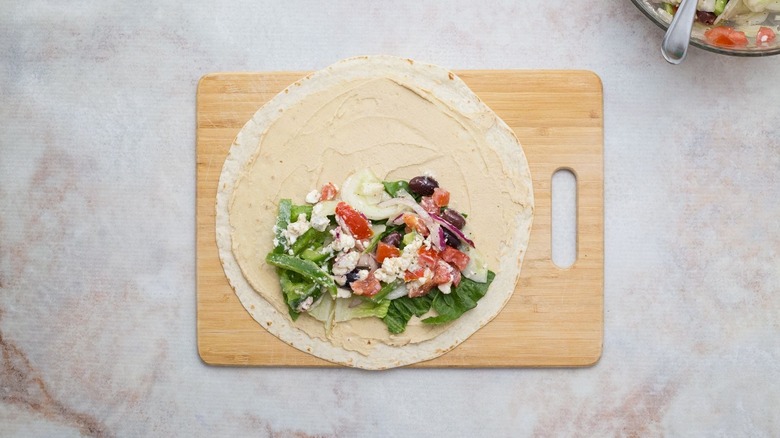
Spoon ¼ of the Greek salad over each romaine leaf, letting excess liquid drip off the salad before adding it.
Step 7: Roll up the wraps
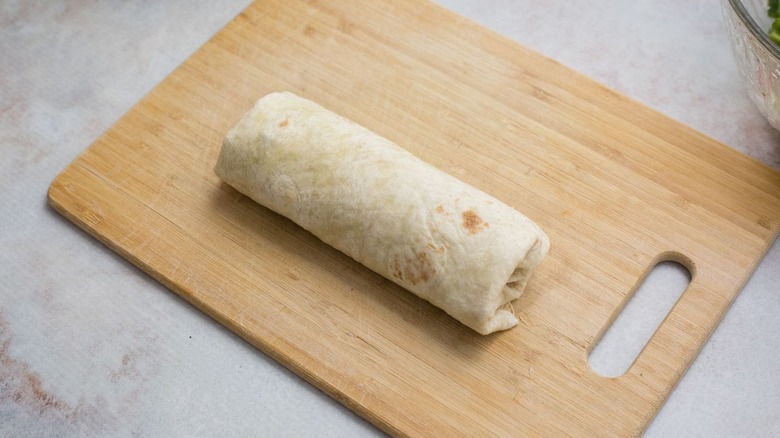
Roll up the wraps. Start by folding in the sides, and then start rolling from the front end closest to the filling. Finish with the seam side down.
Step 8: Slice and serve the Greek salad wraps
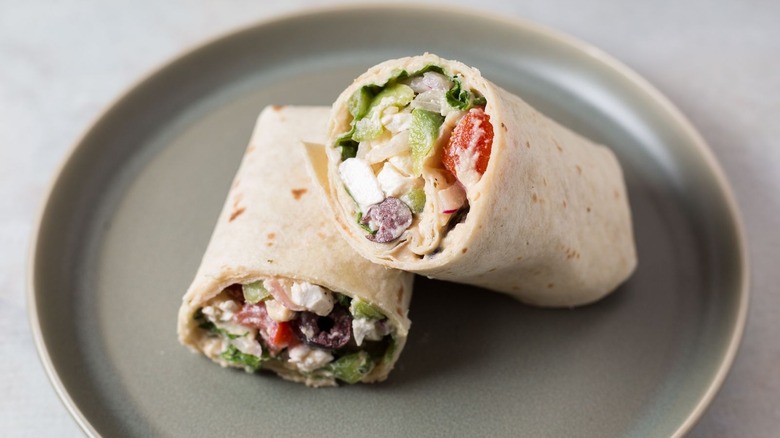
Cut the Greek salad wraps in half and serve.
What to serve with Greek salad wraps
Greek Salad Wrap Recipe
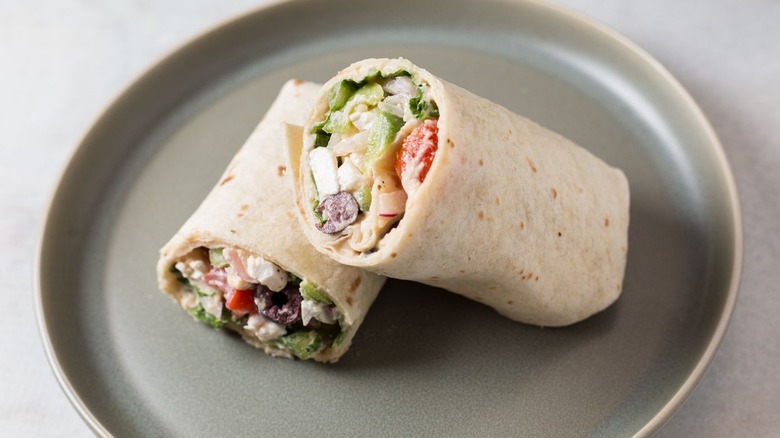
All the flavors of a classic Greek salad (think feta, crisp veggies, tangy dressing) come together in this no-cook portable meal that's ready in 10 minutes.
Ingredients
- For the salad
- 1 cup thinly sliced cucumber
- 1 cup chopped tomato
- ¾ cup thinly sliced green bell pepper
- ¼ cup thinly sliced red onion
- 4 ounces feta cheese, crumbled
- ½ cup Kalamata olives, halved
- For the dressing
- 1 tablespoon extra virgin olive oil
- 1 tablespoon red wine vinegar
- 1 small clove garlic, crushed
- ½ teaspoon dried oregano
- 1 teaspoon Dijon mustard
- ⅛ teaspoon salt
- ⅛ teaspoon black pepper
- For assembly
- 1 cup hummus
- 4 (12-inch) flour tortillas
- 4 romaine lettuce leaves
Directions
- To make the salad, place the cucumber, tomato, green bell pepper, red onion, feta, and Kalamata olives in a bowl.
- For the dressing, place the extra virgin olive oil, red wine vinegar, crushed garlic, oregano, Dijon mustard, salt, and black pepper in a small bowl or measuring cup and whisk to mix.
- Pour the dressing over the salad ingredients and toss to coat evenly. Taste and add more salt or black pepper if desired.
- Spread equal amounts of the hummus over each tortilla (¼ cup each), leaving a border around the edges.
- Place a romaine leaf horizontally on each tortilla, closer to the front end and leaving 1 to 2 inches of space on the sides. Break up the leaves if they are large, and flatten the stems for easier rolling.
- Spoon ¼ of the Greek salad over each romaine leaf, letting excess liquid drip off the salad before adding it.
- Roll up the wraps. Start by folding in the sides, and then start rolling from the front end closest to the filling. Finish with the seam side down.
- Cut the Greek salad wraps in half and serve.
Nutrition
| Calories per Serving | 437 |
| Total Fat | 26.2 g |
| Saturated Fat | 6.8 g |
| Trans Fat | 0.0 g |
| Cholesterol | 25.2 mg |
| Total Carbohydrates | 40.0 g |
| Dietary Fiber | 6.1 g |
| Total Sugars | 3.9 g |
| Sodium | 1,090.2 mg |
| Protein | 13.8 g |

What else can I use to make a wrap besides tortillas?
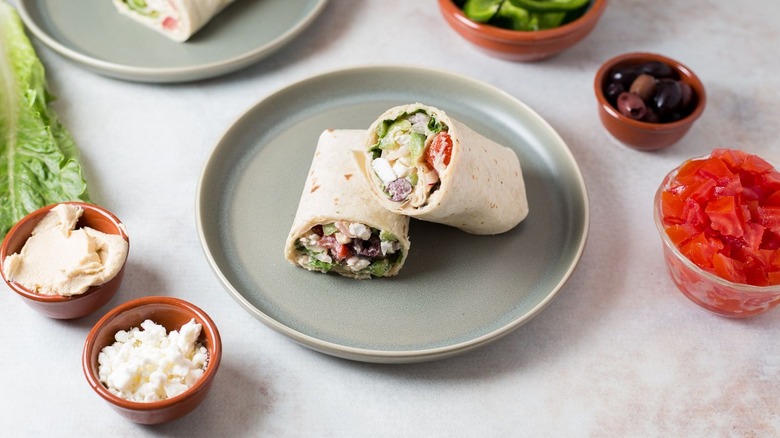
The beauty of a homemade wrap is that you can get creative with exactly what you use for the actual "wrap" part. Flour tortillas are ideal for their neutral flavor, large size, and pliability, but there are other bready options on the table. Lean into the Mediterranean vibe with pita bread, but note that it'd be easier to halve and stuff a piece of pita as opposed to trying to roll it up. Another great option is lavash, which is a type of Armenian and Iranian flatbread that offers a similar flexibility as tortillas.
If you'd prefer to steer away from bread or are looking for a gluten-free wrap option, you may want to take the classic lettuce wrap route. Butter lettuce is one of the best options thanks to its soft nature and general flexibility, though romaine or iceberg lettuce could also work. Even if you can't find pieces of lettuce big enough to make wraps with, you can make something more like a Greek salad cup, simply scooping the filling into lettuce cups. Of course, if you go the lettuce route, you can skip the romaine lettuce that the recipe calls for.
Finally, an innovative way to make a salad portable is by rolling it up into a rice paper wrap. To use rice paper, dampen a sheet in water (and make sure it's a quick dip to avoid mushiness), lay the damp sheet out on a work surface, fill it with salad, and roll it up. Since the rice paper doesn't have much of a flavor on its own, it will allow the freshness and tanginess of the salad itself to shine.
What's the best way to fold a wrap?
There are a few common mistakes that nearly everyone makes when making wraps, and many of them come down to rolling or folding issues. The key to successfully folding a wrap starts with not overfilling it, so make sure you're not going overboard with the Greek salad filling, tempting as it may be. When it comes to the hummus, spread on a relatively thin layer, and don't spread it all the way to the edge, otherwise it will start to ooze out when you fold and roll. Consider briefly heating up your tortillas before adding ingredients and folding to make them more pliable and a bit easier to work with.
You'll notice that we layer the lettuce and salad filling towards the bottom of the tortilla (as opposed to the center), and this is an intentional practice that ultimately makes the wraps easier to fold up. With the filling at the bottom, fold the two sides of the tortilla in over the filling, then begin rolling everything upwards and away from your body. As you roll, try to keep those sides pushed in and continue pushing in extra tortilla along the sides as you go, which will help keep things secure and ensure that no filling comes spilling out. Roll firmly but not so tight that the tortillas begin to crack, and use that hummus as glue to help seal the wraps shut once they're all rolled up.